Efficient Tomography of Non-Interacting Fermion States
Delve into quantum state tomography algorithms for non-interacting fermion systems, exploring efficient methods for state reconstruction and measurement through theoretical frameworks and error analysis.
Quantum Supremacy in Mechanical Tasks: Projectiles, Rockets and Quantum Backflow
Explore quantum mechanical advantages in particle behavior, focusing on probability distributions, quantum backflow, and the Bracken-Mellow constant through mathematical analysis and theoretical frameworks.
Exploring Resemblance Between Topological Charges, Vortices, Knots and Particle Physics - Part 2
Dive into the intriguing connections between topological structures and particle physics, expanding on advanced concepts in this continuation lecture.
The Fundamentals: Physical Origins of Particles in Circumstellar Space
Explore the physical origins of particles in circumstellar space with Dr. Julián Alvarado-Gómez's insightful lecture on extrasolar space weather and its impact on exoplanet evolution.
Blackbody Radiation Shifts in an Optical In+/Yb+ Ion Clock
Explore advanced atomic clock technology using ion Coulomb crystals, focusing on precision control and measurement of blackbody radiation shifts in In+/Yb+ systems for ultra-high accuracy timekeeping.
How Modern Science Relies on Sand
Explore sand's critical role in modern science, from microscopes to particle detectors, and its impact on groundbreaking discoveries in physics and astronomy.
Berkeley Lab's Breakthroughs in Exascale Supercomputing and AI Energy Efficiency
Explore Berkeley Lab's journey from atomic age to supercomputing forefront. Discover exascale computing challenges, energy efficiency innovations, and future HPC directions with specialized hardware and chiplets.
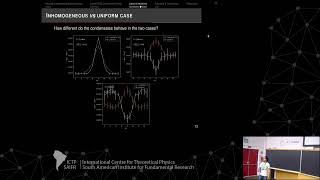
Lattice QCD with an Inhomogeneous Magnetic Background
Explore Lattice QCD simulations with inhomogeneous magnetic fields, uncovering their impact on strongly interacting matter and advancing our understanding of quantum chromodynamics.
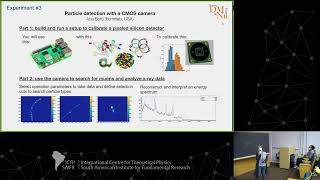
Laboratory and Hands-on Activities for Dark Matter and Neutrino Detection
Explore hands-on experiments in dark matter and neutrino detection, covering sensitivity limits, simulations, particle detection techniques, and detector characterization.
Julia's Use in Nuclear Physics Data Analysis: A Case Study
Explore Julia's potential in nuclear physics data analysis, combining high performance with dynamic capabilities for efficient processing and visualization of large datasets.
Geant4.jl - Particle Transport in Julia
Explore Geant4.jl, a Julia wrapper for simulating particle interactions in physics. Learn about its user-friendly interface, performance benefits, and automated generation using WrapIt.
Cosmic Showers: How Particle Space Weather Changes Planets
Explore how particle space weather impacts planetary evolution, focusing on cosmic showers and their effects on exoplanets.
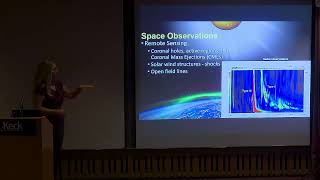
View from the Inside: The Solar System's Particle Environment
Explore the solar system's particle environment with Dr. Christina Cohen in this Keck Institute for Space Studies talk on extrasolar space weather and exoplanet evolution.
Mutation Testing in Python with Cosmic Ray
Explore mutation testing with Cosmic Ray to validate Python test suites. Learn implementation challenges, benefits, and real-world examples of improving code quality through systematic source mutations.
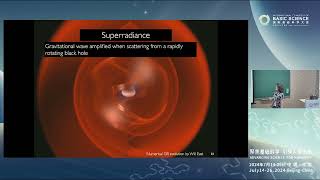
Detecting Ultralight Axions with Black Holes and Gravitational Waves
Explore how black holes and gravitational waves can detect ultralight axions, shedding light on particle physics puzzles and dark matter candidates.
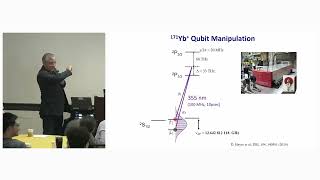
Gate and Analog Quantum Processing with Trapped Ions
Explore trapped ion quantum computing fundamentals, from qubit manipulation to architectural scaling, emphasizing the unified nature of gate-based and analog processing methods.
Data Science in High Energy Physics - Applications at Future Collider Experiments
Explore how data science tackles challenges in high-energy physics experiments, from managing vast datasets to precise measurements and signal detection in particle colliders.
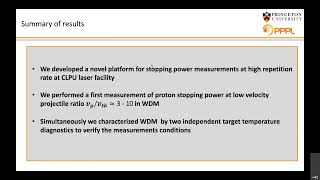
Low-Velocity Proton Stopping Power Measurement in Warm Dense Matter
Explore low-velocity proton stopping power in Warm Dense Matter through cutting-edge measurements and analysis techniques.
Exploring Resemblance Between Topological Charges, Vortices, Knots and Particle Physics - Part 1
Explore connections between topological structures and particle physics, delving into charges, vortices, and knots to uncover fundamental similarities and insights.
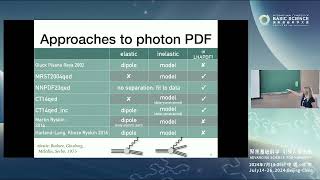
How Bright is the Proton? A Precise Determination of the Photon Parton Distribution Function
Explore the precise determination of photon distribution in protons using electron-proton scattering data, enhancing our understanding of particle physics at the Large Hadron Collider.
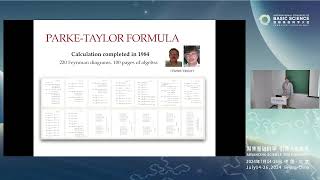
The Amplituhedron - Connecting Scattering Amplitudes and Quantum Field Theory
Explore the connection between scattering amplitudes and the Amplituhedron, a novel mathematical concept generalizing convex polytopes into Grassmannians.