New Kind of Physics? Exploring Particle Decay Discrepancies at CERN
Explore the exciting possibility of a new force of nature through recent LHCb experiment findings. Particle physicists discuss unexpected discrepancies in B meson decay data and their potential implications for fundamental physics.
Did the Universe Spring from Chaos?
Explore the origins of the universe with particle physicist Guido Tonelli, who discusses ancient and modern theories, the Higgs Boson discovery, and complex scientific concepts in an accessible manner.
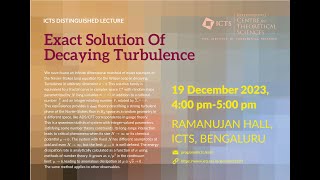
Exact Solution of Decaying Turbulence by Alexander Migdal
Explore an infinite dimensional manifold of exact solutions for the Navier-Stokes loop equation in decaying turbulence, presented by renowned physicist Alexander Migdal.

On Quarks and Turbulence by David Tong
Explore two major unsolved physics problems: quark confinement and turbulence. Gain insights into physicists' approach to understanding complex phenomena with Prof. David Tong.

Heavy Ion Physics - Lecture 1
Explore heavy ion physics fundamentals, including collision dynamics, quark-gluon plasma formation, and experimental techniques used in high-energy nuclear collisions.

Single Spin Asymmetries and Transverse Momentum Dependent Parton Distributions - Lecture 3
Explores single spin asymmetries and transverse momentum dependent parton distributions in hadron structure, crucial for understanding nucleon spin and momentum at the Electron-Ion Collider.

Od crnih rupa do financijskih tržišta - Primjena zakona fizike u svakodnevnom životu
Fizičar Davor Horvatić otkriva primjenu zakona fizike u raznim područjima života - od prometa do financija i crnih rupa, pokazujući kako nam fizika može pomoći u razumijevanju svakodnevnih pojava.

Unifying Nature's Laws - The State of String Theory
Leading string theorists discuss the current state and potential of string theory as a unified description of nature's laws, exploring its mathematical elegance and promise as a "theory of everything."
Structural Analysis of Pion With Distribution Functions - Talks by Satyajit Puhan & Bhumika Pandya
Explore pion structure through distribution functions in talks by Satyajit Puhan and Bhumika Pandya, part of a workshop on probing hadron structure at the Electron-Ion Collider.
Axial-Vector Bottom-Charm Tetraquarks
Explore axial-vector bottom-charm tetraquarks through expert talks, delving into advanced particle physics concepts and cutting-edge research in hadron structure and quark interactions.
Valence Quark and Gluon TMDs of Spin-1 QCD System - A Light-Front Hamiltonian by Satvir Kaur
Explore valence quark and gluon TMDs in spin-1 QCD systems using light-front Hamiltonian approach. Gain insights into hadron structure and fundamental particle interactions.
The Drell-Yan Process with Pions and Polarized Proton
Explore the Drell-Yan process in pion-proton collisions, focusing on polarized protons and its implications for understanding hadron structure and quark-gluon dynamics in particle physics.
The Pion Electromagnetic Form Factor at Jefferson Lab and Future Electron-Ion - by Vijay Kumar
Explores pion electromagnetic form factor research at Jefferson Lab and future electron-ion collider implications, discussing experimental techniques and theoretical insights in hadron structure studies.

Angularity Event Shapes in High Energy Scattering by Tanmay Maji
Explore angularity event shapes in high-energy particle collisions, examining their role in understanding hadron structure and quark-gluon interactions at the electron-ion collider.
Machine Learning Knowledge Transfer - From LHC to EIC by Sanmay Ganguly
Explore machine learning applications in particle physics, transferring knowledge from LHC experiments to the upcoming Electron-Ion Collider for advanced proton and neutron structure analysis.
Jets and Heavy Flavor Production at The EIC by Prabhakar Palani
Explore jets and heavy flavor production at the Electron-Ion Collider, examining their role in probing hadron structure and advancing our understanding of fundamental particle physics.
Jets at EIC - Theory by Felix Ringer
Explore jet physics theory for the Electron-Ion Collider, covering fundamental concepts, analysis techniques, and implications for probing hadron structure at unprecedented levels.
Gluon Distributions in the Proton
Explore gluon distributions in protons, crucial for understanding hadron structure. Learn about cutting-edge research and its implications for particle physics at the electron-ion collider.

Gluon Distributions in the Proton
Explore gluon distributions in protons, crucial for understanding hadron structure and fundamental interactions. Gain insights into cutting-edge research in particle physics and quantum chromodynamics.

Theory Status of Quark TMDs - Extraction from Data by Alessandro Bacchetta
Explore quark transverse momentum distributions (TMDs) in hadron structure, their theoretical foundations, and methods for extracting them from experimental data.

Hadron Structure in Experiments - Lecture 3
Explore hadron structure through experimental insights, focusing on proton and neutron composition, quark-gluon dynamics, and implications for understanding fundamental particle physics.