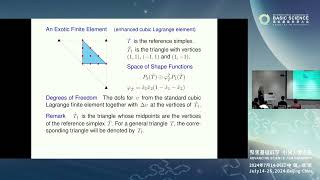
A Nonlinear Least-squares Finite Element Method for the Monge-Ampere Equation
Explore a nonlinear least-squares finite element method for solving the Monge-Ampere equation, focusing on smooth convex solutions and innovative degrees of freedom.
A Potential Approach for One-Dimensional Price Formation Models
Explore a novel approach to solving first-order mean-field games in price formation using Poincaré's Lemma and potential functions, with applications to linear-quadratic models.
Sharp Restriction Theory - Part 1
Explore advanced concepts in sharp restriction theory, focusing on key principles and applications in mathematical analysis.
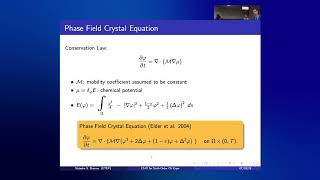
Continuous Interior Penalty Method Framework for 6th Order Cahn-Hilliard Equations
Explore unconditionally stable numerical methods for sixth-order Cahn-Hilliard equations, focusing on crystal growth and microemulsion systems. Gain insights into complex physical phenomena modeling.
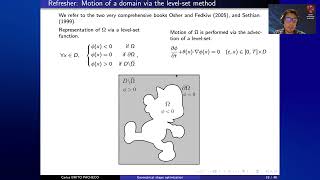
Rodin: Density and Topology Optimization Framework - MFEM Workshop 2022
Explore Rodin, a C++17 framework for shape, density, and topology optimization. Learn its functionalities, from refining shapes to solving variational problems in scientific simulations.
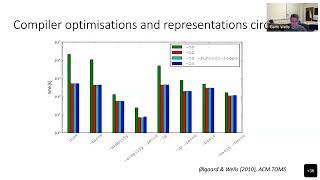
FEniCSx: Design of the Next Generation FEniCS Libraries for Finite Element Methods
Explore FEniCSx, the next-gen finite element library. Learn design improvements, high-performance kernels, and flexible solver creation in C++ or Python for partial differential equations.
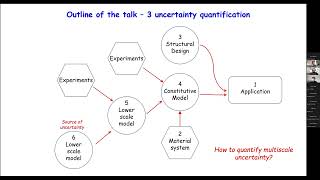
Learning-Based Multiscale Modelling: Computing, Data Science, and Uncertainty Quantification
Explore machine learning frameworks for multiscale modeling in materials science, including Fourier and recurrent neural operators, to accelerate computations and bridge scales across multiple physics levels.
Enhancing Scientific Computing Through Physics-Informed Neural Networks
Explore physics-informed neural networks (PINNs) as an alternative to traditional scientific computation, addressing challenges in high-dimensional problems and incorporating noisy data in inverse problems.
Exploring Variational Functions - Calculus of Variations and Geometric Measure Theory
Dive into variational problems and bounded Hessian functions with Luigi Ambrosio. Explore the intersection of Calculus of Variations and Geometric Measure Theory, inspired by machine learning insights.
Adaptive Regularization and Linearization for Nonsmooth and Degenerate Problems
Explore advanced mathematical techniques for solving nonsmooth and degenerate problems in flow and transport, focusing on adaptive regularization methods and Newton-based linearization approaches.
H-theorems for Queues with Reneging
Delve into measure-valued transport equations and their applications in many-server queues, exploring mathematical modeling techniques for systems ranging from biology to operations research.
The Spaces Up and Vp and Global Solutions to Dispersive Equations
Delve into advanced mathematical concepts of Up and Vp spaces and their applications in solving dispersive equations, featuring insights from Professor Herbert Koch of Universität Bonn.
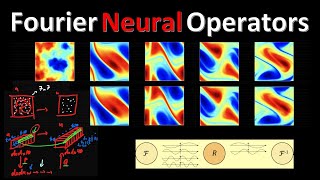
Fourier Neural Operator for Parametric Partial Differential Equations - Paper Explained
Explore a novel neural network architecture for solving partial differential equations efficiently. Learn about Fourier Neural Operators and their potential to revolutionize scientific computing and engineering simulations.

Solving PDEs with the Laplace Transform - The Wave Equation
Explore solving the wave equation using Laplace transforms, covering problem setup, PDE to ODE conversion, and solution methods including the Heaviside function and method of characteristics.
Canonical Linear PDEs- Wave Equation, Heat Equation, and Laplace's Equation
Explore fundamental linear PDEs: wave, heat, and Laplace's equations. Gain insights into their properties, applications, and mathematical foundations in engineering and physics.

Heat Equation- Derivation and Equilibrium Solution in 1D - Laplace's Equation
Explore the derivation and equilibrium solution of the heat equation in 1D, including Laplace's equation, boundary conditions, and practical applications in engineering mathematics.
Potential Flow and Laplace's Equation
Explore potential flow and Laplace's equation in engineering mathematics, covering vector fields, heat conduction, and practical applications in fluid dynamics and thermodynamics.
Solving High Dimensional HJ Equations Using Generalized Hopf-Lax Formulas vs Using Machine Learning
Explore advanced techniques for solving high-dimensional Hamilton-Jacobi equations, comparing generalized Hopf-Lax formulas with machine learning approaches in control and differential games.
The Monge-Ampere System - Convex Integration in Arbitrary Dimension and Codimension
Explore flexibility in weak solutions to the Monge-Ampere system via convex integration, covering isometric immersions and nonlinear elasticity with focus on Holder regularity in arbitrary dimensions.
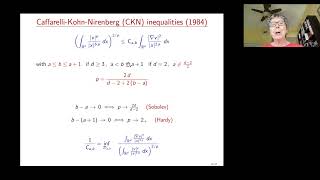
Functional Inequalities and Improvements: Stability - Part 2
Explore functional inequalities, their optimal constants, and stability properties. Learn strategies for addressing these issues and recent developments in improved inequalities for non-optimizers.
Gamma Convergence - Lecture 2
Explore gamma convergence, minimization problems, and homogenization in this advanced mathematics lecture. Learn about coercivity, lower semicontinuity, and integral functions in the context of multi-scale analysis.