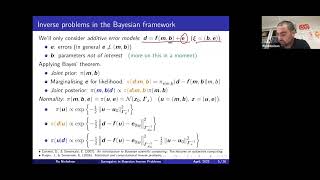
On the Use of Linear Surrogate Models for Bayesian Inverse Problems
Explore efficient Bayesian inverse problem solutions using linear surrogate models. Learn about model discrepancy, Gaussian priors, and applications in high-dimensional PDE discretization problems.
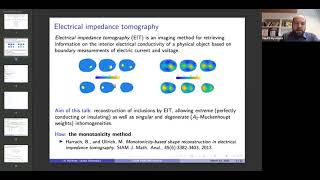
Monotonicity Method for Extreme, Singular and Degenerate Inclusions in Electrical Impedance Tomography
Explores advanced mathematical techniques for electrical impedance tomography, focusing on the monotonicity method's application to extreme, singular, and degenerate inclusions in conductivity reconstruction.
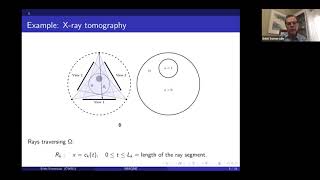
Imaging with Unstructured Adaptive Meshes
Explore adaptive mesh techniques for imaging problems, focusing on finite element methods and mesh adaptation to improve resolution and computational efficiency in PDE solutions.
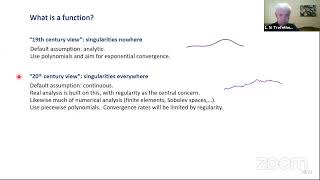
Rational Functions
Explores recent advances in rational approximation theory for numerical computation, focusing on "AAA" and "lightning" algorithms for solving PDEs in complex domains with singularities.
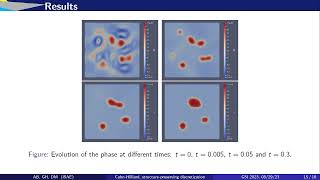
Structure Preserving Discretization of the Cahn-Hilliard Equations Recast as a Port-Hamiltonian System
Explore structure-preserving discretization of Cahn-Hilliard equations recast as port-Hamiltonian systems, advancing numerical methods in mathematical physics.
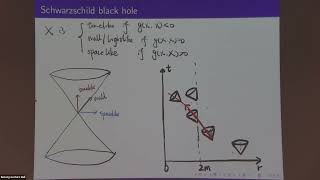
Stability Problems in General Relativity
Explore stability problems in general relativity, focusing on mathematical challenges and recent advancements in understanding gravitational phenomena.
A Variational Principle of Minimum for Navier-Stokes Equation Based on the Symplectic Formalism
Explore a variational principle of minimum for Navier-Stokes equations using symplectic formalism, advancing understanding of fluid dynamics and mathematical physics.
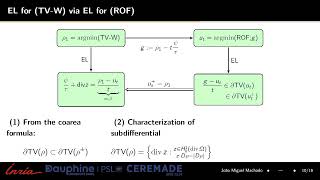
The Total Variation Wasserstein Problem - A New Derivation of the Euler-Lagrange Equations
Explore a novel derivation of Euler-Lagrange equations for the Total Variation Wasserstein problem, advancing understanding in mathematical optimization and transport theory.
Code Walkthrough for PINNs in Burgers Equation
Explore Physics-Informed Neural Networks (PINNs) applied to the Burgers equation through a detailed code walkthrough.
Laminated Metamaterials - Divergence Form Equations and Homogenisation
Explore divergence form equations with sign-indefinite coefficients, solution criteria, and homogenization methods for oscillatory ill-posed problems in quantum theory.
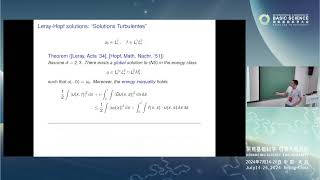
Instability and Non-Uniqueness in Fluid Dynamics
Explore instability and non-uniqueness in fluid dynamics, focusing on Leray solutions to Navier-Stokes equations and Vishik's findings on 2D Euler systems.
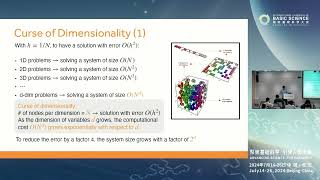
Solving High-Dimensional Partial Differential Equations Using Deep Learning
Explore deep learning algorithms for solving high-dimensional PDEs, overcoming dimensionality challenges in scientific computing applications.

Understanding the KPZ Problem - A New Perspective on Random Geometry and Universal Statistics
Delve into the universal properties of random geometries and geodesics in the KPZ framework, exploring statistical mechanics, probability theory, and mathematical physics applications.
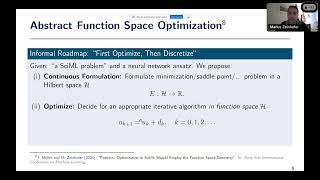
Infinite Dimensional Optimization for Scientific Machine Learning
Explore advanced optimization techniques in scientific machine learning, focusing on infinite-dimensional perspectives and the "first optimize, then discretize" paradigm for neural network applications.

ML for Solving PDEs: Neural Operators on Function Spaces
Explore AI advancements in scientific applications, including neural operators for weather and climate modeling, offering significant speedups and zero-shot generalization across function spaces.
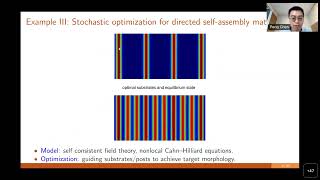
Derivative-Informed Neural Operators for Solving PDE-Governed Optimization Problems
Explore novel machine learning for solving optimization problems with PDEs, featuring derivative-informed neural operators for efficient, scalable solutions in high-dimensional parameter spaces.
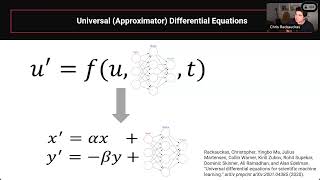
Generalizing Scientific Machine Learning and Differentiable Simulation Beyond Continuous Models
Explore generalizing scientific machine learning beyond continuous models, covering differentiable simulation for chaotic systems, stochastic processes, and inverse problems in advanced scientific computing.
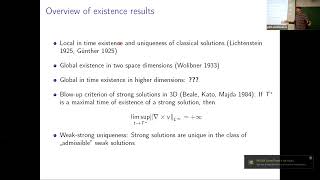
Conserved Quantities and Regularity in Fluid Mechanics
Explore conserved quantities and regularity in fluid mechanics, gaining insights into fundamental principles and advanced concepts in this field.
Physics-Informed Machine Learning for Complex Systems - A Focus on Power System Applications
Explorez l'application de l'apprentissage automatique aux systèmes électriques, en mettant l'accent sur les modèles réduits et la calibration à partir de données enregistrées pour améliorer la résilience du réseau.
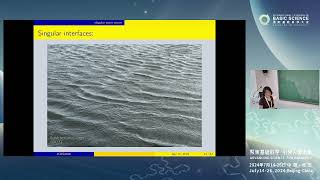
On the Motion of Water Waves with Angled Crests
Explore recent findings on 2D water wave dynamics with angled crests, delving into their unique motion and characteristics.

Probabilistic Simulation Methods for Machine Learning in Science and Technology
Explore probabilistic numerics in machine learning, bridging computation and inference. Gain insights into physics-informed ML and adaptive solver integration for enhanced efficiency in scientific computing.