Collisions in Plasmas: The Landau Equation - Part 5
Explore plasma collisions through the Landau equation, delving into advanced mathematical concepts and their applications in physics and probability theory.
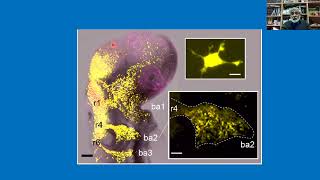
Modelling Collective Cell Migration
Explore mathematical models of collective cell migration in development and cancer, combining theory and experiments to gain insights into biological processes and cell phenotype cooperation.
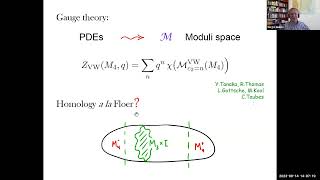
Floer Theory and Quantum Groups
Explore Floer theory, quantum groups, and gauge theories in 3-manifolds. Discover connections between moduli spaces, Floer invariants, and skein modules in topological quantum field theory.
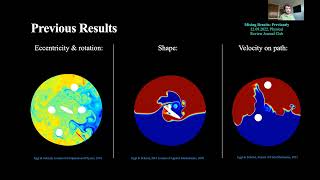
Mixing Enhancement for Binary Fluids Using PDE-Constrained Optimization
Optimization approach for enhancing binary fluid mixing efficiency through innovative stirring protocols and stirrer shapes, utilizing unsteady hydrodynamics and vortex-shedding to improve homogeneity within energy constraints.

Landau Damping and Related Effects in Kinetic Models of Plasma Physics
Explore asymptotic stability in plasma physics, covering Landau damping, plasma echoes, and collision-enhanced dissipation. Gain insights into recent progress and open directions in collisionless and weakly collisional plasmas.
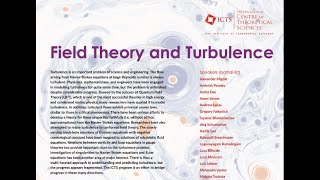
The Galerkin-Truncated Burgers Equation - Crossover from Inviscid-Thermalized to K by Marc Brachet
Explores the Galerkin-truncated Burgers equation, examining the transition from inviscid-thermalized to Kolmogorov scaling in turbulence. Offers insights into fluid dynamics and mathematical modeling of complex flow phenomena.
Introduction to Difference Equations - Computational Quantum Mechanics Part 1
Transform differential equations into difference equations for computer-based quantum mechanics study. Explore this process using the heat equation and learn to create visualizations with VPython.
Modern Numerical Methods in Computational Relativity - Lecture 4
Explore advanced numerical techniques in computational relativity, focusing on solving Einstein's field equations for gravitational-wave astronomy and astrophysical phenomena modeling.
Introduction to Numerical Relativistic Hydrodynamics - Lecture 4
Explore advanced concepts in numerical relativistic hydrodynamics, focusing on computational techniques for modeling high-energy astrophysical phenomena and gravitational wave sources.
Introduction to Numerical Relativistic Hydrodynamics - Lecture 3
Explore advanced concepts in numerical relativistic hydrodynamics, focusing on computational techniques for modeling high-energy astrophysical phenomena and gravitational wave sources.
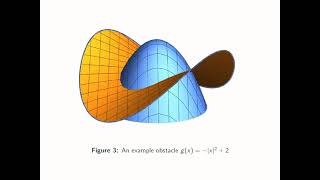
A Perturbation and Free Boundary Approach to the Monopolist's Problem
Explore a mathematical approach to the Monopolist's problem using perturbation theory and free boundary methods, offering insights into economic optimization strategies.

Transition from Fractional Diffusion to Normal Diffusion in Kinetic Models
Explore the transition between fractional and normal diffusion in kinetic models, examining mathematical principles and applications in complex systems.
Phase Separation in Active Brownian Particles
Explore models of active matter systems, focusing on motility-induced phase separation in self-propelled particles and the resulting macroscopic PDEs.
On the Incompressible Limit for a Tumour Growth Model Incorporating Convective Effects
Explore mathematical modeling of tumor growth with convective effects, focusing on the incompressible limit and its connection to free-boundary problems.
Fokker-Planck Equations of Neuron Networks: Understanding Time Periodic Solutions
Explore Fokker-Planck equations in neuron networks, focusing on time periodic solutions and their implications for neural dynamics.

The Nonlinear Stability of Black Holes: An Overview
Explore the mathematical properties of black holes, focusing on their stability as solutions to Einstein's equation and recent proof of nonlinear stability for slowly rotating Kerr black holes.
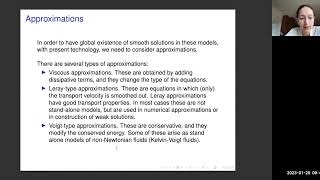
Voigt Boussinesq Equations - Global Regularity and Fluid Dynamics
Explore Voigt Boussinesq equations, their relation to fluid mechanics, and global regularity results for critical cases. Gain insights into incompressible fluid equations and their approximations.
Non-uniqueness in the Partial Differential Equations of Fluid Dynamics
Explore instability and non-uniqueness in fluid dynamics equations, focusing on recent advancements in Euler and Navier-Stokes equations and their implications for unpredictability.
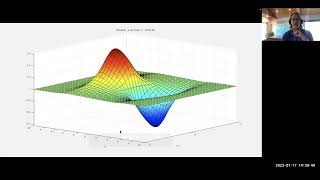
Geometry of Shock Formation and Maximal Development for Euler
Explore the geometry of shock formation and maximal development in Euler equations, focusing on fluid flow analysis and honoring David Ebin's contributions.
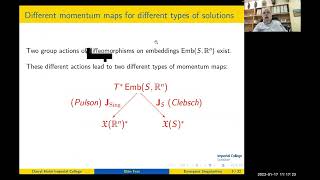
Emergent Singular Solutions of Nonlinear Wave Equations
Explore nonlinear wave equations and their emergent singular solutions with Imperial College London's Darryl Holm in this advanced mathematics workshop.
Probabilistic and Deterministic Scattering for Non-linear Schrödinger Equations
Explore probabilistic and deterministic scattering in non-linear Schrödinger equations, examining random initial data and wave operators through recent research findings.