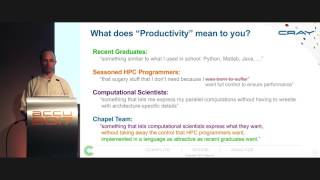
The Audacity of Chapel - Scalable Parallel Programming Done Right
Explore scalable parallel programming with Chapel, a language designed for productivity and portability. Learn its motivating themes, key features, and challenges in modern parallel computing.
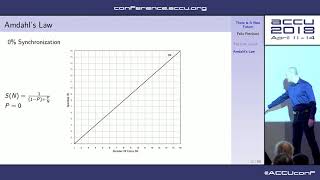
There Is a Better Future
Explore advanced concurrency concepts, including improved futures and CSP channels, for creating efficient parallel task graphs and addressing limitations in std::future.
Finally Executors for C++
Explore C++ executors for asynchronous and parallel programming, covering motivation, requirements, interfaces, and practical examples. Learn about recent proposal developments and interactions with coroutines.
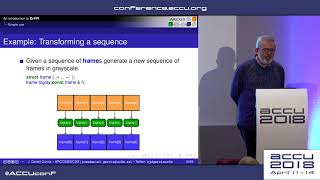
Parallel Design Patterns and Stream Parallelism
Explore parallel design patterns and stream parallelism using GrPPI, an experimental library for expressing parallelism through patterns, with focus on composability and multiple back-end support.
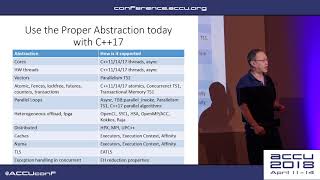
Heterogeneous Programming in C++ Today
Explore the evolving landscape of heterogeneous parallelism in C++, including standards, specifications, and future applications in IoT, self-driving cars, and machine learning.
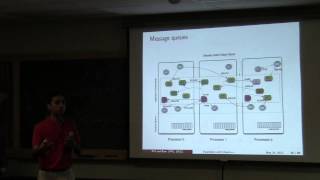
Parallel Programming Using Charm++ - C++Now
Explore Charm++, a C++-based parallel programming framework for high-performance computing across shared and distributed memory systems, using object-oriented principles for efficient and scalable software development.
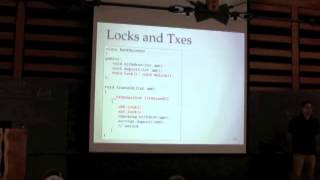
Intel's C++ STM Compiler and Transactional Language Constructs for C++
Explore Intel's C++ STM compiler and transactional language constructs, focusing on type-safety, optimization, and complex operations in parallel programming using transactional memory.
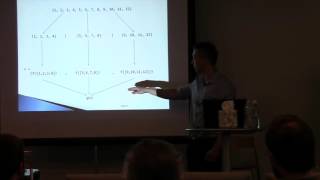
Parallelizing the Standard Template Library
Exploring parallel implementation of STL algorithms in HPX, discussing benefits and limitations of parallel computing in C++. Insights on execution time and scaling for modern programming paradigms.

Come Stream with Me - Build Performant Simple Parallel Applications in C++ Using RaftLib
Explore RaftLib for simple, performant parallel C++ applications using stream processing. Learn its functionality, implementation, and hands-on application building for optimized multi-threaded streaming.

Haskell Taketh Away - Limiting Side Effects for Parallel Programming
Exploring how limiting side effects in programming languages enhances parallel programming, with insights from Haskell and C++ on determinism, purity, and embedded domain-specific languages.
Good FIFOs Make Good Thread Neighbors
Explore microarchitectural implications of FIFO queues in parallel programming, analyzing open-source implementations and their impact on processor core performance through code and assembly examination.

RaftLib - Simpler Parallel Programming
Explore RaftLib, a C++ library simplifying parallel programming for heterogeneous multicore processors. Learn to write efficient code for complex hardware without extensive low-level knowledge.
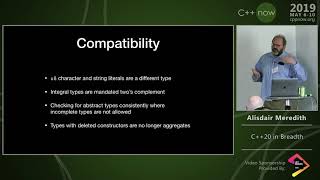
C++20 in Breadth
Comprehensive overview of C++20's major features and changes, exploring language updates, new capabilities, and their impact on C++ development and standardization.
Concurrency in C++ - A Programmer’s Overview - Part 2 of 2
Explore advanced C++ concurrency features, including memory models, thread-safety, primitives, parallel algorithms, and C++20 coroutines. Gain insights for maximum performance through live benchmarks and practical examples.
C++ Standard Parallelism
Explore C++ Standard Parallelism: portable, efficient parallel programming for all platforms. Learn about common algorithms, tools for custom algorithms, and task graph composition.

Scrivere un tool parallelo e distribuito per backup multi-terabyte
Sviluppo di uno strumento parallelo e distribuito per gestire backup di dati su larga scala, ottimizzando le prestazioni e l'affidabilità in ambienti multi-terabyte.
Emulating Stackless and Greenlet with Each Other
Explore techniques for emulating Stackless Python and greenlet, comparing their implementations and performance characteristics for concurrent programming.
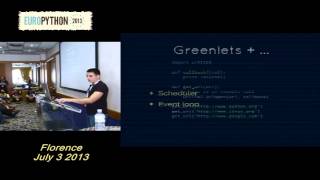
Greenlet Based Concurrency
Explore greenlet-based concurrency in Python, understanding its implementation, advantages, and practical applications for efficient asynchronous programming.
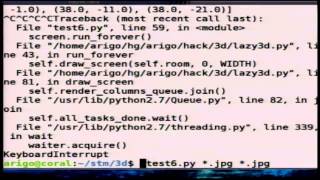
The GIL is Dead - PyPy-STM
Explore PyPy's Software Transactional Memory, enabling GIL-free Python execution on multiple cores. Learn to identify and resolve STM conflicts for improved performance in large codebases.

Implementing Parallel Programming Design Patterns Using EFL for Python
Explore parallel programming in Python using EFL, a deterministic tool for multi-core CPUs. Learn design patterns, compare code translations, and discover efficient parallelization techniques.
Running Python Code in Parallel and Asynchronously
Explore parallel and asynchronous Python execution, covering GIL, threads vs. processes, implementation techniques, potential pitfalls, and practical applications in web development contexts.