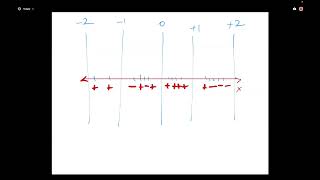
Machine Learning: Understanding Hypothesis Spaces Through Shattering - Lecture 17
Delve into the concept of shattering and its application in analyzing infinite hypothesis spaces within machine learning theory and computational learning frameworks.
PAC Learning
Explore PAC learning framework in machine learning, covering supervised classification, learnability criteria, and VC dimension. Understand theoretical foundations and practical implications.
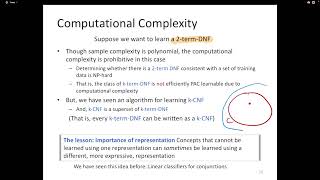
Positive and Negative Learnability Results in Machine Learning - Lecture 15
Delve into fundamental learnability concepts in machine learning, exploring both positive and negative results that shape our understanding of learning algorithms and their limitations.
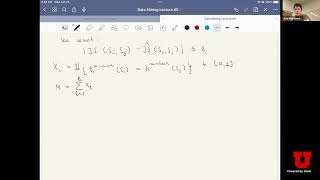
Data Mining: Choosing k for MinHashing - Spring 2023
Delve into advanced min hashing concepts, exploring PAC learning, Central Limit Theorem, and Chernoff-Hoeffding Inequality to optimize k-value selection for accurate Jaccard similarity estimates.
Optimal Lower Bounds for Quantum Learning via Information Theory
Delve into quantum learning theory's fundamental bounds, exploring information-theoretic approaches to PAC and agnostic models, with insights into the Quantum Coupon Collector problem and state distinguishability.
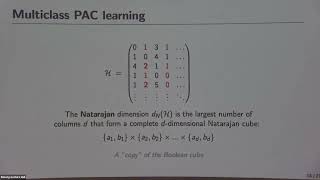
Characterizations of PAC Learnability
Explore key characterizations of PAC learnability in machine learning theory with insights from postdoctoral researcher Nataly Brukhim.
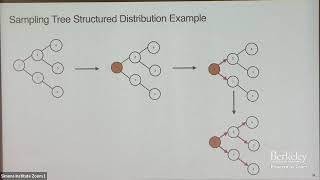
Distribution Learning Meets Graph Structure Sampling
Explore the connection between PAC-learning of graphical models and efficient graph structure sampling, leveraging online learning algorithms for new insights in high-dimensional distribution learning.
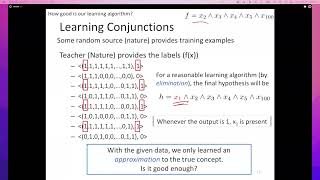
Machine Learning: Computational Learning Theory and Batch Learning - Lecture 12
Delve into formal models of learnability, focusing on batch learning concepts, mistake bound models, and PAC learning theory in machine learning applications.
Tree Learning: Optimal Algorithms and Sample Complexity - Hierarchical Clustering and PAC Learning
Explore optimal algorithms and sample complexity for learning hierarchical tree representations from labeled data, covering PAC learning, online learning, and efficient tree classifier construction.
Learning in a Dynamic World: From PAC to Prospective Learning Theory
Explore dynamic learning theory and its evolution beyond PAC learning, examining how AI systems can adapt to changing data distributions and goals while maintaining performance over time.