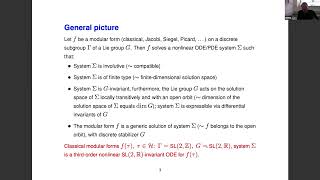
On ODEs Satisfied by Modular Forms
Explore ODEs satisfied by modular forms, their invariance under Lie groups, and associated algebraic curves. Extend results to Jacobi forms and examine examples from classical modular forms.

ME3255 - Verifying Implicit and Explicit Integration Methods for Tsiolkovsky Solution
Verify implicit and explicit integration methods for Tsiolkovsky solution, enhancing understanding of numerical techniques in aerospace applications.

ME3255 - Shooting Method for ODE Solutions
Explore the shooting method for solving ODEs, enhancing your numerical analysis skills and problem-solving abilities in engineering applications.

ME3255 - Define and Integrate Differential Equations
Define and integrate differential equations, exploring key concepts and techniques for solving various types of equations in mechanical engineering applications.
The Non-Abelian p-Curvature Conjecture
Explore a generalized p-curvature conjecture for non-linear ODEs, its implications for algebraic geometry, and proof techniques inspired by Katz and Esnault-Groechenig's work.
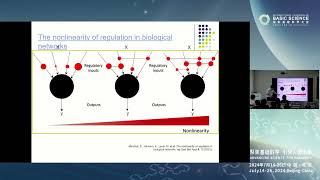
Quasi-Dynamic System Representation of Multiple Nonlinear Regression
Explore evolutionary game theory and allometric scaling to model nonlinear relationships between variables, overcoming limitations of linear regression for complex systems analysis.
Flows of Irregular Vector Fields in Fluid Dynamics - Lecture 6
Explore modern techniques for analyzing flows of irregular vector fields, with applications to fluid dynamics and turbulence theory. Gain insights into nonlinear PDEs and Euler/Navier-Stokes equations.
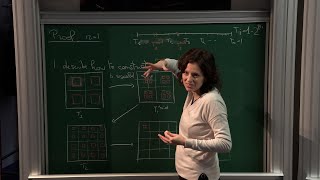
Flows of Irregular Vector Fields in Fluid Dynamics - Lecture 5
Explore modern techniques for analyzing flows of irregular vector fields, including quantitative regularity estimates, nonuniqueness solutions, and applications to fluid dynamics PDEs.
Flows of Irregular Vector Fields in Fluid Dynamics - Lecture 4
Explore modern techniques for analyzing flows of irregular vector fields, including quantitative regularity estimates, nonuniqueness solutions, and applications to fluid dynamics PDEs.
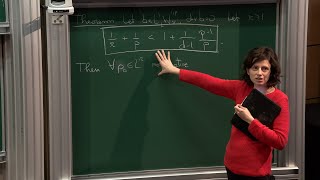
Flows of Irregular Vector Fields in Fluid Dynamics - Lecture 3
Explore modern techniques for analyzing flows of irregular vector fields, including quantitative regularity estimates, nonuniqueness solutions, and applications to fluid dynamics PDEs.
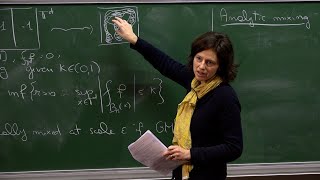
Flows of Irregular Vector Fields in Fluid Dynamics - Lecture 2
Explore modern techniques for analyzing flows of irregular vector fields, including quantitative regularity estimates, nonuniqueness solutions, and applications to fluid dynamics PDEs.
Flows of Irregular Vector Fields in Fluid Dynamics - Lecture 1
Explore modern concepts in flows of irregular vector fields, including quantitative regularity estimates, nonuniqueness solutions, and applications to fluid dynamics and turbulence theory.
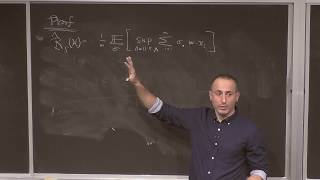
Gradient Descent, Stochastic Gradient Descent, and Acceleration - Part 2
Explore advanced gradient-based optimization methods for large-scale machine learning, including stochastic gradient descent and accelerated versions, with convergence analysis and ODE connections.

Neural ODEs - From ResNet to Continuous-Time Machine Learning
Explore Neural ODEs: a powerful machine learning approach for learning ODEs from data. Discover its advantages over ResNet and extensions like HNNs and LNNs.
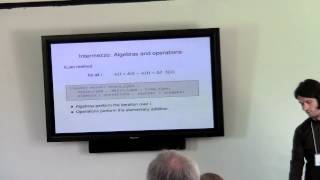
Odeint - Solving Ordinary Differential Equations in C++
Explore odeint, a C++ library for solving ordinary differential equations. Learn about its generic design, container independence, and versatility in scientific and engineering applications.
Metaprogramming Applied to Numerical Problems
Explore advanced Template Metaprogramming techniques for implementing efficient Runge-Kutta schemes to solve ordinary differential equations in various scientific fields.
Interpretable Hierarchical Calibration of Agent-Based Models
Explore scientific machine learning's fusion of traditional modeling and ML, focusing on neural network surrogates for agent-based models in epidemiology and automated hierarchical calibration.
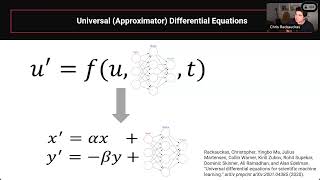
Generalizing Scientific Machine Learning and Differentiable Simulation Beyond Continuous Models
Explore generalizing scientific machine learning beyond continuous models, covering differentiable simulation for chaotic systems, stochastic processes, and inverse problems in advanced scientific computing.
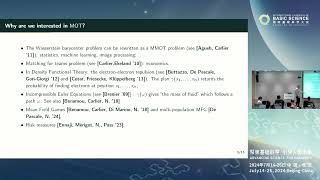
Entropic Optimal Transport: Convergence Rates and ODE Characterization
Explore recent advances in entropic optimal transport, focusing on convergence rates and a novel ODE-based numerical method for multi-marginal problems. Gain insights into theoretical bounds and practical applications.
Probabilistic Simulation Methods for Machine Learning in Science and Technology
Explore probabilistic numerics in machine learning, bridging computation and inference. Gain insights into physics-informed ML and adaptive solver integration for enhanced efficiency in scientific computing.
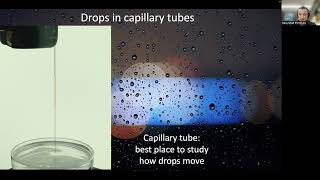
Moving Contact Lines Over Imperfect Surfaces: From Stick-Slip to Steady-Sliding
Explore fluid-fluid interface dynamics on heterogeneous surfaces, from stick-slip to steady sliding. Uncover key parameters and timescales in partial wetting displacement through coupled differential equations and mechanical analogies.