ML for the Theory Frontier - Jesse Thaler
Explore machine learning applications in theoretical physics, from lattice field theory to collider geometry, and its potential impact on various aspects of high-energy physics research.
Nonlinear Reduced Basis Methods and Transport in Electronic Structure Calculation
Explore nonlinear reduced basis methods and optimal transport for efficient electronic structure calculations, focusing on a 1D toy model with potential extensions to larger systems.
Fluid Mechanics-Informed Machine Learning - Successes and Failures
Explore machine learning approaches for fluid mechanics simulations, including physics-based features and CNNs, with insights on successes and challenges in speeding up predictions.
Statistical Physics of Optimal Transport
Explore statistical physics principles applied to optimal transport problems, unraveling complex systems through mathematical modeling and analysis.

Information Constrained Optimal Transport
Explore information-constrained optimal transport theory and its applications in trustworthy machine learning with Stanford researcher Ayfer Ozgur.
Particle Methods for Optimization Over Measures - Lecture 3
Explore particle methods for measure optimization in this advanced lecture, covering theoretical foundations and practical applications in data science and machine learning.
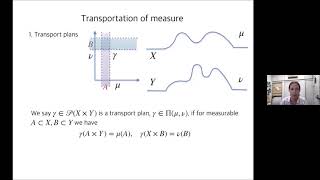
On Optimal Transport with Respect to Non-Traditional Costs
Explore optimal transport with non-traditional costs, focusing on c-transforms, c-subgradients, and conditions for Brenier-type maps. Includes examples like the polar cost in function polarity transforms.
Optimal Transport for Machine Learning - Gabriel Peyre, Ecole Normale Superieure
Explore optimal transport in machine learning, covering Kantorovitch's formulation, entropic regularization, and applications in generative models and GANs. Gain insights into cutting-edge advances in data science.
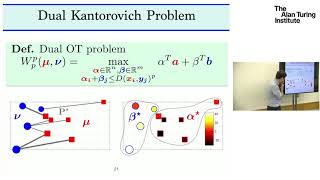
Regularization for Optimal Transport and Dynamic Time Warping Distances - Marco Cuturi
Explore regularization techniques for optimal transport and dynamic time warping distances, focusing on smoothing strategies to enhance machine learning applications and Fréchet mean computation.
Optimal Transport and PDE - Gradient Flows in the Wasserstein Metric
Explore gradient flows in Wasserstein metric, continuity equations, and aggregation dynamics. Learn about two-layer neural networks and chi-squared divergence in optimization and sampling.
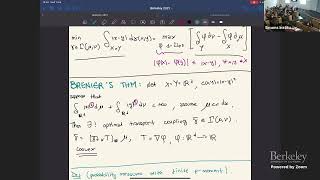
Crash Course on Optimal Transport
Explore optimal transport theory, its applications, and key concepts like cost formulation, optimal coupling, and transport maps in this comprehensive lecture.
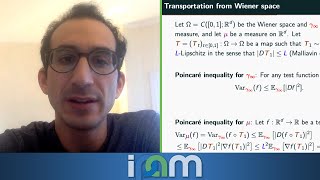
The Brownian Transport Map - IPAM at UCLA
Explore Lipschitz transport maps between probability measures, focusing on the Brownian transport map's construction, properties, and applications to Euclidean functional inequalities.
Introduction to Optimal Transportation and Monge Ampère Type Equations - Lecture 2
Explore optimal transportation and Monge Ampère equations, covering key concepts like super differentials, isoperimetric problems, and probability measures in this advanced mathematics lecture.
Optimal Transportation, Monge-Ampère Equations and Riemannian Ricci Bounds - Lecture 1
Explore optimal transportation, Monge-Ampère equations, and Riemannian Ricci bounds in this advanced mathematics lecture by L. Ambrosio from Scuola Normale Superiore di Pisa.
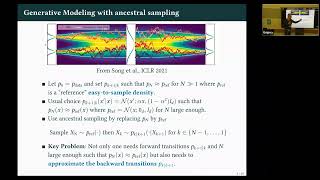
From Denoising Diffusion Models to Transport for Generative Modeling and Inference
Explore advanced generative modeling techniques, from denoising diffusion models to transport-based approaches, focusing on diffusion Schrödinger bridge and its numerical approximation for improved inference.
Statistical Applications of Wasserstein Gradient Flows
Explore statistical applications of Wasserstein gradient flows in optimal transport, covering Otto calculus, Riemannian structures, and applications to variational inference and Gaussian mixture models.
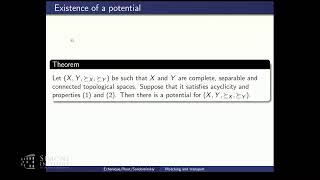
Stable Matching by Optimal Transport
Explore matching models with aligned preferences, focusing on supply-demand imbalances in markets like organ donation. Learn about stability, fairness, and optimal transport connections in matching theory.
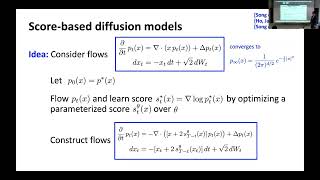
Renormalization Group Flow, Optimal Transport, and Diffusion Models
Explore connections between renormalization group flow, optimal transport, and diffusion models in applied mathematics, with insights from Harvard researcher Jordan Cotler.
Transport, Variational Inference and Diffusions
Explore connections between optimal transport and variational inference, focusing on stochastic differential equations and Girsanov transformations. Discover novel sampling and generative modeling techniques.
A Computational Framework for Solving Wasserstein Lagrangian Flows
Explore a computational framework for solving Wasserstein Lagrangian flows, covering optimal transport variations and applications in single-cell trajectory inference.
Action Matching: Learning Stochastic Dynamics from Samples
Explore Action Matching for learning stochastic dynamics from samples. Discover applications in quantum systems, biology, and generative modeling. Gain insights into novel approaches for simulating trajectories.