The Faint Lyman-Alpha Cosmic Web in TNG50 - Chris Byrohl
Explore the faint Lyman-alpha cosmic web in TNG50 simulation, examining its structure, properties, and implications for galaxy formation and evolution in the early universe.
Massive Galaxies at Cosmic Dawn - Cold Streams & Feedback-Free Starbursts
Explore massive galaxies in the early universe, focusing on cold streams and intense star formation periods without feedback, as presented by Avishai Dekel from Hebrew University.
The Importance of the Tracers in Extracting Filaments - Dark Matter and Galaxy Particles
Exploración de la importancia de los trazadores en la extracción de filamentos de materia oscura y partículas galácticas en la estructura del universo a gran escala.
Dissecting the Cosmic Web With Caustics - Job Feldbrugge
Explore the cosmic web's structure and its role in galaxy formation through caustics analysis. Gain insights into the universe's large-scale structure and its impact on cosmic evolution.
Indicator Power Spectra- Surgical Excision of Non-linearities and Covariance Matrices for Counts in Cells
Explore indicator power spectra for cosmic web analysis, focusing on non-linearity removal and covariance matrices in cell count studies to enhance understanding of large-scale structures.
Optimal Transport Reconstruction and Peaks Theory for Energy - Ravi Sheth
Explore optimal transport reconstruction and peaks theory for energy in cosmic web evolution, connecting galaxy properties to cosmology and structure formation.
Large-Scale Structure at the Interface of Numerical and Analytical Techniques - Oliver Hahn
Explores numerical and analytical techniques for studying large-scale cosmic structures, bridging cosmology and galaxy formation to understand the universe's evolution and structure.
Time Evolution of Bias - Applying Various Methods
Explore the evolution of bias in cosmic structure formation using various methods, examining its impact on galaxy distribution and the cosmic web across time.
Observational Tests of Theory in Binary Systems - Part II
Explore observational tests of binary system theories, focusing on circumbinary gas evolution and its influence on embedded binaries across stellar and black hole scales.
Observational Tests of Theory I - Discussion on Binary Systems
Explore observational tests of binary systems in astrophysics, from stellar pairs to supermassive black holes, and their interactions with surrounding gas in this insightful conference talk.
From Kiloparsec Scales to Merger - Properties of Dual AGNs
Explore dual AGN properties from kiloparsec scales to merger, focusing on systems that become gravitational wave sources. Gain insights into circumbinary gas evolution and its influence on binary systems.
Supermassive Black Hole Binaries, from Galaxy Mergers to Gravitational Waves
Explore the evolution of supermassive black hole binaries from galaxy mergers to gravitational waves, examining their interactions with circumbinary gas and observational signatures.
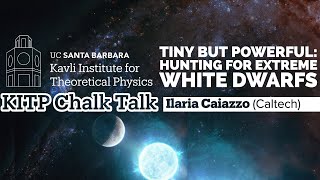
Tiny but Powerful- Hunting for Extreme White Dwarfs - KITP Chalk Talk by Ilaria Caiazzo
Explore extreme white dwarfs: their unique properties, recent discoveries, and implications for stellar evolution. Learn about cutting-edge research using advanced telescopes and instruments to uncover mysteries of these dense stellar remnants.
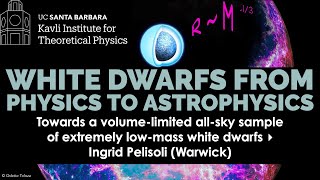
Towards a Volume-Limited All-Sky Sample of Extremely Low-Mass White Dwarfs - Ingrid Pelisoli
Explore the latest research on extremely low-mass white dwarfs using all-sky surveys, focusing on their significance in astrophysics and potential for new scientific discoveries.
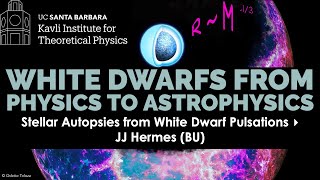
Stellar Autopsies from White Dwarf Pulsations - JJ Hermes
Explore white dwarf pulsations as a tool for stellar autopsies, uncovering insights into stellar evolution, Galactic history, and fundamental physics through cutting-edge observational and theoretical approaches.
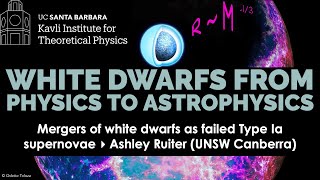
Mergers of White Dwarfs as Failed Type Ia Supernovae - Ashley Ruiter
Explore white dwarf mergers as potential failed Type Ia supernovae, examining their characteristics and implications for stellar evolution and galactic populations.
Secrets Revealed by the Webb Telescope - Looking at Ourselves from the Beginning of Time
Explore the universe's origins with the James Webb Space Telescope. Dr. Bullock discusses its groundbreaking capabilities to observe early stars, galaxies, and nearby planet formation, offering unique insights into our cosmic history.

The Spins of Binary Black Holes Following LIGO and Virgo's Third Observing Run
Explore binary black hole spins after LIGO and Virgo's third observing run, featuring insights from MIT experts on gravitational wave detections and their implications for astrophysics.
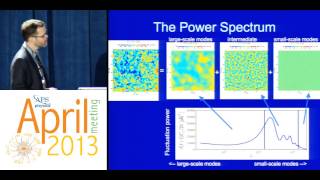
The Universe According to Planck
Explore the cosmic microwave background and its implications for our understanding of the universe through Planck satellite data, presented by Dr. Lloyd Knox.
Capturing a Supermassive Black Hole - 2021 Kavli Foundation Keynote Plenary
Explore groundbreaking research on supermassive black holes with Nobel laureate Andrea Ghez as she discusses her team's revolutionary observations at the center of our galaxy.
When Galaxies Were Born - Exploring the Early Universe
Explore the birth of galaxies and early universe with Richard Ellis, delving into groundbreaking discoveries in modern cosmology and the quest to witness the dawn of starlight.