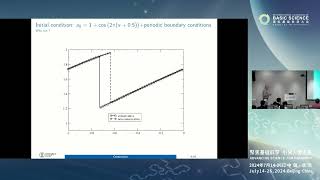
Approximation of Non-Linear Hyperbolic Problems and Conservation Properties
Explore advanced numerical methods for non-linear hyperbolic problems, focusing on conservation properties and flux formulations in various schemes like finite volume and discontinuous Galerkin.
Some Approaches for Solving the Discretely-Constrained Mixed Complementarity Problem (DC-MCP)
Explore approaches for solving discretely-constrained mixed complementarity problems in energy and transportation, combining integer restrictions with MCP systems and considering equity aspects.
Gradient and Hessian Approximations for Model-based Blackbox Optimization
Explore gradient and Hessian approximations for blackbox optimization, covering theoretical foundations, novel techniques, and practical applications in medical physics.
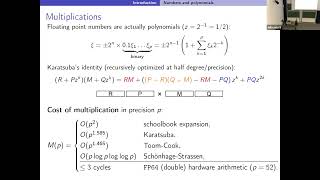
Fast Evaluation of Real and Complex Polynomials
Explore efficient techniques for evaluating real and complex polynomials, enhancing computational skills in mathematical analysis and numerical methods.

PDEs and Stencils - SPARSE 2024
Explore PDEs and stencils in computational science, focusing on efficient numerical methods for solving partial differential equations.
Pendulum Dynamics - Exploring Different Driving Functions
Explore pendulum behavior with different driving functions. Visualize and analyze changes in motion using Python simulations, including kick, sawtooth, and step functions.
Pendulum Simulation - Breaking Simple Harmonic Motion
Explore pendulum motion beyond simple harmonic approximations through coding, visualizing how small angle assumptions break down as amplitude increases.
Wave Function Evolver: Lennard-Jones Simulation Analysis - Episode 10
Explore Lennard-Jones simulation behavior by modifying potential energy minimum locations. Augment code to analyze changes and generate insights for physics enthusiasts and programmers.
Gravity Simulator - Sun and Earth Orbital Motion - Episode 1
Explore gravitational motion simulation using VPython, focusing on Sun-Earth dynamics. Learn about Euler-Cromer method, indices tracking, and Earth's scale in space.
Bouncy Balls Collision Math - Episode 3
Explore elastic collision math for bouncy balls, covering conservation of momentum, parallel axis, and unit vectors. Practical application in coding physics simulations.
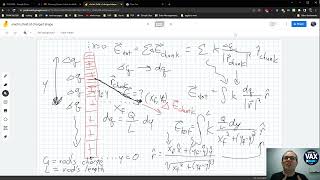
E-Field of Charged Shapes - Calculating Electric Fields for Complex Geometries
Learn to calculate the electric field of charged shapes by dividing them into small pieces. Explore techniques for various configurations, including dipoles, using Python code.
Introduction to Resurgence, Trans-Series and Non-Perturbative Physics II by Gerald Dunne
Explore advanced concepts in quantum field theory, including resurgence, trans-series, and non-perturbative methods. Gain insights into connecting perturbative and non-perturbative physics across various areas.
Deterministic Solution of the Boltzmann Equation - Fast Spectral Methods
Explore fast Fourier spectral methods for solving the Boltzmann equation, addressing computational challenges and showcasing applications in rarefied gas dynamics.
Error Bounds for Properties in Planewave Electronic Structure Calculations
Explore error bounds in planewave electronic structure calculations, focusing on ground state density matrix and interatomic forces estimation. Learn efficient approximation methods and see numerical results for materials systems.
Convergence of the Planewave Approximations for Quantum Incommensurate Systems
Explore quantum incommensurate systems through rigorous analysis of Schrödinger operators' spectrum distribution, focusing on density of states characterization and planewave approximation methods with novel energy cutoffs.
Estimate Transport Coefficients From Short Equilibrium Molecular-Dynamic Simulation
Discover optimal methods for estimating transport coefficients in molecular dynamics simulations, enhancing efficiency and accuracy in quantum mechanics research.
Acceleration of Quantum Mechanical Systems by Exploiting Similarity - IPAM at UCLA
Explore innovative approaches to accelerate quantum mechanical simulations by leveraging solution similarities, focusing on extended Lagrangian Born-Oppenheimer dynamics and reduced basis methods for quantum-spin systems.
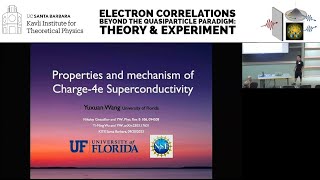
Mechanism and Properties of Charge-4e Superconductivity - Yuxuan Wang
Explore charge-4e superconductivity mechanisms and properties in this advanced physics talk by Yuxuan Wang, part of a conference on electron correlations beyond quasiparticle paradigms.
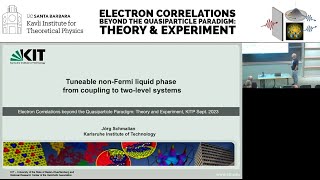
Crossover from BCS to Strange-Metal Superconductivity - Joerg Schmalian
Explore the transition from BCS to strange-metal superconductivity in this talk by Joerg Schmalian, part of a conference on electron correlations beyond the quasiparticle paradigm at KITP.
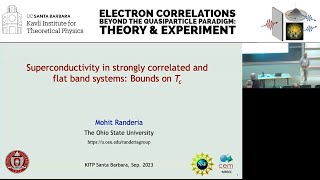
Superconductivity in Strongly Correlated Systems and Flat-Bands - Bounds
Explore superconductivity in strongly correlated systems and flat-bands, focusing on theoretical bounds and implications for quantum materials research.
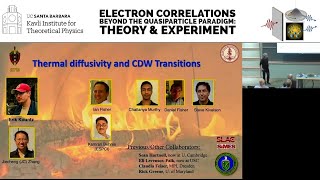
Anomalous Thermal Transport in Strange Metals - Beyond the MIR Limit
Explore anomalous thermal transport in strange metals beyond the MIR limit with Stanford's Aharon Kapitulnik. Delve into non-Fermi liquid behavior and cutting-edge quantum matter research.