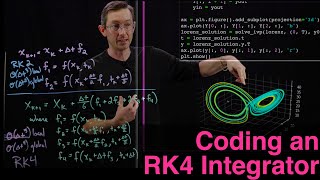
Coding a Fourth-Order Runge-Kutta Integrator in Python and Matlab
Learn to implement a 4th-order Runge-Kutta integrator in Python and Matlab, and apply it to simulate the chaotic Lorenz 1963 system. Gain practical coding skills for numerical integration.
Numerical Integration and Numerical Solutions to ODEs
Explore numerical methods for integration and solving ordinary differential equations, enhancing your computational skills in engineering mathematics.

Finite Differences and Successive Over Relaxation - Jupyter Notebook Assignment Development
Explore finite differences and successive over-relaxation methods in computational physics through a guided Jupyter notebook project, enhancing problem-solving skills in numerical analysis.
Jupyter Notebook Assignment - Runge-Kutta Method Development - Vlog 3
Explore the Runge-Kutta Method in computational physics, comparing it with Euler-Cromer. Develop skills in numerical analysis and scientific computing using Jupyter Notebooks.
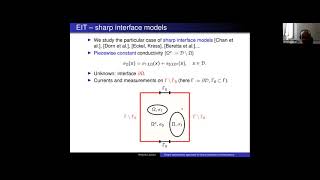
Shape Optimization Approach for Sharp-Interface Reconstructions in Inverse Problems
Shape optimization techniques for inverse problems: analyzing piecewise constant models, shape derivatives, and Lagrangian approaches. Applications in electrical impedance tomography and full waveform inversion.
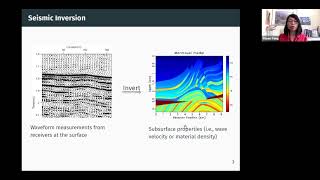
Optimal Transport for Inverse Problems and Implicit Regularization
Exploring optimal transport theory for inverse problems, addressing nonconvexity and noise sensitivity in least-squares methods, with applications in industry and broader data-fitting challenges.
Mathematical Framework and Numerical Aspects of Adapted Optimal Transport
Explore mathematical frameworks for transfer learning and numerical aspects of adapted optimal transport in financial mathematics and engineering through expert talks from leading researchers.
Probabilistic Numerical Computation - A New Concept?
Explore probabilistic numerics, a new field combining mathematics, statistics, and computer science to quantify uncertainty in numerical methods for complex data analysis and modeling.
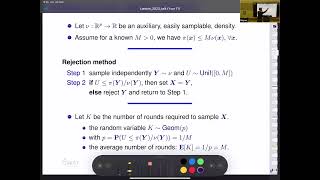
Langevin Monte Carlo: Randomized Midpoint Method Revisited
Explore advanced Langevin Monte Carlo techniques, focusing on the Randomized Midpoint method's superior sampling error guarantees and recent improvements for high-dimensional target distributions.
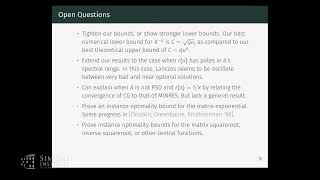
Instance Optimal Iterative Methods for Matrix Function Approximation
Explores instance-optimality of Lanczos method for matrix function approximation, extending conjugate gradient analysis to rational and other function classes. Discusses recent progress and open questions.
Numerical Approach to Polylogarithms on Higher-Genus Riemann Surfaces
Explore numerical evaluation of polylogarithms on genus-two Riemann surfaces using Schottky parametrization and averaging over genus-one differential forms, advancing particle physics research.
Conservative Adaptive Rank Integrators for Nonlinear Kinetic Models
Explore low-rank time integrators for PDEs, including explicit and implicit schemes, with applications to Vlasov, heat, Fokker-Planck, and advection-diffusion equations.
Solving High-Dimensional Optimal Control Problems with Empirical Tensor Train Approximation
Explore innovative approaches to solve high-dimensional optimal control problems using Tensor Train approximation, with applications to destabilized viscous Burgers and diffusion equations.
Introduction to Theory and Numerics of Partial Differential Equations - Lecture 4
Explore advanced concepts in partial differential equations, focusing on theory and numerical methods for solving complex mathematical problems in physics and engineering.
High Resolution Shock Capturing Scheme for Non-Relativistic Hydrodynamics - Lecture 2
Explore advanced numerical techniques for modeling shock waves in non-relativistic fluid dynamics, enhancing understanding of complex hydrodynamic phenomena in astrophysical simulations.

A Numerical Toolkit for the Likelihood Correspondence
Explore numerical methods for analyzing likelihood correspondences in statistical models, focusing on applications in enumerative geometry and algebraic statistics.
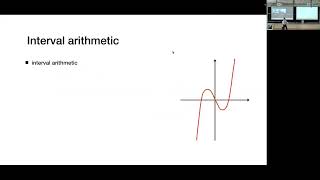
Certified Homotopy Tracking in Enumerative Geometry
Explore certified homotopy tracking in enumerative geometry with Kisun Lee from Clemson University, focusing on advanced mathematical concepts and applications.
Raw Moment, Measure of Central Tendency, and Moment about Arbitrary Point - Statistics for BTech, BCA, and BBA
Explore key statistical concepts: raw moments, central tendency measures, and moments about arbitrary points. Gain practical skills through numerical problems applicable to various fields.
Central Moment and Measure of Central Tendency in Statistics - Numericals
Explore central moments and measures of central tendency in statistics through numerical examples, applicable for various undergraduate programs.
Cumulative Distribution Function - Numericals and Problems for BTech and BSc
Explore cumulative distribution functions (CDF) through practical examples, enhancing understanding of probability theory for engineering and science students.
Probability Density Function and Continuous Probability Distribution - Numericals
Explore probability density functions and continuous distributions through explanations and numerical examples, enhancing understanding for BTech, BSc, and JEE students.