Kinetics of Radioactive Decay - General Physics
Explore radioactive decay kinetics, including exponential decay, decay rates, half-life, and decay constants. Solve practice problems to reinforce understanding of these fundamental concepts.
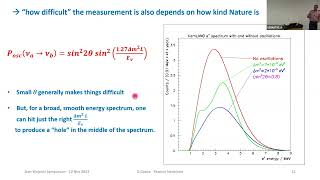
A Different Kind of Long Baseline: Reactor Neutrino Oscillation Experiments
Explore reactor neutrino oscillation experiments and their unique long baseline approach in this insightful talk by Giorgio Gratta from Stanford University.
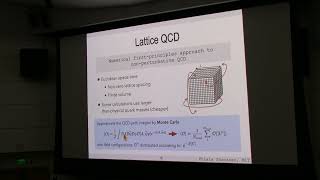
From Quarks to Nuclei: Computing the Standard Model
Explore how first-principles calculations reveal insights into matter's structure, from quark-gluon interactions to nuclear properties, with implications for dark matter detection and new physics searches.
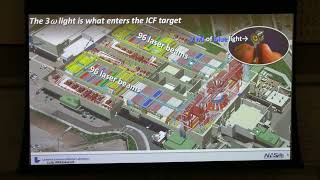
How Ignition and Target Gain 1 Was Achieved in Inertial Fusion
Explore key physics principles and applied challenges overcome to achieve burning plasmas, fusion ignition, and target energy gain in inertial fusion research.
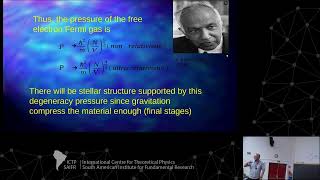
Effects of Strong Electric and Magnetic Fields in Superdense Matter
Explore the impact of intense electromagnetic fields on ultra-dense matter, focusing on astrophysical implications and theoretical models.
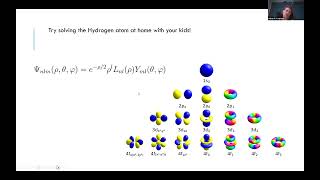
A Mathematical Approach to Coupled Cluster Methods
Explore mathematical foundations of Coupled Cluster methods for many-body problems, covering essential concepts and recent advances in quantum chemistry and nuclear physics.
Probing the Cosmic Unknowns Through Neutrinos
Explore cosmic mysteries through neutrinos, their role in stellar dynamics, element formation, and powerful cosmic events. Discover recent developments and exciting detection prospects in multi-messenger astronomy.
How Ignition and Target Gain Greater Than 1 Were Achieved in Inertial Fusion
Explore key physics principles and applied challenges overcome to achieve burning plasmas, fusion ignition, and target energy gain greater than unity in inertial fusion research.
Ultrarelativistic Nuclear Collisions as Seen Through Photons
Explore photon production in ultrarelativistic nuclear collisions, focusing on energy spectra, production mechanisms, and momentum anisotropy in proton-proton and heavy-ion collisions.
Electromagnetic Radiation Probing QCD Matter
Explore electromagnetic radiation's role in probing QCD matter, focusing on light vector mesons and their dilepton decays to understand in-medium spectral functions and QCD phase transitions.
Fundamental Physics with Nuclei: Exploring Standard Model Tests and Beyond
Explore lepton-number violation, neutrino mass hierarchy, and dark matter through nuclear physics. Gain insights into Standard Model tests and beyond using advanced computational methods.
Strong Interaction Matter in the Universe
Explore quantum chromodynamics, hadron formation, and nuclei in the universe. Discover advances in understanding dense matter in neutron stars and high-temperature phenomena in compact object mergers.
Probing Physics Beyond the Standard Model at Low Energies
Explore precision measurements and rare processes in physics beyond the Standard Model, focusing on beta decay and neutrinoless double beta decay as probes for new interactions and lepton number non-conservation.
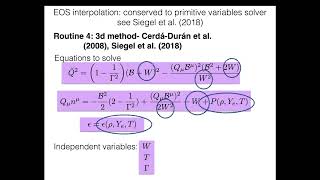
HARM3D and NUC: Numerical Simulations in Relativistic Astrophysics
Explore HARM3D and NUC in relativistic astrophysics, focusing on computational techniques for modeling extreme cosmic events and gravitational phenomena.
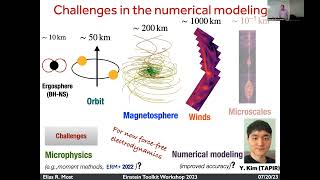
Simulating Extreme Plasmas in Neutron Star Mergers
Explore cutting-edge simulations of extreme plasma behavior during neutron star mergers, uncovering insights into astrophysical phenomena and gravitational waves.
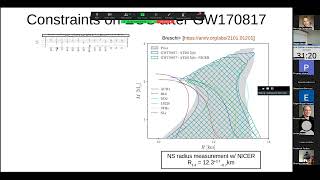
Nuclear Equation of State and Multimessenger Astronomy
Explore nuclear equation of state and its impact on multimessenger astronomy through cutting-edge research and insights from gravitational wave observations.
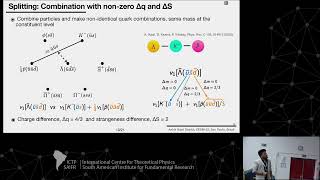
Probing Electromagnetic Field with Charge Dependence of Directed Flow in STAR Experiment at RHIC
Explore electromagnetic field probing through charge-dependent directed flow analysis in STAR experiment at RHIC, presented by Ashik Ikbal Sheikh.
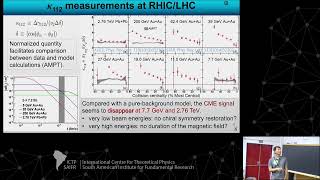
Search for the Chiral Magnetic Effect in Heavy-ion Collisions
Explore the search for the Chiral Magnetic Effect in heavy-ion collisions with insights from Gang Wang's workshop presentation at ICTP-SAIFR.
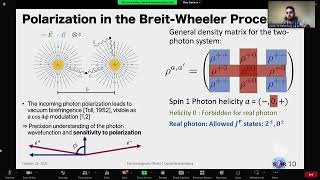
Studying the Electromagnetic Fields of Heavy-Ion Collisions with Photon-Mediated Processes
Explore electromagnetic fields in heavy-ion collisions through photon-mediated processes, focusing on cutting-edge research in nuclear physics.
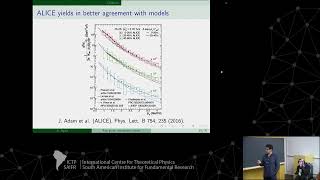
Anisotropic Photon Emission from Gluon Fusion and Splitting in Peripheral Heavy-Ion Collisions with Strong Magnetic Background
Explore anisotropic photon emission in heavy-ion collisions with strong magnetic fields, focusing on gluon fusion and splitting processes in peripheral collisions.
The Secret Force for Limitless Energy - Lasers and Fusion Ignition
Physicist Tammy Ma discusses fusion ignition breakthrough at Lawrence Livermore National Laboratory, explaining how giant lasers catalyzed the reaction and envisioning its potential for limitless clean energy.