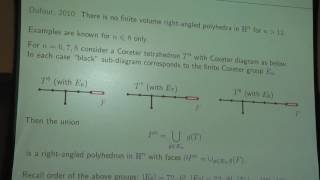
On Volumes of Compact and Non-Compact Right-Angled Hyperbolic Polyhedra
Explore the mathematical intricacies of right-angled hyperbolic polyhedra, examining volume calculations for both compact and non-compact forms in this advanced geometry lecture.
A. Gaifullin - Analytic Continuation of the Volume of Hyperbolic Tetrahedron
Explore the mathematical concept of analytic continuation applied to hyperbolic tetrahedron volumes, delving into advanced geometric and topological theories.
Inverse Problems on Graphs with Geometric Deep Learning
Explores geometric deep learning for graph inverse problems, focusing on non-Euclidean geometries, physics-based approaches, and applications in particle physics and community detection.
How Geometry Created Modern Physics
Explore the evolution of geometry from Euclid to Einstein, uncovering how post-Euclidean concepts revolutionized our understanding of spacetime and laid the foundation for modern physics.

The Story of Mathematical Proof - From Ancient Greece to Modern Logic
Explore the evolution of mathematical proof across number theory, geometry, topology, and logic, delving into the fascinating gap between natural and real numbers.

Of Corals and the Cosmos - A Story of Hyperbolic Space
Explore hyperbolic geometry in nature, from corals to cactuses, and its historical significance. Discover how these forms challenge traditional Euclidean concepts and their prevalence in the natural world.
Null Points and Null Lines in Universal Hyperbolic Geometry - Lecture 12
Explore null points and null lines in universal hyperbolic geometry, including rational and projective parametrization, joins and meets theorems, and a triply nil triangle.
The Circle and Projective Homogeneous Coordinates - Universal Hyperbolic Geometry Lecture 7a
Introduction to projective geometry and its relation to universal hyperbolic geometry, exploring concepts like affine spaces, perspective, and one-dimensional projective geometry.
The Circle and Projective Homogeneous Coordinates in Universal Hyperbolic Geometry - Lecture 7b
Explores projective geometry as the foundation of universal hyperbolic geometry, focusing on the circle in projective homogeneous coordinates and its significance in mathematics and physics.
The Circle and Cartesian Coordinates in Universal Hyperbolic Geometry - Lecture 5
Explore Cartesian coordinates and the unit circle, covering key theorems on lines, points, and circles. Learn about determinants, parametrization, and the intersection of lines and circles in geometry.
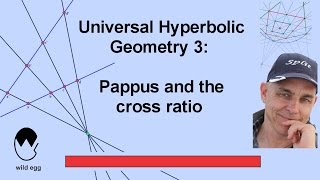
Pappus' Theorem and Cross Ratio in Projective Geometry - Universal Hyperbolic Geometry 3
Explore Pappus' theorem, cross ratio, and key projective geometry concepts. Learn about invariance, transformations, and applications in hyperbolic geometry through theorems and exercises.
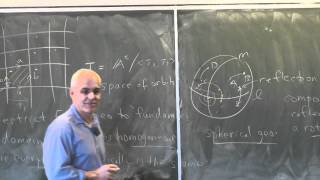
The Geometry of Surfaces - Algebraic Topology Lecture 20
Explore the connection between 2D surfaces and classical geometries, focusing on isometries and introducing hyperbolic geometry through circle inversions in the Beltrami Poincare disk model.
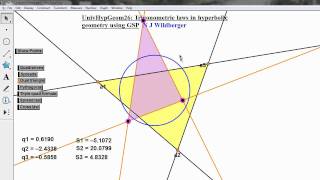
Trigonometric Laws in Hyperbolic Geometry Using Geometer's Sketchpad - Universal Hyperbolic Geometry 26
Explore trigonometric laws in hyperbolic geometry using Geometer's Sketchpad. Learn about Pythagoras' theorem, Triple quad formula, Spread law, and Cross law with practical examples and custom tools.
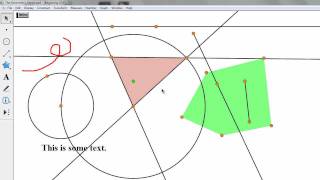
Geometer's Sketchpad and Circles in Universal Hyperbolic Geometry - Lecture 25
Explore Geometer's Sketchpad for dynamic illustrations in universal hyperbolic geometry. Learn custom tools, construct point duals, and discover various circles, including equidistant curves, in hyperbolic space.
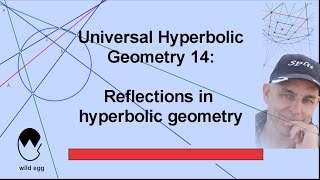
Reflections in Hyperbolic Geometry - Universal Hyperbolic Geometry Lecture 14
Explore reflections in hyperbolic geometry, comparing with Euclidean counterparts. Discover unique properties and surprising connections to circle geometry in this advanced mathematical exploration.
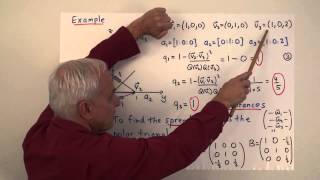
Applications of Rational Spherical Trigonometry - Universal Hyperbolic Geometry Lecture 43
Exploring rational spherical trigonometry through a specific spherical triangle example, demonstrating its connection to hyperbolic geometry and three-dimensional space.
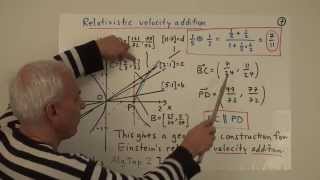
Relativistic Velocity and Core Circles in Rational Geometry - Lecture 4
Exploring relativistic velocity and core circles in rational geometry, extending Paul Miller's protractor concept to projective quadrance and comparing Euclidean and relativistic geometries.
Duality, Polarity and Projective Linear Algebra - Differential Geometry Lecture 11
Explores projective geometry, quadratic forms, and pole-polar duality in relation to the unit circle. Connects these concepts to Lorentz/Einstein/Minkowski geometry and Apollonius' work.
Probabilistic Methods in Hyperbolic Geometry
Explore probabilistic approaches to solve geometric and topological questions in hyperbolic manifolds, bridging mathematics domains through innovative analytical techniques.
Dimers and M-curves: Limit Shapes from Riemann Surfaces
Explore dimer models, M-curves, and limit shapes through algebraic geometry, integrating Riemann surfaces and Schottky uniformization. Gain insights into statistical mechanics and discrete geometry.

Geometric Bounds for Spanning Tree Entropy of Planar Lattices
Explores geometric bounds for spanning tree entropy in planar lattices, connecting hyperbolic geometry, number theory, probability, and graph theory. Discusses conjectures and recent progress.