Modern Numerical Methods in Computational Relativity - Lecture 3
Explore advanced numerical techniques for solving Einstein's equations in computational relativity, focusing on modeling gravitational waves from merging black holes and neutron stars.

Modern Numerical Methods in Computational Relativity - Lecture 1
Explore modern numerical methods for solving Einstein's equations in computational relativity, essential for modeling gravitational waves from black hole and neutron star mergers.
Introduction to Numerical Relativistic Hydrodynamics - Lecture 5
Explore advanced concepts in numerical relativistic hydrodynamics, focusing on computational techniques for modeling high-energy astrophysical phenomena and gravitational wave sources.
Introduction to Numerical Relativistic Hydrodynamics - Lecture 2
Explore advanced concepts in numerical relativistic hydrodynamics, focusing on mathematical formulations and computational techniques for modeling high-energy astrophysical phenomena.
Introduction to Numerical Relativistic Hydrodynamics - Lecture 1
Explore numerical relativistic hydrodynamics, essential for modeling high-energy astrophysical phenomena like black hole mergers and supernovae, crucial for gravitational-wave astronomy advancements.
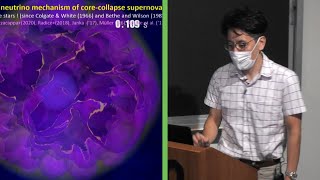
Multi-Dimensional Modeling of Core-Collapse Supernovae - IPAM at UCLA
Explore 3D modeling of core-collapse supernovae, focusing on neutrino and gravitational-wave signatures to unravel the long-standing mystery of the explosion mechanism.
Astronomy with Gravitational Waves
Explore gravitational waves and their role in astronomy with Dr. Alexander Nitz. Learn about neutron star and black hole mergers, and the open-source PyCBC library used in gravitational wave detection.
Neutron Star Perturbation Theory - Lecture 5
Explore advanced concepts in neutron star physics, focusing on perturbation theory and its applications in understanding compact object behavior and gravitational wave phenomena.
Neutron Star Perturbation Theory - Lecture 4
Explore advanced concepts in neutron star perturbation theory with expert Nils Andersson, covering key principles and applications in gravitational physics and astrophysics.
Neutron Star Perturbation Theory - Lecture 2
Explore advanced concepts in neutron star physics, focusing on perturbation theory and its applications to understanding stellar structure and behavior in extreme gravitational environments.
Neutron Star Perturbation Theory - Lecture 1
Explore neutron star perturbation theory in this advanced lecture, covering key concepts and applications in gravitational physics and compact object studies.
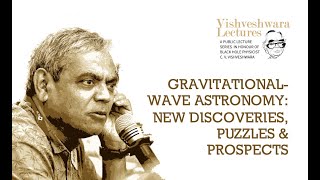
Gravitational-Wave Astronomy - New Discoveries, Puzzles & Prospects
Explore gravitational-wave astronomy's latest findings, challenges, and future prospects. Learn about compact binary coalescences and their impact on physics and astronomy.

Catching Gravitational Waves - Understanding Detection and Future Implications
Explore gravitational waves: their nature, sources, detection methods, and future implications in astronomy. Learn about LIGO's groundbreaking discoveries and the new era of cosmic observation.
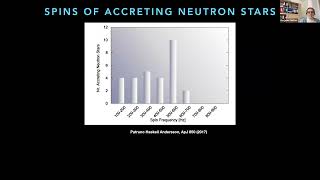
Volunteer Computing to Search the Sky for Continuous Gravitational Wave Emission
Explore the search for continuous gravitational waves using volunteer computing. Learn about detection challenges, signal integration, and the latest results from Einstein@Home all-sky searches in LIGO data.
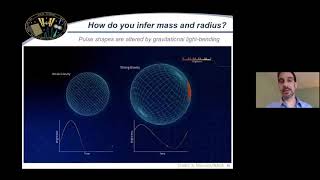
NICER Mission: Exploring Neutron Star Physics and Astrophysics from the ISS
Exploring neutron stars with NASA's NICER mission: probing extreme physics, dense matter, and strong gravity from the International Space Station through soft X-ray observations of celestial sources.
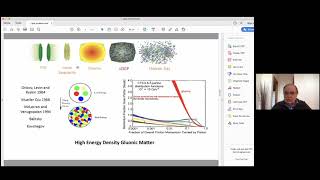
20 Years of RHIC and Beyond - Frontiers of Discovery in Quark Gluon Plasma
Exploring Quark Gluon Plasma discoveries at RHIC, their implications, and future research directions in high-energy nuclear physics and astrophysics.
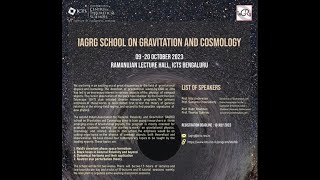
Neutron Star Perturbation Theory - Lecture 3
Explore advanced concepts in neutron star perturbation theory, focusing on mathematical models and physical implications for compact object behavior and gravitational wave emissions.
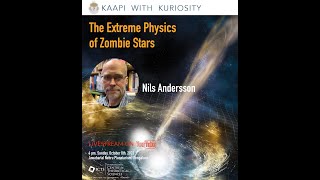
The Extreme Physics of Zombie Stars by Nils Andersson
Explore the fascinating world of neutron stars, their extreme physics, and the challenges in understanding these 'zombie stars' through astrophysical observations and theoretical models.
Modern Numerical Methods in Computational Relativity - Lecture 4
Explore advanced numerical techniques in computational relativity, focusing on solving Einstein's field equations for gravitational-wave astronomy and astrophysical phenomena modeling.
Introduction to Numerical Relativistic Hydrodynamics - Lecture 4
Explore advanced concepts in numerical relativistic hydrodynamics, focusing on computational techniques for modeling high-energy astrophysical phenomena and gravitational wave sources.
Introduction to Numerical Relativistic Hydrodynamics - Lecture 3
Explore advanced concepts in numerical relativistic hydrodynamics, focusing on computational techniques for modeling high-energy astrophysical phenomena and gravitational wave sources.