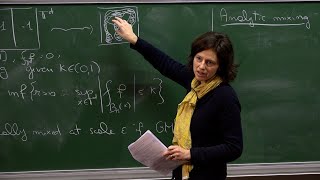
Flows of Irregular Vector Fields in Fluid Dynamics - Lecture 2
Explore modern techniques for analyzing flows of irregular vector fields, including quantitative regularity estimates, nonuniqueness solutions, and applications to fluid dynamics PDEs.

Flows of Irregular Vector Fields in Fluid Dynamics - Lecture 1
Explore modern concepts in flows of irregular vector fields, including quantitative regularity estimates, nonuniqueness solutions, and applications to fluid dynamics and turbulence theory.
Instability and Non-uniqueness for the Euler and Navier-Stokes Equations
Explore recent advances in non-unique solutions for incompressible Navier-Stokes and Euler equations, including groundbreaking work on forced Navier-Stokes equations' non-uniqueness.
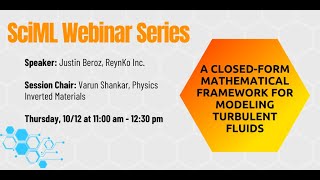
A Closed-Form Mathematical Framework for Modeling Turbulent Fluids
Explore a groundbreaking mathematical framework for turbulent fluid motion, covering energy spectra, instability mechanisms, and analytical solutions for turbulence in confined spaces.
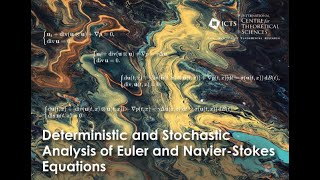
On Statistical Solutions of Fluids and Their Computation
Explore statistical solutions of fluid dynamics and computational methods. Gain insights into Euler and Navier-Stokes equations, Onsager's conjecture, and recent breakthroughs in fluid mechanics research.
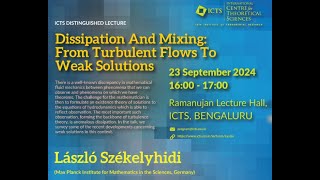
Dissipation and Mixing: From Turbulent Flows to Weak Solutions - Lecture 1
Explore dissipation and mixing in turbulent flows, focusing on weak solutions in hydrodynamics. Gain insights into anomalous dissipation and recent developments in mathematical fluid mechanics.
Instability and Non-Uniqueness for the Euler and Navier-Stokes Equations
Explore instability and non-uniqueness in Euler and Navier-Stokes equations, focusing on effective theories in classical and quantum particle systems.
Instability and Non-Uniqueness for the Euler and Navier-Stokes Equations
Explore instability and non-uniqueness in Euler and Navier-Stokes equations, focusing on effective theories in classical and quantum particle systems.
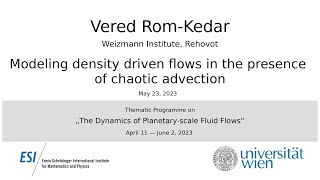
Modeling Density-Driven Flows in the Presence of Chaotic Advection
Explore a hybrid kinematic-dynamic model for density-driven flows, combining traditional Stommel Box and chaotic advection approaches to study oceanic feedback processes.
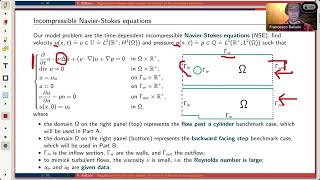
Regularized Reduced Order Models for Control of Navier-Stokes Equations
Explore regularized reduced order models for controlling Navier-Stokes equations in convection-dominated flows, focusing on evolve-filter-relax and approximate deconvolution techniques for numerical stabilization.
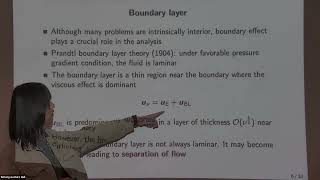
Energy Dissipation of Navier-Stokes Equation with Non-Characteristic Boundary
Explore energy dissipation in Navier-Stokes equations with non-characteristic boundaries, presented by Jincheng Yang from the Institute for Advanced Study.

A Short but Up-to-Date Introduction to Partially Parabolic Systems - Lecture 4
Explore advanced concepts in fluid mechanics, focusing on Euler and Navier-Stokes equations. Gain insights into recent breakthroughs and cutting-edge techniques in this field of mathematical physics.
Modeling Fluid Dynamics with Navier-Stokes Equations
Explore fluid flow modeling using partial differential equations and learn to solve Navier-Stokes equations with NDSolve.

On Random Grid Neural Processes for Solving Forward and Inverse Problems
Explore innovative deep learning models for parametric PDEs using random grids and variational neural processes, addressing challenges in physics-informed frameworks and data integration.
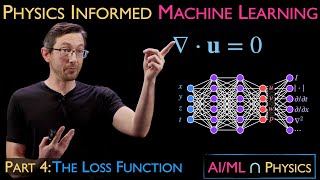
Crafting a Physics-Informed Loss Function for AI/ML in Physics - Part 4
Explores designing physics-informed loss functions in AI/ML, including case studies on fluid dynamics, sparse modeling, and equivariant loss, to enhance model performance and incorporate physical constraints.

Score Matching via Differentiable Physics
Explore score matching via differentiable physics for inverse problems. Learn about combining physics operators with stochastic differential equations to generate plausible trajectories towards given end states.
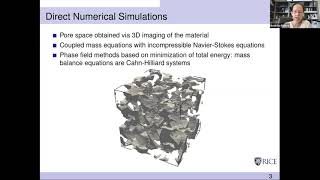
Bound-Preserving Numerical Solutions of Variable Density Two-Phase Flows
Explore efficient numerical methods for solving phase-field models in pore-scale flows, focusing on bound-preserving solutions and applications in energy and environmental sciences.
A Variational Principle of Minimum for Navier-Stokes Equation Based on the Symplectic Formalism
Explore a variational principle of minimum for Navier-Stokes equations using symplectic formalism, advancing understanding of fluid dynamics and mathematical physics.
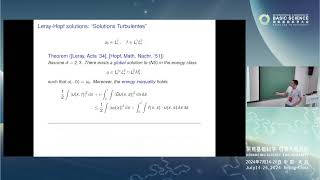
Instability and Non-Uniqueness in Fluid Dynamics
Explore instability and non-uniqueness in fluid dynamics, focusing on Leray solutions to Navier-Stokes equations and Vishik's findings on 2D Euler systems.
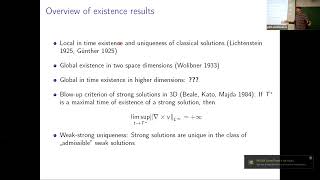
Conserved Quantities and Regularity in Fluid Mechanics
Explore conserved quantities and regularity in fluid mechanics, gaining insights into fundamental principles and advanced concepts in this field.

Review of Governing Equations: Navier-Stokes Equations and Energy Equation
Explore fluid dynamics fundamentals: Navier-Stokes equations, energy conservation, and viscosity modeling for a comprehensive understanding of fluid flow mechanics.