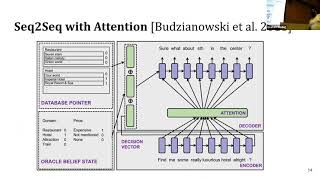
CMU Advanced NLP 2021: Dialog
Learn about dialog systems in NLP, covering key issues, datasets, evaluation methods, and typical models for response generation in task-oriented and open-domain contexts.

CMU Advanced NLP: Word Segmentation and Morphology
Explore word segmentation, morphology, and unsupervised subword segmentation in this advanced NLP lecture, covering linguistic concepts and computational approaches to language analysis.
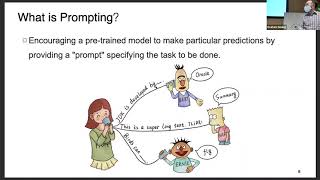
CMU Advanced NLP: Prompting + Sequence-to-Sequence Pre-Training
Explore advanced NLP techniques including prompting, sequence-to-sequence pre-training, and prompt engineering. Learn innovative methods to enhance language models and improve their performance across various tasks.
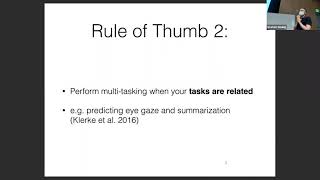
CMU Advanced NLP: Pre-training Methods
Explore advanced NLP concepts including multi-task learning, sentence embeddings, BERT variants, and language modeling objectives. Gain insights into cutting-edge techniques for natural language processing.
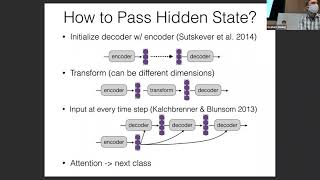
CMU Advanced NLP 2021 - Conditional Generation
Learn advanced NLP techniques for conditional generation, including encoder-decoder models, search algorithms, ensembling, and evaluation methods. Explore applications in translation, summarization, and dialogue systems.
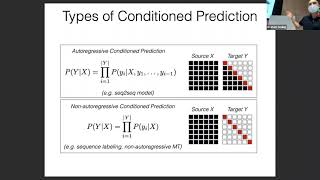
CMU Advanced NLP: Recurrent Neural Networks
Explore recurrent neural networks, LSTMs, and their applications in NLP, covering long-distance dependencies, prediction types, and optimization techniques for advanced language processing tasks.
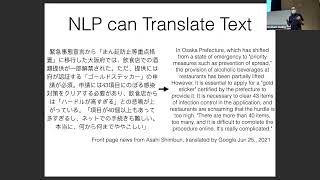
CMU Advanced NLP: Introduction to NLP
Explore key concepts, challenges, and applications of natural language processing, including feature extraction, sentiment analysis, and neural network models.
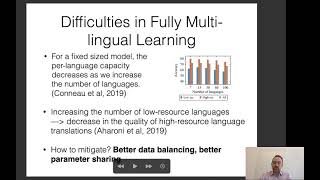
Neural Nets for NLP 2021 - Multilingual Learning
Explore multilingual learning in NLP, covering models, data balancing, parameter sharing, and cross-lingual transfer techniques for improved language processing across diverse languages.

Neural Nets for NLP - Models with Latent Random Variables
Explore neural network models with latent random variables for NLP, covering variational autoencoders, discrete latent variables, and their applications in language processing.
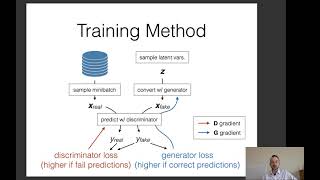
Neural Nets for NLP 2021 - Adversarial Methods
Explore generative adversarial networks, adversarial feature learning, and adversarial attacks in NLP. Learn cutting-edge techniques for robust and domain-invariant neural network models in natural language processing.
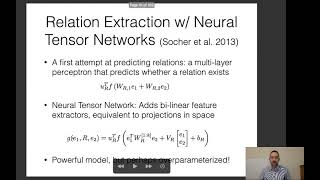
Neural Nets for NLP 2021 - Neural Nets + Knowledge Bases
Neural networks for knowledge bases: learning embeddings, incorporating KBs into models, and probing language models. Covers relation extraction, distant supervision, retrofitting embeddings, and open information extraction.
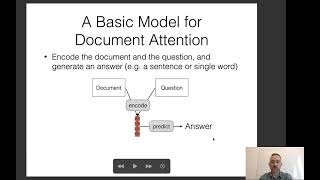
Neural Nets for NLP 2021 - Machine Reading with Neural Nets
Explore machine reading techniques for NLP, covering datasets, context encoding, multi-hop reasoning, and dataset limitations. Gain insights into advanced neural network applications in natural language processing.

Neural Nets for NLP 2021 - Structured Prediction with Local Independence Assumptions
Explore structured prediction in NLP, focusing on local independence assumptions and Conditional Random Fields. Learn about sequence labeling, potential functions, and dynamic programming models.
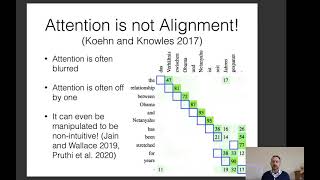
Neural Nets for NLP 2021 - Attention
Explore attention mechanisms in neural networks for NLP, covering key concepts, improvements, and specialized varieties with practical examples and applications.
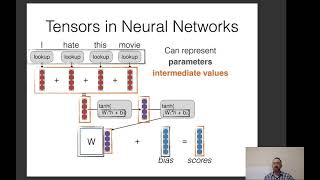
Neural Nets for NLP 2021 - Building A Neural Network Toolkit for NLP
Implement a minimal neural network toolkit for NLP, covering model definition, graph creation, forward/backward calculation, and parameter updates.

CMU Multilingual NLP 2020 - Data Annotation
Explore data annotation techniques, tools, and best practices for multilingual NLP, covering labeler selection, task definition, and quality control measures.
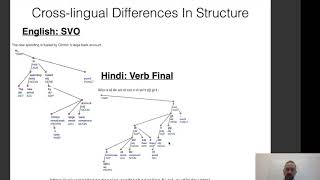
CMU Multilingual NLP - Dependency Parsing
Explore dependency parsing, its applications, and cross-lingual methods. Learn about linguistic structures, universal dependencies, and techniques for improving multilingual parsing performance.
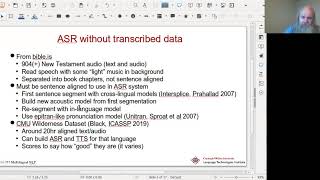
CMU Multilingual NLP 2020 - Low Resource ASR
Explore low-resource ASR techniques, including lexicon-free systems, cross-lingual recognition, and speech translation. Learn innovative approaches for languages with limited data.
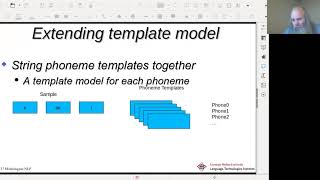
CMU Multilingual NLP 2020 - Automatic Speech Recognition
Learn about automatic speech recognition, covering pronunciation, acoustic, and language modeling techniques for multilingual NLP applications.
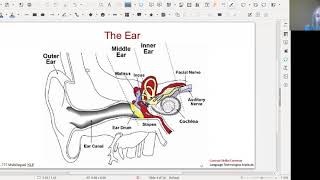
CMU Multilingual NLP 2020 - Speech
Explore speech production, language differences, and speech technologies in this comprehensive overview of vocal communication and its computational applications.
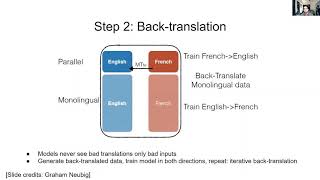
CMU Multilingual NLP - Unsupervised Translation
Explore unsupervised machine translation techniques, including word translation, back-translation, and bidirectional modeling. Learn about initialization methods and challenges in multilingual NLP.