Achieving a Highly Available and Scalable Multi-Tenant Eventing Backend Architecture in Serverless Products
Explore a new architecture for highly available and scalable event sources in serverless platforms, focusing on Knative Eventing and KafkaSource optimization for improved performance and resource efficiency.
Delivery Done Right with Service Mesh - Implementing at Scale
Explore Shipt's journey implementing service mesh, solving challenges in ingress, security, multi-tenancy, and multi-cluster operations at scale. Learn from their experiences and gain insights for your own implementation.
Build Serverless with Kubernetes, Kata Containers and Bare Metal Cloud - Alibaba's Approach
Explore Alibaba's serverless infrastructure using Kubernetes, Kata Containers, and bare metal instances. Learn about multi-tenancy, isolation, and performance optimizations in cloud environments.
Bring Elastic and Resilient Multi-Tenancy to TiKV
Explore TiKV's multi-tenancy enhancements, including data space separation, timestamp integration, and solutions for region management and TSO service challenges to improve elasticity and resilience.
Wasm and Kubernetes: Beyond Containers
Explore WebAssembly's potential in cloud-native architectures, focusing on its integration with Kubernetes for efficient backend operations and multi-tenancy solutions.
Integrated Cloud Native Blueprint - Goals and Framework
Explore Intel's Integrated Cloud Native Blueprint for enterprise-scale cloud solutions, addressing challenges in cluster management, geo-distribution, network functions, and edge connectivity.
Operate Multi-Tenancy Service Mesh with ArgoCD in Production
Learn to implement and manage soft and hard multi-tenancy in Istio service mesh using ArgoCD, addressing challenges in configuration, resource consumption, and security for scaled environments.
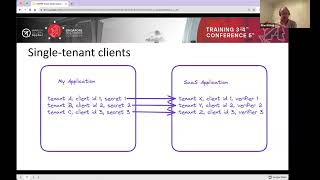
Cross-Tenant Request Forgery Attack in Multi-Tenancy Environments
Unveiling security vulnerabilities in multi-tenant SaaS platforms using OAuth, focusing on the "Cross-Tenant Request Forgery" attack and discussing potential remediations for developers.
Flavors of Certificates in Service Mesh - The Whys and Hows
Explore various certificate deployment options in Service Mesh security, with demonstrations using Istio for scenarios like external management, SPIFFE integration, and 5G Telco Cloud security.
Unlocking the Power of Multi-Tenancy - Perspectives from Platform Leaders
Industry experts discuss challenges, strategies, and best practices for harnessing multitenancy in cloud-native applications, focusing on security, collaboration, and meeting unique tenant demands.
Lessons Learned Migrating an Existing Product to a Multi-Tenant Cloud Native Environment
Explore challenges and solutions in migrating Adobe Experience Manager to a Cloud Native environment, focusing on microservices, multi-tenancy, and scalability considerations.
Bringing Apache Cassandra Closer to Kubernetes
Explore the design and implementation of Astra Serverless Database, built on Kubernetes. Learn how decoupling Cassandra components creates a more powerful and scalable database service.
Cloud Native Security - Cell-Based Architecture and Kubernetes
Explore Cell-Based Architecture for scalable, secure multi-tenant Kubernetes environments. Learn practical applications, real-world case studies, and how to enhance security, isolation, and performance using open-source technologies.
UFO: The Ultimate QoS-Aware Core Management for Virtualized and Oversubscribed Public Clouds
Optimizing multi-tenancy, virtualization, and resource oversubscription in public clouds through QoS-aware core management, addressing challenges in latency-critical workloads and VM resource contention.
Cloud Computing Security - Risks and Mitigation Strategies
Explore cloud computing security risks and mitigation strategies, covering topics like data loss, virtualization, compliance, and encryption in emerging large-scale web application deployments.
Partial Multi-Tenancy on Kafka Using Strimzi - Managing Multiple Applications
Explore Strimzi's solutions for partial multi-tenancy in Kafka, including topic creation, least privilege enforcement, and noisy neighbor mitigation. Learn how LittleHorse Cloud leverages Strimzi CRDs for efficient management.
KubeSecRay - Fortifying Multi-Tenant Ray Clusters on Kubernetes
Discover how to secure multi-tenant Ray clusters using KubeSecRay, implementing robust Kubernetes security features for isolation, access control, and resource management in distributed computing environments.
Kata Containers 3.0 - Virtualization Optimized for Cloud Native Environments
Discover the latest evolution of Kata Containers 3.0, featuring the new Dragonball hypervisor and async rust runtime for enhanced container virtualization and cloud-native performance.
Sokovan - Container Orchestrator for Accelerated AI/ML Workloads and Massive Scale GPU Computing
Discover how Sokovan optimizes AI/ML workloads through intelligent container orchestration, featuring dual-layer scheduling and hardware acceleration integration for enhanced GPU computing performance.
Programmable Networks: Hardware, Software, and Applications
Explore cutting-edge developments in programmable networks, from multi-tenant packet processing to compiler technology and distributed applications, with insights into future RPC processor designs.
Creating a Landlord for Multi-tenant Kubernetes Using Flux, Gatekeeper, Helm, and Friends
Explore multi-tenant Kubernetes environments using Flux, Gatekeeper, and Helm. Learn to create isolated namespaces, enforce policies, and build a scalable platform for efficient workload management.