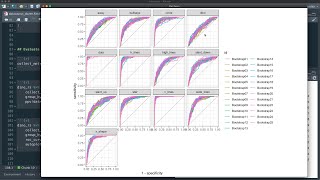
Predict Class Membership for the Datasaurus Dozen With Tidymodels
Explore multiclass evaluation metrics for random forest models using the Datasaurus Dozen dataset, focusing on model performance and visualization techniques.

Mathematical Models for Predicting the Future - Limitations and Ethics
Explore the power and limitations of mathematical models in predicting future events, from pandemics to climate change, with insights on their ethical implications and real-world applications.

Evidently AI Tutorial - Open Source ML Models Monitoring and Observability
Learn to monitor and evaluate ML models with Evidently AI, an open-source Python library for data scientists. Explore reports, test suites, and dashboards for continuous model quality assessment.
Introduction to Text Analytics with R - Pre-Processing Our Test Data
Learn to preprocess test data, cache IDF values, perform SVD projections, and evaluate model effectiveness for text analytics in R. Enhance your skills in handling unseen textual data and making predictions.
Beyond Test Accuracies for Studying Deep Neural Networks
Explore deep neural networks beyond test accuracies, focusing on model construction, optimization, and inference. Gain insights into generative multitask learning, learning trajectories, and language model consistencies.
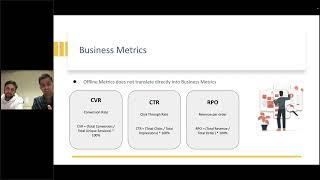
Building Robust and Scalable Recommendation Engines for Online Food Delivery
Unlock the power of recommendation engines for food delivery. Learn data preprocessing, feature engineering, and scalable algorithms to create personalized recommendations using the DHRD dataset.
MLSecOps with Automated Online and Offline ML Model Evaluations on Kubernetes
Explore automated ML model evaluations on Kubernetes, focusing on MLSecOps practices for enhanced security and efficiency in both online and offline scenarios.
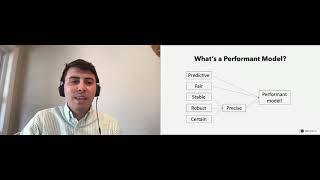
Validate and Monitor Your AI and Machine Learning Models
Discover techniques for validating and monitoring advanced AI and ML models, ensuring long-term performance and business adoption in various industries.
Automated Machine Learning on Azure - Comparing Azure ML Service and Azure Databricks
Explore AutoML on Azure Machine Learning Service and Azure Databricks to quickly build and deploy ML models, reducing time and expertise required for preprocessing and model creation.
Regression Analysis in Machine Learning - Linear Regression - Logistic Regression
Comprehensive exploration of regression analysis, covering linear and logistic techniques. Learn to leverage data relationships for informed decision-making in various business contexts.

Making Sense of Your Data: Statistics and Machine Learning - Lecture 2
Explore advanced statistical techniques and machine learning methods for analyzing complex neutrino data, enhancing your ability to extract meaningful insights from experimental results.
Improving Insights by Utilizing Causal Inference Methods
Explore causal inference methods to de-bias data, approximate incremental improvements, and accelerate insights using propensity score matching and regression discontinuity.

Linear Regression
Explore linear regression concepts, techniques, and applications for data analysis and predictive modeling.
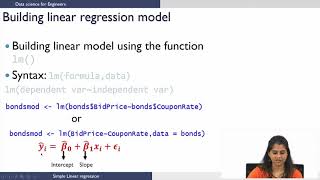
Simple Linear Regression Model Building
Build a simple linear regression model by loading data, exploring its structure, and fitting a regression line, with a comprehensive model summary.
Multiple Linear Regression Model and Application of F Statistics - Part 5
Explore multiple linear regression models and apply F statistics in advanced statistical analysis. Enhance your understanding of complex data relationships and hypothesis testing.
Multiple Linear Regression Model and Application of F Statistics - Part 2
Explore advanced concepts of multiple linear regression and F-statistics, enhancing statistical analysis skills for complex data modeling.
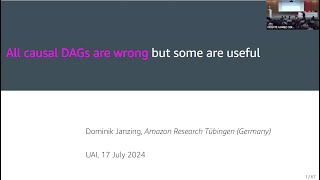
All Causal DAGs Are Wrong but Some Are Useful
Explore the concept of causal DAGs, their usefulness, and challenges in causal discovery. Gain insights into evaluating causal models without ground truth and understanding causality's meaning across various tasks.
Learning to Untangle Genome Assembly Graphs - IPAM at UCLA
Explore deep learning techniques for untangling genome assembly graphs, improving accuracy and efficiency in DNA sequencing without manual intervention.
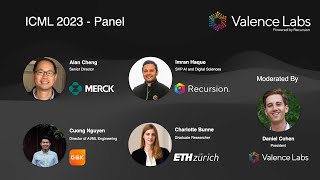
Fostering the Development of Impactful AI Models in Drug Discovery - ICML 2023 Panel
Explore challenges and solutions in bridging academic AI research with real-world drug discovery applications through expert panel insights on benchmarking, data sharing, and industry-academia collaboration.

LLM Performance Analysis: Context Length Failures at 2K Tokens
Explore the limitations of LLM context lengths, performance variations across models, and surprising findings about open-source LLMs outperforming commercial counterparts in 2024.
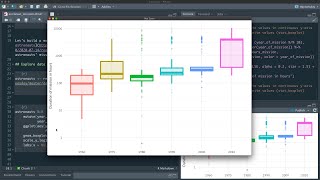
Predict Astronauts' Mission Duration With Tidymodels and Bootstrap Aggregation
Explore astronaut mission duration prediction using R's tidymodels and bootstrap aggregation, featuring data analysis, preprocessing, and model evaluation techniques.