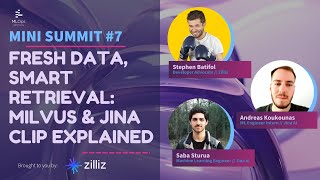
Fresh Data and Smart Retrieval: Milvus and Jina CLIP Explained - MLOps Mini Summit 7
Explore vector database updates, Milvus mechanics, and Jina CLIP's novel multi-task contrastive training for enhanced multimodal and text-based retrieval systems. Master data freshness in high-throughput, low-latency scenarios.
Accelerating Multimodal AI - From Tabular ML to Generative Video Systems
Explore challenges and solutions in multimodal AI, from data management to efficient inference. Learn about systems supporting research and productionization in generative video and language models.
AI Agents for Consumers - The Future of AI and Consumer Empowerment
Explore RealChar's Rivia, an AI application leveraging generative AI and machine learning to handle mundane calls and customer service, freeing human time for meaningful tasks. Gain insights on AI challenges and future prospects.
Why Data Scientists Should Learn Software Engineering Principles
Learn essential software engineering principles for data scientists to improve code quality, modularity, and readability. Enhance project scalability and model deployment capabilities.

AI for Good - Detecting Harmful Content at Scale
Explore AI-driven strategies for detecting harmful online content at scale, optimizing speed and accuracy while addressing cultural sensitivities and evolving challenges in content moderation.
AI Operations Without Fundamental Engineering Discipline - MLOps Podcast #250
Explore the anti-AI hype trend and learn how to bridge the gap between management and tech for effective AI implementation. Gain insights on balancing engineering fundamentals with AI initiatives.
Reliable LLM Products Fueled by Feedback - MLOps Podcast #251
Explore user-centric approaches for reliable LLM products. Learn to convert feedback into actionable insights, analyze root causes, and optimize AI solutions for real-world deployment across various industries.

The Variational Book - Exploring Generative AI and Diffusion Models
Explore the evolution of generative AI, diffusion models, and LLMs with ML scientist Yuri Plotkin as he discusses his upcoming book "The Variational Book" and shares insights on advanced machine learning concepts.

BigQuery as a Feature Store for AI/ML Applications
Discover how to transform BigQuery into an effective feature management system for AI/ML applications. Learn about designing feature tables, addressing challenges, and optimizing workflows without additional software.
Exploring Long Context Language Models - MLOps Reading Group August 2024
Explore the potential of Long-Context Language Models to replace traditional methods like retrieval, RAG, and SQL. Dive into recent research and engage in critical discussions about LCLMs' capabilities and limitations.
Visualize - Bringing Structure to Unstructured Data - MLOps Podcast #258
Explore techniques for structuring and visualizing unstructured data in machine learning, from classification to Retrieval-Augmented Generation, using tools like UMAP and Renumics Spotlight to uncover patterns and evaluate model performance.
Ax: A New Way to Build Complex Workflows with LLMs - MLOps Podcast
Explore Ax, a TypeScript library for building complex LLM workflows. Learn about prompt signatures, tuning, and composable prompts for RAG and agent-powered applications in production environments.
Alignment is Real - Fine-Tuning vs. Prompting in Domain-Specific Tasks
Explore fine-tuning techniques for domain-specific LLMs, discussing strategies for feedback integration, RAG implementation, and AI infrastructure decisions to achieve significant performance improvements.
Azure ML: Pipelines with Python SDK for Data Science and Machine Learning
Create ML pipelines with Azure Machine Learning Studio's Python SDK for efficient data science and machine learning workflows on Azure.
MLOps MLflow: Installing a MLflow Tracking Server in Docker Containers
Install and configure MLflow Tracking Server with MariaDB backend using Docker containers for efficient MLOps workflows.
MLOps MLflow: Time Series Forecasting with SkTime and Prophet
Explore time series forecasting using SkTime and Prophet libraries in MLflow, enhancing your MLOps skills with practical implementation.
MLOps MLflow: Deep Learning Frameworks - PyTorch and TensorFlow Integration
Explore integrating deep learning frameworks Pytorch and Tensorflow with MLflow for enhanced model management and tracking.
MLOps: Integrating HuggingFace Transformers with MLflow
Integrate HuggingFace Transformers with MLflow for efficient MLOps, enhancing model tracking and deployment in machine learning projects.
ML and MLOps with Databricks: LLMs and HuggingFace Transformers
Explore LLMs using HuggingFace Transformers for summarization, translation, sentiment analysis, and advanced prompting techniques on Databricks.
MLOps: Inference ONNX Model in Azure ML Managed Endpoint AKS
Deploy ONNX models to Azure ML Managed Endpoints (AKS) for efficient inference. Learn step-by-step process using Python SDK v2 to optimize machine learning operations.
CPU Inference with ViT ONNX Model in Azure ML Managed Endpoint - AKS
Deploy a Vision Transformer model for CPU inference on Azure Kubernetes Service using ONNX format and Azure ML SDK v2. Learn to create managed endpoints in Azure ML Studio.