From Experimentation to Products - The Production Machine Learning Journey
Explore the journey from ML experimentation to production, covering MLOps, TensorFlow Extended, and pipeline architectures for scalable, maintainable machine learning applications.

Online Safety Bill - How Global Platforms Use MLOps to Keep People Safe
Explore how global platforms use MLOps and AI governance to moderate content and ensure online safety, with insights from social media companies and technology vendors.
MLOps - What's the Deal Behind It?
Explore MLOps, its industry impact, and challenges in real-world AI systems. Learn key strategies for success, including open-source adoption and engineering best practices.
MLOps - Keeping Models from Misbehaving Like Angry Teenagers
Discover strategies to manage and maintain machine learning models in production, ensuring their reliability and performance over time.
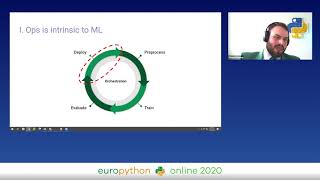
Painless Machine Learning in Production
Discover strategies for efficient machine learning deployment, covering infrastructure, tooling, and best practices for managing the ML lifecycle in production environments.

MLOps - Automated Machine Learning Made Easy
Explore AI and ML optimization techniques to enhance business outcomes through data understanding and model improvement.
Owned By Statistics - How Kubeflow & MLOps Can Help Secure Your ML Workloads
Explore MLOps and Kubeflow to secure machine learning workflows, mitigate risks, and enhance reproducibility, validation, and deployment in production environments.
MLOps at Snapchat - Continuous Machine Learning with Kubeflow & Spinnaker
Explore Snapchat's MLOps journey: transforming manual processes into automated ML pipelines using Kubernetes, Kubeflow, and Spinnaker for continuous integration, delivery, and training in computer vision.
Building MLOps POCs and Sandbox Environments Using k3s and Argo
Explore building MLOps POCs using k3s and Argo. Learn to reduce implementation time and costs for data pipeline automation and ML workflows, with insights on lightweight Kubernetes and Edge Computing.
How to Improve Your Kubernetes Experience with Service Mesh and MLOps
Optimize Kubernetes performance using machine learning and service mesh telemetry. Learn practical cases, model architecture, and data preparation for large-scale private cloud environments.
How Spotify Leverages Flyte to Coordinate Financial Analytics Company-Wide
Explore Spotify's use of Flyte for financial analytics, covering MLOps/DataOps needs, best practices for ML/data apps, and how Flyte bridges technical gaps for users of varying proficiency.
DGL Operator - Distributed Graph Neural Network Training with DGL and K8s
Explore distributed GNN training using DGL and Kubernetes, improving resource utilization and scalability while reducing complexity. Learn about DGL Operator's implementation and future design.
Evaluating Language Models - Challenges and Best Practices
Explore challenges and solutions for evaluating language models, including metrics, datasets, and continuous assessment in production. Learn to address biases and contribute to public evaluation efforts.
Streamlining Model Deployment - AI in Production
Explore strategies for optimizing AI model deployment pipelines, including open governance, runtime benchmarks, and dynamic routing. Learn to make AI deployments faster, cheaper, and more accurate in a rapidly evolving landscape.
Making Sense of LLMOps - Impact, Risk, and Maturity Assessment
Explore LLMOps essentials: impact assessment, risk management, and maturity evaluation. Gain insights on bridging gaps between data science, infrastructure, and IT teams for effective LLM deployment.
Product Thinking in Data and AI
Explore product-centric AI strategy to drive business value. Learn to prioritize customer needs and strategic goals over technology in AI product development.
Navigating the Emerging LLMOps Stack
Explore the emerging LLMOps Stack, including tools and best practices for maximizing LLM potential in organizations. Gain insights from an experienced AI/ML engineering leader.
Evaluating Quality and Improving LLM Products at Scale
Explore techniques for measuring and enhancing LLM output quality at scale. Learn to confidently deploy product changes and consistently improve generative AI products through effective evaluation methods.
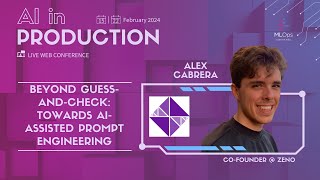
Beyond Guess-and-Check: Towards AI-assisted Prompt Engineering
Explore AI-assisted prompt engineering techniques to improve AI system development. Learn about intelligent "prompt editors" and synthetic data generation to enhance your workflow and move beyond traditional methods.
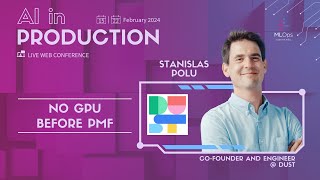
No GPU Before Product-Market Fit - Optimizing AI Startups
Explore Gen AI startup strategies without training models. Learn ecosystem optimization and future trends from Stanislas Polu, co-founder of dust.tt and OpenAI alumnus.
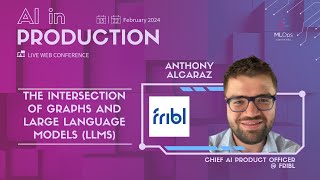
The Intersection of Graphs and Large Language Models - AI in Production
Explore the synergy between graphs and Large Language Models, focusing on Retrieval Augmented Generation Knowledge Graphs and their applications in AI-powered recruitment and ethical hiring practices.