Cloud-Based Generative AI Supporting Preliminary Engineering Design
Optimize engineering design with cloud-based generative AI. Learn how Rolls-Royce and Databricks reduced cGAN training time by 30x using distributed computing, MLflow, and Unity Catalog for aerospace compliance.
Efficient MLOps: Developing and Deploying ML Models with Databricks
Explore efficient MLOps framework design for ML model development and deployment, covering environment management, CI/CD pipelines, and tools like Unity Catalog and MLflow for model monitoring and progression.

Methods for Evaluating Your GenAI Application Quality
Explore comprehensive tools for evaluating GenAI applications, including inference tables, Lakehouse Monitoring, and MLflow. Learn best practices for offline and real-time quality assurance in production environments.
Productionize AI and ML Algorithms in Cloud Environments
Explore AI and ML algorithm productionization in cloud environments. Learn development phases, NLP tasks, Hugging Face, MLflow, and AWS deployment for effective model management and serving.
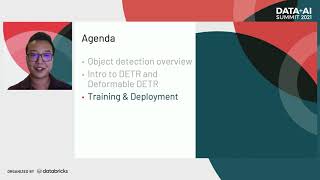
Object Detection with Transformers - From Training to Deployment
Explore cutting-edge object detection using transformers, from fundamental concepts to advanced techniques. Learn scalable training with Determined AI and deployment using MLflow.
Simplifying Model Development and Management with MLflow - New Features and Innovations
Explore MLflow's latest features for simplified experiment tracking, improved model portability, schema management, and faster deployment in machine learning lifecycle management.
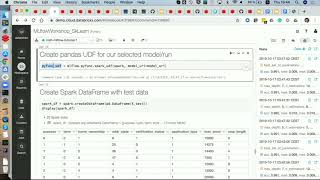
Managing the Complete Machine Learning Lifecycle with MLflow - Part 2
Explore MLflow's capabilities for managing machine learning lifecycles, from data preparation to model deployment, with practical insights on hyperparameter optimization and production workflows.
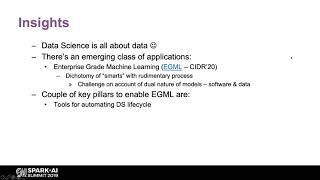
Improving the Life of Data Scientists - Automating ML Lifecycle through MLflow
Explore Flock, an end-to-end platform leveraging MLflow to automate and simplify enterprise-grade machine learning, enhancing data scientist productivity and addressing regulatory challenges in ML adoption.
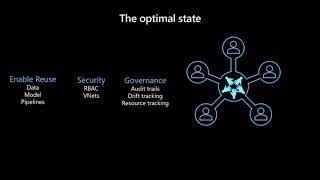
MLflow and Azure Machine Learning - The Power Couple for ML Lifecycle Management
Explore MLflow and Azure Machine Learning integration for streamlined ML lifecycle management, covering versioning, run history, automation, deployment, and CI/CD pipelines in MLOps.
Machine Learning at Scale with MLflow and Apache Spark
Explore Société Générale's journey in scaling machine learning, focusing on MLflow and Apache Spark for production deployment, CI/CD pipelines, and overcoming challenges in large-scale ML implementation.

Introducing MLflow for End-to-End Machine Learning on Databricks
Learn to predict life expectancy using health data with MLflow. Covers data engineering, exploration, model tuning, and deployment on Databricks' unified analytics platform powered by Apache Spark.

Combining Machine Learning and MLflow with Lakehouse Architecture - Data Brew Episode 5
Explore how Quby leverages ML and MLflow with their lakehouse to extract value from IoT sensor data, moving from batch to real-time streaming for energy optimization and customer insights.

MATS Stack for Cross-System Orchestration of Machine Learning Pipelines
Explore the MATS stack for orchestrating ML pipelines across systems, featuring MLFlow, Airflow, Tensorflow, and Spark. Learn how Avast leverages this approach for efficient phishing detection and streamlined ML workflows.
Model Experiments Tracking and Registration Using MLflow on Databricks
Automate ML model experimentation and tracking using MLflow on Databricks. Learn to streamline data preparation, model development, and artifact management for efficient machine learning workflows.
ML Production Pipelines: Building and Deploying a Classification Model
Learn to build and deploy production-ready machine learning pipelines using Python, Databricks, and MLflow. Explore training and prediction workflows, model registration, and deployment options for both batch and on-demand processing.

Productionizing Real-time Serving with MLflow
Explore production-grade MLflow serving: containerization, custom middlewares, monitoring, logging, and performance optimization for high-scale deployment of machine learning models as REST API endpoints.

MLflow at Company Scale - Scaling and Optimizing for High-Volume Machine Learning
Learn how Criteo scaled MLflow to handle massive data volumes, including horizontal scaling, monitoring, SSO integration, and hadoop cluster integration for data scientists.

Taking Machine Learning to Production with MLflow - New Features and Best Practices
Explore MLflow's latest features for productionizing machine learning, including model management, CI/CD, data schemas, and integration with PyTorch for seamless deployment and operation of ML applications.
Taking Deep Learning to Production with MLflow and RedisAI
Explore MLflow and RedisAI integration for efficient deep learning model deployment, featuring multi-framework support, auto-batching, and DAGing capabilities in a reliable runtime environment.
Introducing MLflow for End-to-End Machine Learning on Databricks
Explore end-to-end machine learning with MLflow on Databricks: from data engineering to model deployment, using health data to predict life expectancy through Spark, hyperopt, and interactive dashboards.

Productionizing Machine Learning Pipelines with Databricks and Azure ML
Jumpstart ML projects with Databricks and Azure ML. Learn to build, track, and deploy production-ready pipelines using tools like MLflow, TensorFlow, and PyTorch for efficient, reproducible data science workflows.