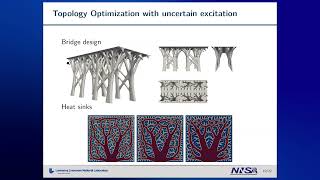
Scalable Design and Optimization with MFEM
Explore scalable design and optimization using MFEM for large-scale scientific simulations. Learn about topology and shape optimization algorithms, gradient-based techniques, and implementation strategies for industrial problems.
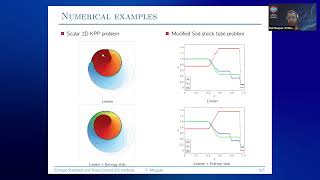
MFEM Workshop 2023 - Student Lightning Talks Part 1
Explore cutting-edge finite element research through student presentations on topics like µFEA, entropy stabilization, Maxwell's equations, and thermo-mechanical solves using MFEM.
MFEM Workshop 2023 - Student Lightning Talks Part 2
Explore cutting-edge research in high-order mathematical calculations for scientific simulations through student presentations on neural networks, GPU acceleration, and Monte Carlo methods.
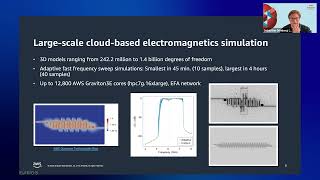
Palace: Parallel Large-scale Computational Electromagnetics - MFEM Workshop 2023
Explore Palace, a parallel finite element code for full-wave electromagnetics simulations, and its capabilities for large-scale 3D modeling in quantum computing hardware design.
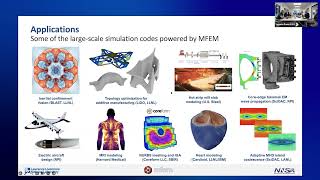
The State of MFEM - Workshop 2023
Explore MFEM's key capabilities, recent developments, and future directions in high-order finite element methods for scientific simulations.
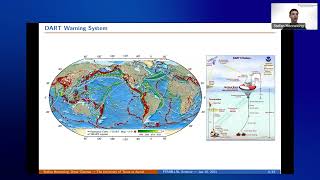
Bayesian Inversion of an Acoustic-Gravity Model for Predictive Tsunami Simulation
Explore Bayesian inversion of acoustic-gravity models for predictive tsunami simulation, focusing on real-time monitoring and early-alert systems using near-field data observation.
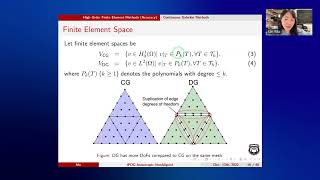
An Efficient and Effective FEM Solver for Diffusion Equation with Strong Anisotropy
Explore an efficient discontinuous Galerkin scheme with auxiliary space preconditioning for solving diffusion equations with strong anisotropy, focusing on magnetic confinement fusion applications.
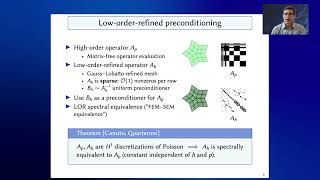
High-Order Solvers and GPU Acceleration for MFEM - Workshop 2022
Explore high-order finite element methods, GPU acceleration, and matrix-free solvers for scientific simulations using MFEM. Learn about low-order-refined preconditioning and adaptive mesh refinement.
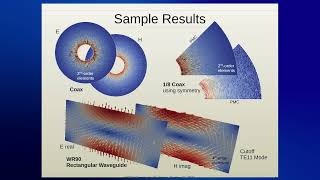
OpenParEM2D: A Free, Open-Source Electromagnetic Simulator for 2D Waveguides and Transmission Lines
Explore OpenParEM2D, a free 2D electromagnetic simulator for guided waves and transmission lines. Learn its capabilities, methodology, and applications in this insightful presentation.
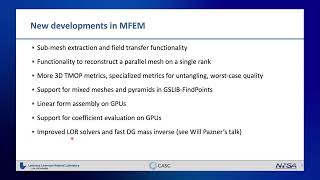
Recent Developments in MFEM - Workshop 2022
Explore recent developments in MFEM, including sub-mesh extraction, GPU-based calculations, and integrations with scientific software libraries for high-order finite element simulations.
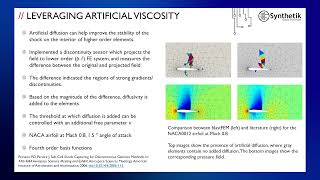
BlastFEM: GPU-Accelerated, High-Performance, Energy-Efficient Solver for Highly Compressible Flows
Explore GPU-accelerated solver for highly compressible flows, enhancing efficiency in scientific simulations across various applications. Learn about blastFEM's capabilities for next-generation computational modeling.
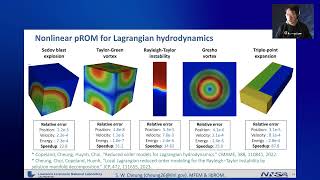
Reduced Order Modeling for Finite Element Simulations with MFEM and libROM
Explore reduced order modeling techniques for finite element simulations using MFEM and libROM. Learn to lower computational complexity while maintaining accuracy in various scientific applications.
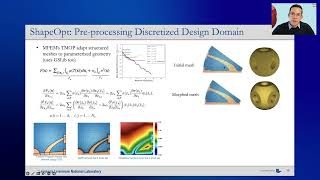
Shape and Topology Optimization Powered by MFEM - Workshop 2022
Explore shape and topology optimization using MFEM and LiDO for high-order calculations in scientific simulations, featuring multi-material geometries and HPC-powered design tools.
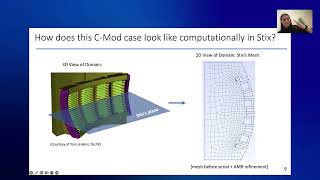
The Development of the EM RF-Edge Interactions Mini-App Stix Using MFEM
Explore electromagnetic RF-edge interactions in fusion devices using MFEM. Develop a parallelized cold-plasma wave equation solver with non-linear sheath impedance boundary conditions for accurate simulations.
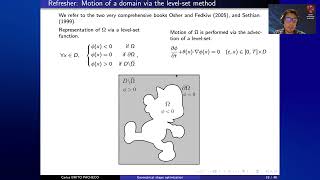
Rodin: Density and Topology Optimization Framework - MFEM Workshop 2022
Explore Rodin, a C++17 framework for shape, density, and topology optimization. Learn its functionalities, from refining shapes to solving variational problems in scientific simulations.
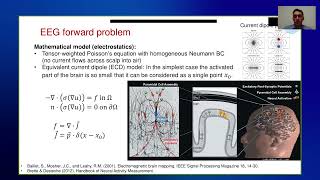
Solution of the Electroencephalography Forward Problem Using MFEM - Workshop 2022
Explore high-order mathematical calculations for EEG source localization using MFEM. Learn to solve the EEG forward problem with patient-specific geometry and tissue conductivity from medical images.
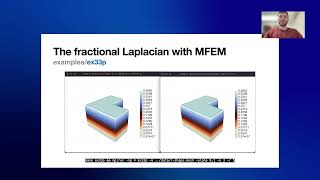
Stochastic Fractional PDEs: Random Field Generation and Topology Optimization - MFEM Workshop 2022
Explore stochastic fractional PDEs, Gaussian random fields, and topology optimization using MFEM. Learn numerical solutions and applications in scientific simulations and additive manufacturing.
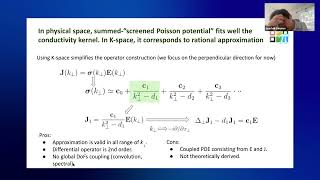
Radio-Frequency Wave Simulation in Hot Magnetized Plasma - MFEM Workshop 2023
Explore advanced radio-frequency wave simulation techniques in hot magnetized plasma, focusing on innovative approaches to construct dielectric operators with all-order finite Larmor radius effects.
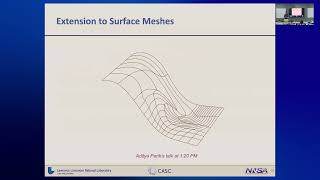
Interpolation at Arbitrary Points in High-Order Meshes on GPUs
Discover advanced techniques for arbitrary point interpolation in high-order mesh computations, focusing on GPU optimization and parallel processing for efficient scientific simulations.
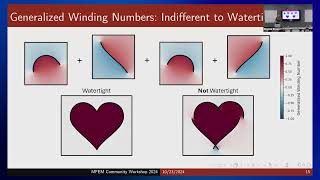
Robust Containment Queries over Collections of Parametric Curves via Generalized Winding Numbers
Discover advanced geometric containment query techniques for 2D regions using rational Bezier curves and generalized winding numbers, enabling efficient multiphysics simulations without expensive refinement processes.
Automatic Parameter Sensitivities in Serac for Engineering Applications
Discover how to leverage automatic parameter sensitivities in Serac for engineering applications, featuring robust nonlinear solvers, coupled thermal-mechanics, and differentiable material models for optimization workflows.