
A Numerical Toolkit for the Likelihood Correspondence
Explore numerical methods for analyzing likelihood correspondences in statistical models, focusing on applications in enumerative geometry and algebraic statistics.
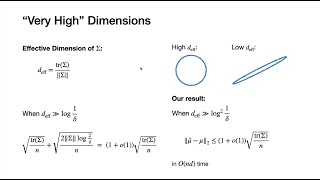
Mean and Location Estimation with Optimal Constants - UW Madison
Explore advanced statistical techniques for mean and location estimation, focusing on finite sample theories and optimal constants in high-dimensional regimes.

Multinomial Regression Model - Part I: Introduction to MRM and Multinomial Logit Model
Explore multinomial regression models, including types and the multinomial logit model. Learn key concepts and applications in statistical analysis.
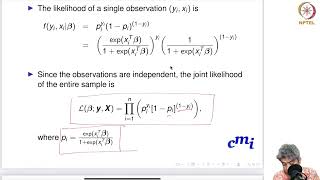
Maximum Likelihood Estimate for Logistic Regression
Explore maximum likelihood estimation for logistic regression, covering likelihood functions and gradient descent techniques.
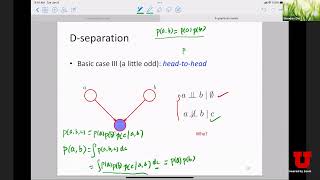
Probabilistic Graphical Models and Maximum Likelihood Estimation - Lecture 13
Dive into probabilistic graphical models, exploring likelihood estimation, Gaussian models, and network structures while learning to analyze real-world data using conditional independence concepts.
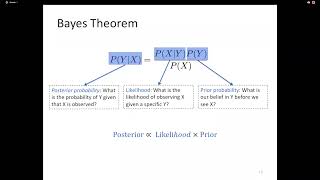
Bayesian Learning and Maximum Likelihood Methods - Lecture 23
Explore probabilistic learning criteria through maximum a posteriori and maximum likelihood examples, enhancing your understanding of Bayesian learning fundamentals.
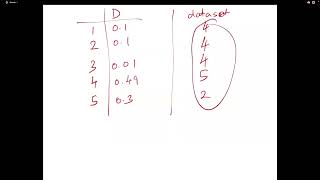
Logistic Regression - Machine Learning Lecture 25
Dive into logistic regression classification, exploring maximum likelihood, posterior criteria, and loss minimization principles for effective machine learning model development.
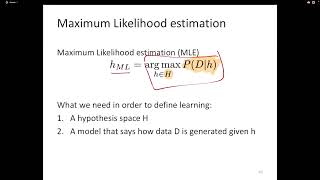
Bayesian Learning: Maximum A Posteriori and Maximum Likelihood - Lecture 24
Delve into Bayesian learning principles, exploring maximum a posteriori and maximum likelihood learning criteria through practical examples and comprehensive demonstrations.
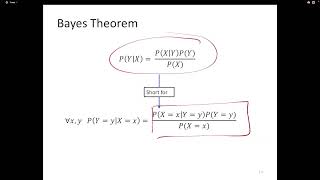
Bayesian Learning and Maximum Likelihood Methods - Lecture 23
Explore probabilistic learning criteria through maximum a posteriori and maximum likelihood approaches, with practical examples of Bayesian learning applications.
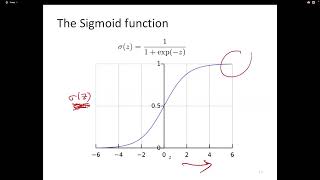
Logistic Regression - Machine Learning Lecture 24
Master logistic regression classification through maximum likelihood and maximum a posteriori criteria, building practical skills for effective machine learning model development.
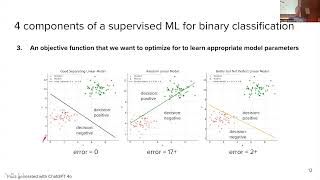
Machine Learning Foundations - Logistic Regression
Master logistic regression fundamentals through hands-on practice, exploring core concepts, implementation techniques, and practical applications in machine learning and data analysis.
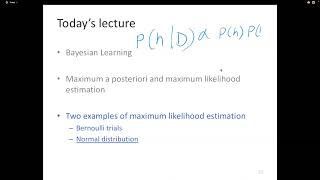
Maximum Likelihood Estimation for Regression in Machine Learning - Lecture 24
Dive into maximum likelihood estimation for regression through practical examples and explore its connection to loss minimization in Bayesian learning frameworks.
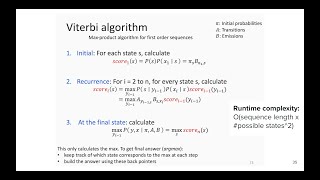
Hidden Markov Models - Parameter Estimation and Efficient Inference
Master parameter estimation and efficient inference techniques for Hidden Markov Models, exploring key algorithms and mathematical foundations for probabilistic sequence modeling and pattern recognition.
Wasserstein Distributionally Robust Optimization - Theory and Applications in Machine Learning
Explore Wasserstein distributionally robust optimization theory and its applications in machine learning, focusing on data-driven decision-making under uncertainty and statistical learning.
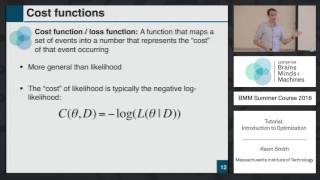
Introduction to Optimization
Learn optimization techniques for machine learning, including likelihood estimation, gradient descent, and regularization, with practical examples and applications.

Statistical Applications of Wasserstein Gradient Flows
Explore statistical applications of Wasserstein gradient flows in optimal transport, covering Otto calculus, Riemannian structures, and applications to variational inference and Gaussian mixture models.
Probabilistic Methods for Classification - 2009
Explore probabilistic methods for classification, covering supervised learning, estimation, and advanced models like Naive Bayes, Maximum Entropy, and Conditional Random Fields.
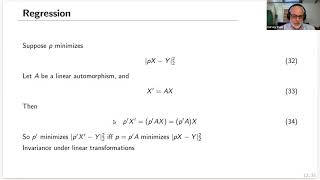
Model Invariants and Functional Regularization
Explore model invariants and functional regularization in quantitative finance. Learn about regression, MLE, Bayesian estimation, and new approaches to improve model robustness and interpretability in data analysis.
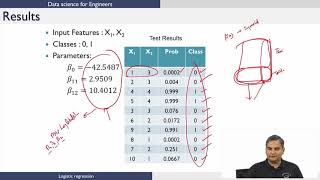
Logistic Regression - Continued
Explore advanced concepts and applications of logistic regression for enhanced predictive modeling and data analysis skills.
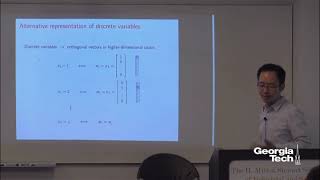
Projected Power Method: An Efficient Algorithm for Joint Discrete Assignment - Lecture 3
Explore an efficient algorithm for joint discrete assignment using projected power method. Learn about low-complexity procedures, optimization techniques, and statistical models for solving discrete assignment problems.
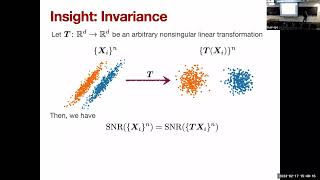
Clustering a Mixture of Gaussians with Unknown Covariance - Lecture
Explore clustering with Gaussian mixtures, focusing on maximum likelihood estimation, Max-Cut solutions, and efficient algorithms. Investigate statistical-computational gaps and challenges in high-dimensional settings.