
Modeling and Rendering a Sci-Fi Drone in Maya
Master 3D modeling in Maya by creating a sci-fi drone from scratch, focusing on proper topology techniques and Arnold material rendering for professional-quality results.

Topology Workflow and 3D Modeling in Maya - Creating Shapes and Details
Master essential topology techniques and 3D modeling workflows in Maya, from basic shape creation to intricate microdetail development for hard surface modeling.

Complex Shapes in 3D Modeling - A Beginner's Guide
Master essential techniques for breaking down and modeling complex 3D shapes, from initial analysis to practical implementation, helping you tackle challenging geometric structures with confidence.

5 Essential Hard Surface Modeling Tips in Blender
Master essential hard surface modeling techniques in Blender with time-saving tips and professional workflows to streamline your 3D modeling process and boost efficiency.

Geometry, Arithmetic, and Dynamics of Discrete Groups - Lecture 11
Explore fundamental concepts in discrete group theory, focusing on geometric principles, arithmetic relationships, and dynamic behaviors in mathematical structures.

Atoms Interlinked by Light - From Quantum Metrology to Topology
Delve into quantum interactions between atoms and light, exploring cutting-edge developments in quantum metrology, topology, and atomic interfaces through advanced experimental platforms and theoretical frameworks.

Vulkan 1.3 Support for Apple M1 with Advanced Graphics Features
Dive into advanced Vulkan 1.3 implementation on M1, exploring geometry shaders, tessellation, and transform feedback with practical demonstrations and technical insights.
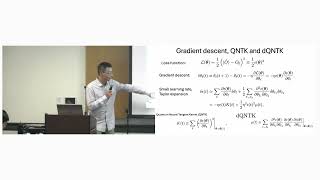
Dynamical Transition in Controllable Quantum Neural Networks with Large Depth
Delve into quantum neural networks' training dynamics, exploring transcritical bifurcation transitions, Lotka-Volterra equations, and experimental validations on IBM quantum devices.
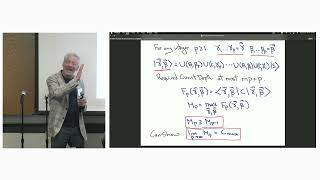
Quantum Approximate Optimization Algorithm (QAOA) - Recent Advances and Performance Updates
Delve into quantum optimization through QAOA, exploring its performance guarantees, supremacy capabilities, and recent breakthroughs in parameter selection for MaxCut problems on 3-regular graphs.
Introduction to R for Data Analysis - 2024
Gain insights into R programming fundamentals for medical and population genetics data analysis through expert-led discussions of essential concepts and practical applications.
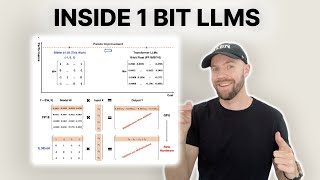
Understanding 1-Bit Large Language Models - From Theory to Implementation
Dive into the revolutionary concept of 1-bit Large Language Models, exploring how weights can be represented with simple integers (0, 1, -1) instead of complex floating-point numbers.

Understanding Text Generation Through Diffusion Models - From Theory to Implementation
Dive into discrete diffusion modeling for text generation, exploring probability distributions, score-based modeling, and practical applications in generative AI that rival GPT-2's capabilities.
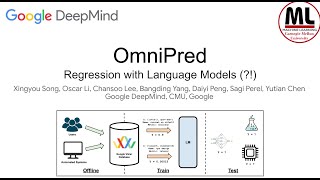
OmniPred - Towards Universal Regressors with Language Models
Explore groundbreaking research on OmniPred's innovative approach to using language models as universal regressors, demonstrating superior performance over traditional regression methods across diverse experiments.

Coresets and Decision Trees for Machine Learning Optimization
Discover how coresets can optimize decision tree algorithms, boost computation speed by 10x, and maintain accuracy in machine learning applications through geometric partitioning techniques.
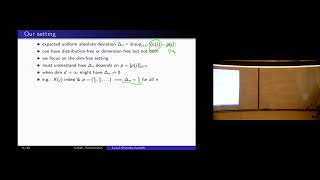
Local Glivenko-Cantelli: Estimating the Mean in Infinite Dimensions
Delve into advanced statistical theory exploring mean estimation in infinite dimensions, focusing on Local Glivenko-Cantelli bounds and maximal deviation analysis for Boolean cube distributions.
Mean Estimation in High-Dimensional Binary Markov Gaussian Mixture Models
Delve into high-dimensional mean estimation in binary Markov Gaussian mixture models, exploring how memory in data affects estimation error and the interplay between sample size, dimension, and signal strength.
A Deep Computational Phenomenology of MPE as Metacognitive Free Energy Optimization
Explore the computational modeling of minimal phenomenal experience through Bayesian mechanics and free energy principles, examining belief dynamics and metacognitive processes.
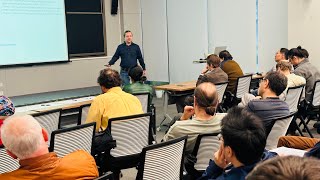
Double Affine Hecke Algebras Beyond Genus Zero
Delve into advanced mathematical concepts of Double Affine Hecke Algebras and their applications beyond genus zero, presented by mathematics expert Dr. Arthamonov.
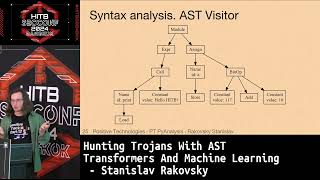
Hunting Trojans with AST Transformers and Machine Learning
Discover advanced techniques for detecting malicious Python projects using AST Transformers and machine learning, focusing on obfuscation methods and countermeasures in cybersecurity.
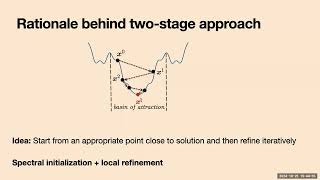
Non-convex Matrix Sensing: Breaking the Quadratic Rank Barrier in Sample Complexity
Explore groundbreaking research on non-convex matrix sensing, focusing on improved algorithms for reconstructing low-rank matrices using fewer samples through innovative probabilistic decoupling methods.

Computational Phenomenology, Mathematical Phenomenology and Pre-Reflective Self-Awareness
Explore the intersection of computational and mathematical phenomenology, examining methodological foundations and their application to pre-reflective self-awareness in consciousness studies.