Designing Topological Quantum Matter
Explore the design principles of topological quantum matter and their applications in advanced quantum materials research.
New Insights on the Quantum Hall Transition Problem
Explore new perspectives on the quantum Hall transition, delving into advanced concepts in quantum materials and electron correlations.
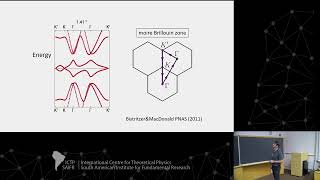
Interacting Hofstadter Spectrum of Twisted Bilayer Graphene
Explore the interacting Hofstadter spectrum in twisted bilayer graphene, examining strong electron correlations, inhomogeneities, frustration, and topology in quantum materials.

Respect Estimates: Recognizing and Eliminating Software Development Cults
Explore common software development pitfalls, including misguided practices in estimation, testing, and architecture. Learn to identify and eliminate ineffective "cults" in your projects.
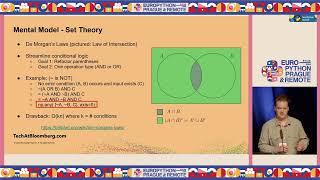
Vectorization Techniques for 1000x Python Speedups - No C or Spark Required
Discover techniques for achieving 1000x speedups in Python through vectorization, matrix operations, and creative optimization strategies. Learn to apply these methods to complex financial and ESG computations.
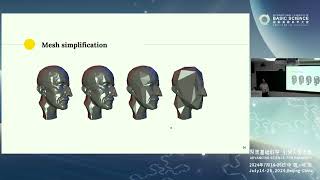
MeshCNN: A Network with an Edge for 3D Shape Analysis
Explore MeshCNN, a neural network designed for triangular meshes, leveraging edge-based operations for efficient 3D shape analysis and task-driven feature extraction.
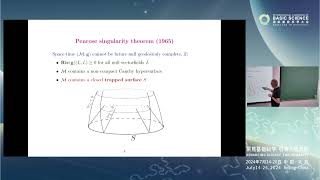
The Resolution of the Bounded L^2 Curvature Conjecture in General Relativity
Explore the resolution of the bounded $L^2$ curvature conjecture in general relativity, examining minimal curvature tensor assumptions for controlling Einstein equation space-times.
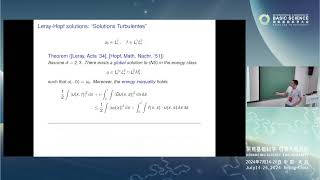
Instability and Non-Uniqueness in Fluid Dynamics
Explore instability and non-uniqueness in fluid dynamics, focusing on Leray solutions to Navier-Stokes equations and Vishik's findings on 2D Euler systems.
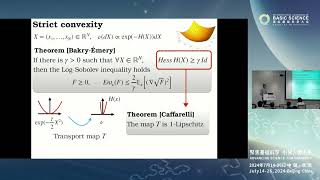
A Renormalisation Group Perspective on Functional Inequalities - ICBS 2024
Explore multiscale analysis for decomposing high-dimensional measures, deriving functional inequalities using renormalization group methods in statistical physics.
Nullstellensatz-Inspired Algorithms for Certifying Entanglement of Subspaces
Explore Nullstellensatz-inspired algorithms for certifying entanglement in quantum subspaces. Delve into computational techniques, applications, and extensions to general varieties.
A Canonical Form for Tensor Networks
Découvrez une forme canonique pour les réseaux de tenseurs, basée sur la théorie des invariants géométriques. Explorez ses applications potentielles, notamment pour améliorer la confidentialité dans l'apprentissage automatique.
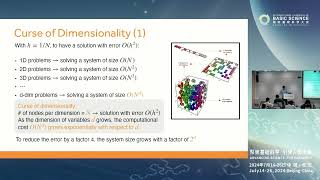
Solving High-Dimensional Partial Differential Equations Using Deep Learning
Explore deep learning algorithms for solving high-dimensional PDEs, overcoming dimensionality challenges in scientific computing applications.
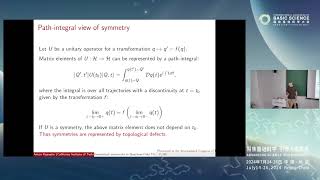
Generalized Symmetries in Quantum Field Theory and Condensed Matter Physics
Explore generalized symmetries in quantum field theory and their applications in high-energy and condensed matter physics, emphasizing locality and observables.
Scaling Structured Concurrency with Async Python
Discover how to leverage async Python for structured concurrency, exploring error handling, timeouts, and cancellation while learning to write elegant concurrent code using tools like flake8-trio and dynamic analysis.
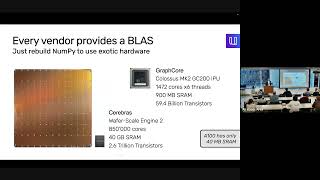
Fantastic Data Science Libraries and Where to Use Them
Discover high-performance alternatives to popular data science libraries, exploring GPU acceleration, distributed computing, and optimization techniques for faster data processing in Python.
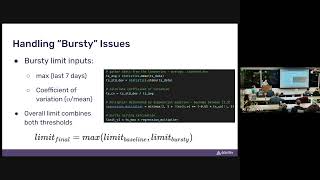
Timeseries Analysis for Issue Volume Detection and Escalation
Discover how to build and implement an escalating issues algorithm for effective signal-to-noise management in data feeds, with practical strategies and implementation insights from Sentry's data team.
Accurate Summary-based Cardinality Estimation Through the Lens of Cardinality Estimation Graphs
Explore advanced cardinality estimation techniques for graph databases, focusing on optimistic and pessimistic estimators through cardinality estimation graphs and their practical applications in query optimization.
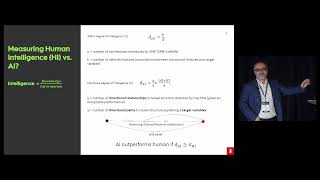
Explainable Machine Learning in Finance - When Machines Surpass Human Intelligence
Explore causal and counterfactual explainability in AI/ML models for finance, addressing challenges when machines surpass human intelligence in complex, high-risk applications.

How to Steal ChatGPT's Embedding Size and Other Low-rank Logit Tricks
Uncover hidden information about API-protected LLMs through low-rank logit analysis. Learn to estimate embedding sizes, audit model updates, and identify source models efficiently.

Orthotope - APL-Inspired Arrays for Haskell - Lambda Days 2022
Explore Orthotope, a Haskell library for multi-dimensional arrays inspired by APL. Learn efficient structural operations, clever array representation, and various implementations for different storage and typing needs.

Pride & Prejudice & C#
Explore machine learning in C# to generate a new Jane Austen novel using Markov Chains, demonstrating practical applications for .NET developers beyond literature.