Finding the Length of a Cycle in Quantum Factoring Algorithm - Lesson 85
Explore how the quantum Factoring algorithm's main task can be rephrased as finding the length of an exponentially long directed cycle in quantum computing.
One Steering Wheel Vector for IncrL - Lesson 89
Explore IncrL's 2-D rotation planes and discover the first vector in this advanced quantum programming lesson, part of a comprehensive series.
All the Planes of Rotation for IncrL - Quantum Computer Programming - Lesson 91
Explore all 2-D rotation planes for the Increment-mod-L operator in quantum computing, advancing understanding of quantum operations and transformations.

Privacy-Friendly Applications with Ollama, Vector Functions, and LangChainJS
Explore building privacy-focused AI applications using Ollama for local LLMs, vector functions for efficient searches, and LangChainJS for versatile agents, ensuring data stays on your device.

Introduction of TulipaEnergyModel.jl - Optimization Model for Energy Markets
Optimization model for electricity markets and energy sectors using graph theory and flexible time resolution, enhancing adaptability and efficiency in large-scale energy system modeling.
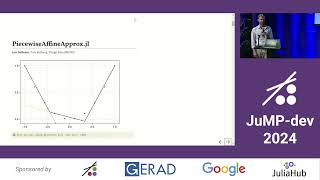
PiecewiseAffineApprox.jl - Automated Piecewise Affine Convex Approximations for Optimization Models
Explore piecewise affine convex approximations for optimization models using PiecewiseAffineApprox.jl, featuring flexible options and methods for best-fit calculations in Julia.

Differentiating Parametric JuMP Models in Julia
Explore differentiating parametric JuMP models, combining DiffOpt and ParametricOptInterface for efficient optimization and parameter sensitivity analysis in Julia.
Solving Matching Problems in Practical Applications Using JuMP
Optimize supply chain matching with JuMP: Efficiently model connections in transportation networks, balancing idle times, delays, and resource allocation for improved performance and robustness.
Teaching Optimization: Comparing cvxpy, pyomo, and JuMP
Explore convex optimization modeling frameworks, comparing cvxpy, pyomo, and JuMP. Learn about common student challenges and how JuMP addresses them in undergraduate and graduate courses.
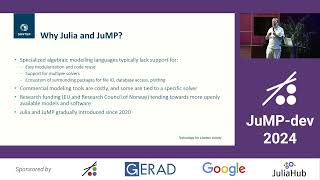
Applied Optimization with JuMP at SINTEF
Explore JuMP for flexible optimization modeling at SINTEF, focusing on hydrogen infrastructure and circular logistics. Learn about complementary packages enhancing JuMP's functionality.
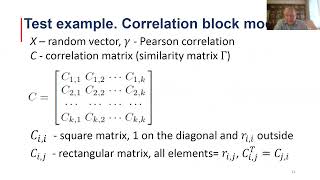
Uncertainty of Clustering in Networked Markets
Explore the complexities of clustering in networked markets, focusing on uncertainty factors and their implications for market analysis and decision-making.
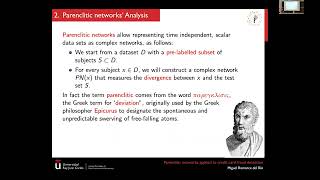
Parenclitic Networks Applied to Credit Card Fraud Detection
Explore innovative fraud detection techniques using parenclitic networks in credit card transactions, enhancing financial security through advanced data analysis.
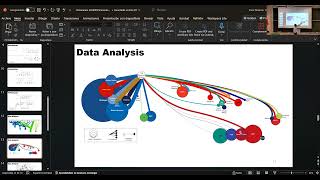
Bicliques and Systemic Risk in Global Banks Bipartite Networks
Explore systemic risk in global banking networks through biclique analysis, uncovering interconnections and potential vulnerabilities in the financial system.

Building a Legacy on My Dash
Inspiring talk on overcoming adversity, defying statistics, and creating a meaningful life legacy despite challenges. Encourages goal-setting, fighting for deserved opportunities, and becoming agents of change.
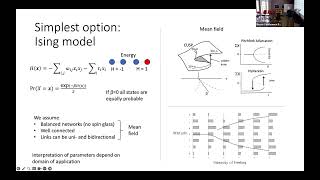
Modeling Psychological Systems with Ternary Spin Models
Explore how ternary spin models enhance psychological research by extending binary network models to include neutral states, offering richer dynamics for analyzing depression, intelligence, and attitude changes.
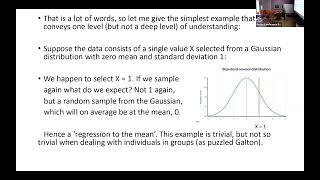
Understanding and Misunderstanding Models - From Linear Regression to Complex Systems
Explore the complexities of scientific modeling, from linear regression to complex systems, examining different levels of understanding and the challenges of explanation in scientific communication.

History of Non-Euclidean Geometry
Explore the fascinating evolution of non-Euclidean geometry through five episodes, covering sacred geometry, historical quests, mathematical challenges, and its impact on our understanding of the world.
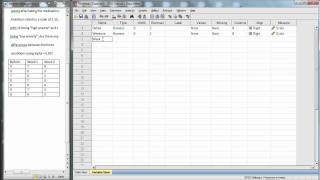
SPSS
Learn essential statistical techniques using SPSS, including ANOVA, regression, t-tests, and descriptive statistics for effective data analysis and interpretation.

What Is Quantum Machine Learning?
Friendly introduction to quantum computing and machine learning, covering qubits, quantum gates, entanglement, and their applications in generative modeling and optimization.

A Friendly Introduction to Deep Learning and Neural Networks
Explore neural networks and deep learning concepts, from gradient descent to activation functions, in this friendly introduction to AI fundamentals.

A Friendly Introduction to Machine Learning
Explore key machine learning algorithms through clear examples, from linear regression to neural networks and clustering techniques, in this beginner-friendly introduction.