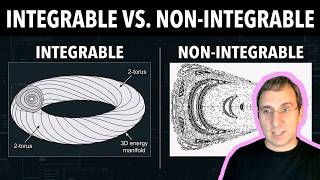
Integrable and Non-Integrable Hamiltonian Systems - KAM Tori - Poincare Sections - Poisson Brackets
Explore integrable and non-integrable Hamiltonian systems, KAM theory, Poincaré sections, and Poisson brackets in this advanced dynamics lecture, offering insights into complex nonlinear systems and their behavior.

The Monty Hall Problem
Explore the Monty Hall Problem through JavaScript and p5.js, learning probability concepts, DOM manipulation, and coding techniques while building an interactive simulation.

Coding a 3D Fractal
Learn to visualize the 3D Mandelbulb fractal using Processing (Java). Explore triplex numbers, spherical coordinates, and point cloud rendering techniques to create stunning fractal visualizations.
Spring Forces
Learn to simulate spring forces using vectors and create oscillating motion in p5.js. Explore Hooke's Law, particle systems, and advanced techniques for realistic spring animations.
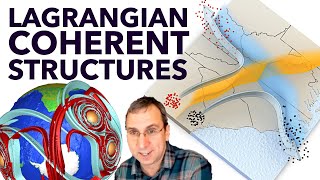
Lagrangian Coherent Structures Introduction
Explore Lagrangian coherent structures in fluid flows, revealing particle transport patterns. Learn theoretical foundations and applications in fluid mechanics, with insights on reduced order modeling.
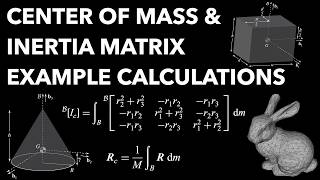
Center of Mass and Moment of Inertia Matrix - Example Calculations
Example calculations for center of mass and moment of inertia matrix in space vehicle dynamics. Covers planar rigid bodies, composite shapes, and practical applications using integrals and common approximation methods.

Euler Angle Simulation with MATLAB - Integrating the Rotational Kinematic Differential Equations
Simulate rigid body orientation using Euler angles and MATLAB. Learn to integrate kinematic differential equations, visualize results, and explore alternative attitude coordinates like quaternions.
Quaternions for Rotation, Axis-Angle, Euler Parameters - MATLAB Examples - Rodrigues Rotation Formula
Explore quaternions, axis-angle representation, and Euler parameters for 3D rotations. Learn to calculate and convert between different rotation formats using MATLAB examples and tutorials.
Hamilton-Jacobi Theory - Finding the Best Canonical Transformation + Examples
Explore Hamilton-Jacobi theory for optimal canonical transformations in Hamiltonian systems. Learn to solve the Hamilton-Jacobi equation and apply it to oscillators and central force problems.
Worked Example of 2 Particle System - MATLAB Tutorial - Implications of Energy and Momentum Conservation
Detailed analysis of a two-particle spring system, exploring conservation laws and using MATLAB to solve complex dynamics problems in space vehicle motion.
Generating Function of a Canonical Transformation - Examples and the Big Picture
Explore generating functions for canonical transformations in Hamiltonian systems. Learn about harmonic oscillator examples, near-identity transformations, and connections to quantum mechanics and gauge invariance.
Principle of Least Action and Lagrange's Equations of Mechanics - Basics of Calculus of Variations
Explore variational principles in mechanics, including the Principle of Least Action and Lagrange's equations. Learn calculus of variations techniques and their applications in physics and engineering problems.
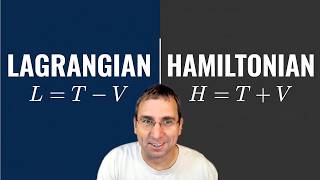
Hamiltonian Systems Introduction - Why Study Them?
Explore Hamiltonian systems and their advantages in mechanics. Learn about generalized momentum, canonical equations, and the transformation from Lagrangian to Hamiltonian formalism.
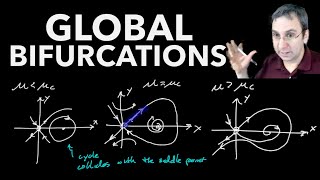
Bifurcations in 2D, Part 4 - Global Bifurcations, Limit Cycle Creation - Homoclinic Bifurcation
Explores global bifurcations in 2D systems, focusing on limit cycle creation through saddle-node, SNIPER, and homoclinic bifurcations. Examines universal behaviors and applications to biological systems.
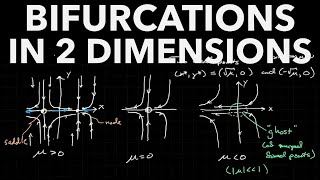
Bifurcations in 2D, Part 1 - Introduction, Saddle-Node, Pitchfork, Examples
Explore bifurcations in 2D systems, including saddle-node and pitchfork types. Learn how fixed points and closed orbits change with parameter variations, using examples from genetic regulatory systems.
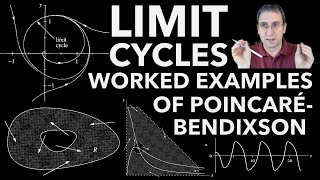
Limit Cycles - Poincare-Bendixson Worked Examples: Glycolysis
Explore Poincaré-Bendixson theorem applications in limit cycle analysis, including a glycolysis model. Learn to construct trapping regions using nullclines and understand parameter spaces for stable limit cycles.
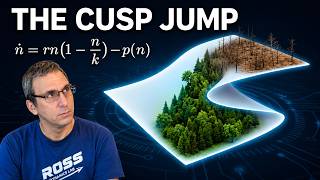
Insect Outbreak Model - A Cusp Catastrophe Population Dynamics Example
Explore insect outbreak modeling using cusp catastrophe theory, analyzing population dynamics, fixed points, and bifurcations in a budworm-fir tree ecosystem.
Rubik's Cube Part 2
Simulate Rubik's Cube face rotations using matrix operations and refactor code with a separate Face class, building on previous concepts to create a more advanced 3D puzzle simulation.

Starting Series on Neural Networks
Comprehensive introduction to neural networks, covering multi-layer perceptrons and essential linear algebra concepts for building a neural network library from scratch.
Forward and Inverse Kinematics
Explore forward and inverse kinematics, create tentacle-like creatures, and learn about polar coordinates in this interactive coding session with hands-on challenges and community showcases.

Searching for Digits in Pi
Explore coding techniques to search for specific digit sequences within Pi's infinite decimal expansion, combining mathematics and programming in an engaging project.