The Adoption of Blockchain-Based Decentralized Exchanges
Explore decentralized finance exchanges, focusing on Automated Market Makers. Learn about their market structure, pricing functions, and impact on liquidity providers and arbitrageurs through game theory and data analysis.
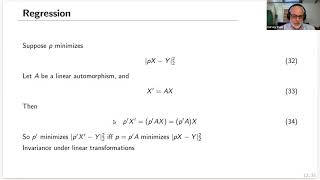
Model Invariants and Functional Regularization
Explore model invariants and functional regularization in quantitative finance. Learn about regression, MLE, Bayesian estimation, and new approaches to improve model robustness and interpretability in data analysis.
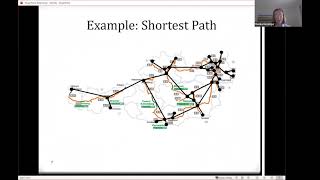
Dynamic Graph Algorithms and Their Implementation
Explore recent advances in dynamic graph algorithms, covering theoretical analysis and empirical evaluations for efficiently handling edge deletions and insertions in evolving graph models.
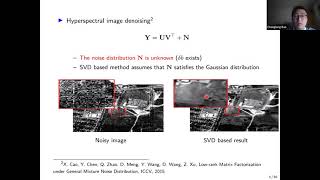
Learning Robust Imaging Models without Paired Data
Explore robust imaging models using Bayesian inference and deep learning without paired data. Learn techniques for image denoising, segmentation, and unpaired degradation modeling in practical applications.
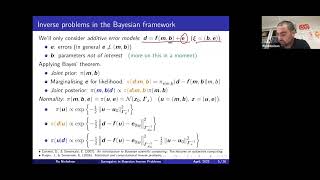
On the Use of Linear Surrogate Models for Bayesian Inverse Problems
Explore efficient Bayesian inverse problem solutions using linear surrogate models. Learn about model discrepancy, Gaussian priors, and applications in high-dimensional PDE discretization problems.
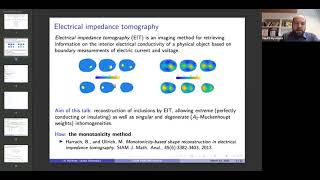
Monotonicity Method for Extreme, Singular and Degenerate Inclusions in Electrical Impedance Tomography
Explores advanced mathematical techniques for electrical impedance tomography, focusing on the monotonicity method's application to extreme, singular, and degenerate inclusions in conductivity reconstruction.
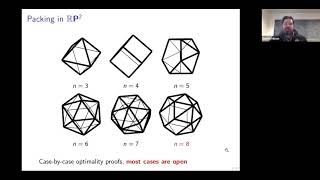
Packing Points in Projective Spaces
Explore optimal point arrangements in projective spaces, surveying current research and open problems in this fundamental area of metric geometry with applications in digital communication.
Modelling, Upscaling and Simulation of Dissolution and Precipitation in a Porous Medium with an Evolving Pore-Scale Geometry
Explore modeling and simulation of dissolution and precipitation in porous media, focusing on evolving pore-scale geometry and its impact on Darcy scale properties. Learn upscaling techniques and numerical approaches.
Essentials of Math Modeling - Introduction to Regression and Statistical Ideas
Explore linear regression, data transformations, and statistical concepts in mathematical modeling. Learn MATLAB examples, sensitivity analysis, and problem-solving techniques for real-world applications.
Essentials of Math Modeling - Session 5 - Probabilistic Models
Explore probabilistic models, including Markov chains and Metropolis-Hastings algorithm, with practical exercises and problem-solving sessions using MATLAB for mathematical modeling applications.
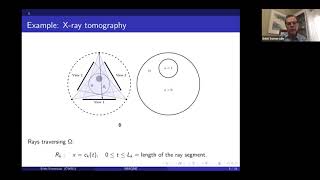
Imaging with Unstructured Adaptive Meshes
Explore adaptive mesh techniques for imaging problems, focusing on finite element methods and mesh adaptation to improve resolution and computational efficiency in PDE solutions.
Essentials of Math Modeling - Model for Disease Spread, Difference, and Differential Eqs
Explore mathematical modeling for disease spread using difference and differential equations. Learn stage-structured models, solution methods, and practical applications through examples and problem-solving sessions.
Essentials of Math Modeling - Intro to Data Analysis Using MATLAB and Excel
Learn data analysis techniques using MATLAB and Excel, covering SI models, plotting, data importing, and problem-solving with real-world examples from mathematical modeling challenges.
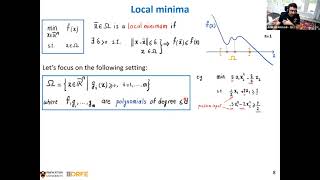
Local Minima, Stable Sets, and Sums of Squares
Explore polynomial optimization complexity, local minima, stable sets, and sum of squares polynomials. Uncover connections between graph theory and algebra in this advanced mathematical presentation.

Stochastic Games on Large Graphs in Mean Field and Sparse Regimes
Explore stochastic games on large graphs, focusing on mean field and sparse regimes. Learn about linear-quadratic models, graph-based player interactions, and large-scale asymptotics in dense and sparse scenarios.
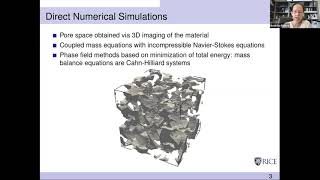
Bound-Preserving Numerical Solutions of Variable Density Two-Phase Flows
Explore efficient numerical methods for solving phase-field models in pore-scale flows, focusing on bound-preserving solutions and applications in energy and environmental sciences.

Solutal Convection in Porous Media
Explore solutal convection in porous media, challenging conventional theories with experimental findings and numerical simulations to understand flux patterns and mixing processes.
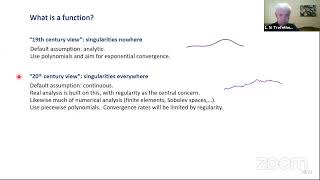
Rational Functions
Explores recent advances in rational approximation theory for numerical computation, focusing on "AAA" and "lightning" algorithms for solving PDEs in complex domains with singularities.

Machine Learning - Dynamical, Statistical, and Economic Perspectives
Explore machine learning's decision-making aspects, focusing on statistical and economic challenges in multiple decision-making, scarcity, and competition through dynamical systems perspectives.

Discrete Reduced Models for Flow in Porous Media
Explore reduced models for porous media flow, focusing on simple models, interfaces, and intersection fractions with practical examples and applications.
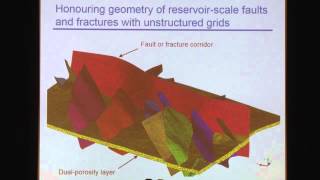
Numerical Simulation of Fractured Reservoirs
Explore advanced techniques for simulating fractured reservoirs, including dual-porosity models, unstructured grids, and probabilistic approaches to enhance flow prediction and reservoir management.