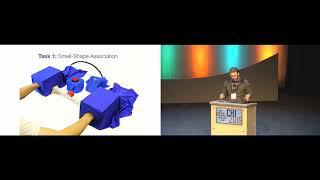
Like Popcorn - Crossmodal Correspondences Between Scents, 3D Shapes and Emotions in Children
Exploring how children associate emotions with scents and 3D shapes, revealing crossmodal connections that can enhance multisensory interactive technologies for more inclusive design experiences.
Detecting Discriminatory Risk through Data Annotation Based on Bayesian Inferences
Explore Bayesian inference techniques for detecting discriminatory risk in data annotation, enhancing fairness and accountability in machine learning systems.
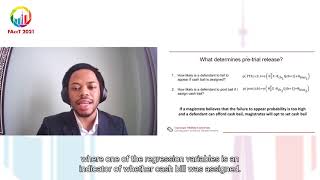
A Bayesian Model of Cash Bail Decisions
Explore a Bayesian approach to modeling cash bail decisions, examining the factors influencing judicial determinations and their implications for fairness in the criminal justice system.
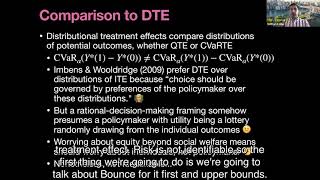
Treatment Effect Risk - Bounds and Inference
Explore bounds and inference in treatment effect risk analysis, focusing on statistical methods for causal inference and risk assessment in experimental studies.
Post-Quantum Cryptography - Today's Defense Against Tomorrow's Quantum Hackers
Explore post-quantum cryptography's role in defending against future quantum hackers, covering motivations, challenges, and practical implementations like Open Quantum Safe.

Symmetry - Reality's Riddle
Explore the hidden world of symmetry with Oxford mathematician Marcus du Sautoy, uncovering its profound impact on subatomic particles, art, and our understanding of reality.

Fractals and the Art of Roughness
Explore the complexity of roughness and discover order in seemingly chaotic patterns through fractal mathematics with legendary mathematician Benoit Mandelbrot in this thought-provoking TED talk.

Six Degrees of Domain Admin
Explora cómo la teoría de grafos revoluciona la escalada de privilegios en Active Directory, revelando relaciones ocultas y optimizando tanto ataques como defensas en redes empresariales.

Attacking RSA Using a New Method of Integer Factorization
Nuevo método de factorización de enteros para atacar RSA, presentado por el matemático Hugo Scolnik. Explora avances en criptografía y seguridad informática.
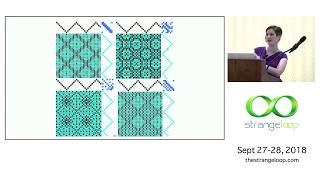
It's Just Matrix Multiplication - Notation for Weaving
Explore weaving notation, from basic terminology to complex network drafting, revealing connections between textile patterns and mathematical concepts like matrix multiplication.
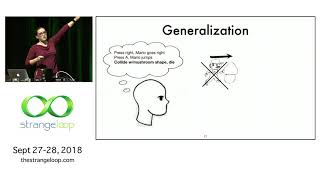
Puzzles, Problems, and Programs
Explore mental model alignment in puzzles, problems, and programming through interactive techniques and informative failure, enhancing cognitive abilities and problem-solving skills.
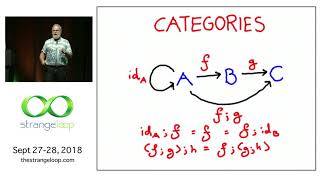
Categories for the Working Hacker
Explore category theory's relevance to developers through Java, Haskell, and blockchain languages. Learn how categories model basic data types and their connection to logic and computing.
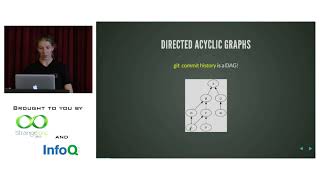
Category Theory - An Abstraction for Anything
Explore category theory's foundations, applications in programming, and powerful abstractions. Learn to recognize category-theoretical patterns and apply them to your projects.
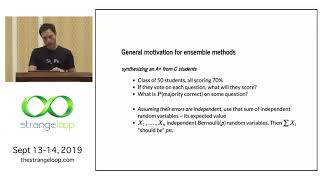
Why Do Tree Ensembles Work?
Explore the statistical properties and effectiveness of decision tree ensembles in classification and regression, covering algorithms, bias-variance decomposition, and advanced interpretations.
Better Spotify Playlists through Discrete Optimization
Explore algorithmic playlist creation using music theory and optimization techniques to generate cohesive, mood-setting Spotify playlists. Includes live demos and audience participation.

Origami Software from Scratch
Explore the journey of creating origami software, from basic geometry to complex algorithms, with interactive visualizations and insights into mathematical foundations and user-friendly design.
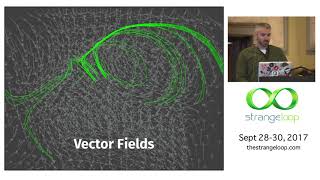
Aesthetic Engine 2
Explore alternative web data interpretation and artistic rendering with Aesthetic Engine 2. Discover unconventional approaches to data visualization and software development in the era of Big Data.
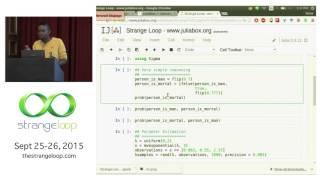
Probabilistic Programs Which Make Common Sense
Explore probabilistic programming as a step towards machines with common sense. Learn about Sigma, a language for functional probabilistic models, and its applications in automated reasoning and inference.
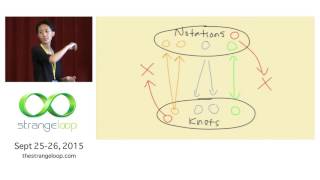
Strange Loops - Capturing Knots With Powerful Notations
Explore knot theory through Conway's and Dowker's notations, examining their efficiency in enumerating knots and the broader implications for systematic thinking in mathematics.
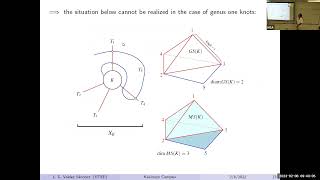
Low Dimensional Topology and Circle-Valued Morse Functions
Explore the Kakimizu complex for genus one hyperbolic knots, examining its structure, dimensions, and examples across various dimensions in 3-sphere topology.

Low Dimensional Topology and Circle-valued Morse Functions
Explore Khovanov homology of torus braids, characterizing simplified complexes and their applications in quantum topology. Gain insights into recent advancements and conjectures in low-dimensional topology.