Accelerating Sparse Matrix Computations with Code Specialization
Explore techniques for optimizing sparse matrix computations through code specialization, enhancing performance in numerical algorithms and scientific computing applications.
Taylor Expansion and Game Semantics - Exploring Isomorphisms in Lambda Calculus
Explore the isomorphism between Taylor expansion of λ-terms and pointer concurrent games interpretation, extending previous results on resource terms and game semantics.

Automated Detection of Under-Constrained Circuits in Zero-Knowledge Proofs
Discover a novel technique for detecting vulnerabilities in zero-knowledge proof circuits, combining SMT solving with uniqueness inference to enhance security in blockchain applications.
An Algebraic Language for Specifying Quantum Networks
Explore BellKAT, a novel specification language for quantum networks based on Kleene algebra, designed to address resource competition and enable formal reasoning about quantum network protocols.
De/Re-Composition of Data-Parallel Computations via Multi-Dimensional Homomorphism - PLDI 2024
Explore a systematic approach for efficient (de/re)-composition of data-parallel computations using Multi-Dimensional Homomorphisms, applicable to various architectures and outperforming state-of-the-art solutions.

Probabilistic Programming Interfaces for Random Graphs: Markov Categories, Graphons, and Nominal Sets - POPL 2024
Explore semantic models of probabilistic programming languages over graphs, connecting graphons to equational theories through Markov categories, measure-theoretic probability, and nominal sets.

Guaranteed Bounds for Discrete Probabilistic Programs with Loops via Generating Functions - LAFI'24
Explore a technique for finding guaranteed bounds on posterior distributions in probabilistic programs with loops using probability generating functions and inductive invariants.

ReLU Hull Approximation - Fast and Precise Convex Hull Over-Approximation for Neural Network Verification
Explore a fast, precise approach to over-approximating ReLU function convex hulls in neural network verification, improving efficiency and precision for large-scale networks.

Information Exchange in Distributed Blockchain Systems - Epidemic Model Approach
Explore architectural drivers, communication models, and distributed consensus in complex blockchain systems. Learn from real-world experiences in designing and implementing large-scale node networks.

Maximum Entropy and Species Distribution Modeling - 2007 - Lecture
Explore maximum entropy methods for species distribution modeling, covering theoretical guarantees, experimental tests, and applications in conservation biology.
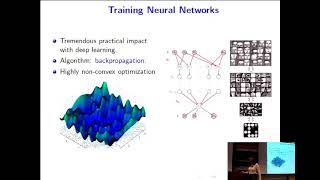
Guaranteed Training of Neural Networks Using Tensor Methods - 2015
Explore guaranteed neural network training using tensor methods. Learn about overcoming non-convexity, risk bounds, and combining unsupervised learning with supervised tasks.
Probabilistic Methods for Classification - 2009
Explore probabilistic methods for classification, covering supervised learning, estimation, and advanced models like Naive Bayes, Maximum Entropy, and Conditional Random Fields.
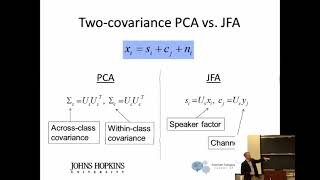
Recent Progress in Acoustic Speaker and Language Recognition - October 2013
Explore recent advancements in speaker and language recognition, focusing on GMM subspace methods, pattern classification, and Bayesian approaches for improved performance and domain adaptation.
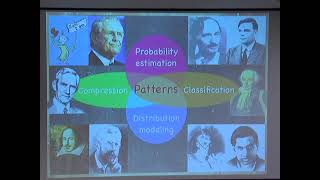
Values and Patterns in Data Learning - 2009
Explore discrete value analysis in data learning through distribution modeling, probability estimation, data compression, and classification. Discover insights from renowned mathematicians and information theorists.

Learning Energy-Based Models of High-Dimensional Data - 2002
Explore energy-based models for high-dimensional data analysis. Learn about deterministic networks, perceptual inference, and efficient learning techniques for large-scale models.
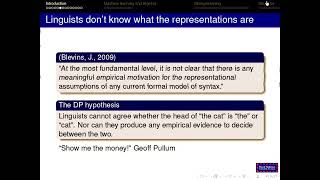
Weak and Strong Learning of Context-Free Grammars - 2012
Explore recent advancements in unsupervised learning of context-free grammars and the transition from weak to strong learning algorithms for accurate syntactic structure prediction.
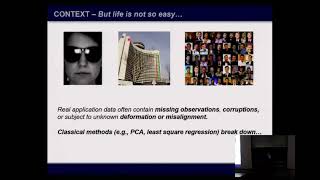
Pursuit of Low-dimensional Structures in High-dimensional Data - 2013
Explore techniques for extracting low-dimensional structures from high-dimensional data, with applications in computer vision, image processing, and pattern recognition. Learn about convex optimization and regularization methods.

Supervised Learning Algorithms - Lecture 3
Explore supervised learning algorithms, model evaluation, and Python implementation for classification and regression tasks in petroleum engineering and energy transition.
Probabilistic Programming in Python - Conf42 Python 2024
Explore Bayesian statistics, probabilistic modeling, and MCMC in Python. Learn key concepts and practical applications through demonstrations and workflow explanations.
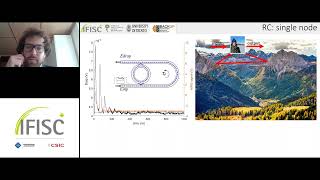
Experimental Investigation of a Microring-Based Time-Delay Reservoir Computing
Explore microring-based time-delay reservoir computing through experimental investigation, delving into advanced concepts and practical applications in photonic computing.
Reservoir Computing in Quantum Systems
Explore quantum reservoir computing, its applications, and potential for enhancing machine learning in quantum systems.