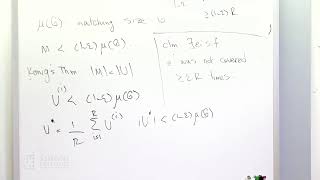
A Simple -Approximation Adaptive Sketching Algorithm for Maximum Weighted Matching
Explore a simple algorithm for approximating weighted matching in graphs using adaptive sketching, featuring a primal-dual analysis and multiplicative weight update method.

Uncertainty-Tracking Computation Hardware for Processing Data from the Physical World
Explore innovative processor architecture for tracking uncertainty in computations, enhancing accuracy and efficiency in various domains from quantum algorithms to sensor data processing.

Geometry Aware Imitation Learning in Robotics
Explores geometry-aware imitation learning for robots, enabling precise movement planning and skill acquisition from demonstrations. Discusses handling non-Euclidean data using differential geometry tools.
Online and Hybrid System Identification Directly From Raw Sensory Signals
Explores neural networks with physical model biases for efficient system identification from sensory data, applicable to robotics, molecular modeling, and X-ray scattering inversion.
A Unified Theory of Barren Plateaus for Deep Parametrized Quantum Circuits
Unified theory explaining barren plateaus in deep parametrized quantum circuits, covering expressiveness, entanglement, locality, and noise effects on variational quantum computing schemes.

Binary Number Systems and Conversions
Explore the fundamentals of binary, its applications in computing, and how it forms the basis for digital information storage and processing.

Adding and Subtracting Binary Numbers
Learn to add and subtract binary numbers efficiently, mastering fundamental operations crucial for computer science and digital systems understanding.
Do Quantum Computers Have Applications in Machine Learning and Combinatorial Optimization
Explores quantum computing's potential in machine learning and optimization, discussing recent developments, comparative power, limitations, and future prospects in these fields.

Neural ODEs - From ResNet to Continuous-Time Machine Learning
Explore Neural ODEs: a powerful machine learning approach for learning ODEs from data. Discover its advantages over ResNet and extensions like HNNs and LNNs.
Lean-HoG: Incorporating a Database of Graphs into a Proof Assistant
Explore the integration of a graph database into a proof assistant, enhancing mathematical reasoning capabilities and streamlining complex proofs in formal verification.
How to Evaluate Observability Agent Performance - Understanding Overhead
Explore observability agent performance, including types of work, resource usage, and key variables. Learn to evaluate overhead and make informed decisions for your infrastructure.
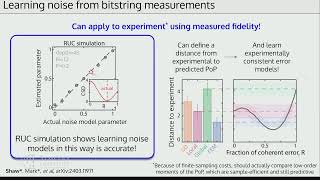
Using Chaos to Characterize a Programmable Analog Quantum Simulator
Explore chaos in analog quantum simulators, uncovering random behavior, estimating fidelity, and learning noise models for large-scale entangled states using Rydberg atom arrays.
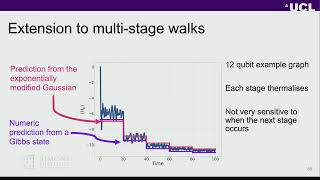
Continuous-Time Quantum Walks for MAX-CUT Optimization
Explore quantum walks for MAX-CUT optimization, linking Hamiltonians to thermalization. Discover novel insights into unitary dynamics for combinatorial problems using multi-stage walks and Floquet systems.
A Quantum Speed-Up for Approximating the Top Eigenvector of a Matrix via Improved Tomography
Quantum algorithm for approximating top eigenvectors of matrices, offering polynomial speedup over classical methods. Introduces efficient quantum tomography techniques for state and process reconstruction.
The Virtues of the Quantum Approximate Optimization Algorithm
Exploring QAOA's potential for solving combinatorial optimization problems, its performance guarantees, quantum supremacy, and practical limitations in near-term quantum computing.

Master AI Efficiency with LoRA - Optimize Fine-Tuning for Large Language Models
Optimize AI fine-tuning with LoRA: Learn selective parameter updates, preserve model integrity, and adapt models efficiently across tasks. Gain practical insights for streamlined, resource-efficient AI projects.
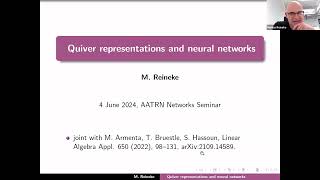
Quiver Representations and Neural Networks
Explore quiver representations in linear algebra and their application to neural networks, examining moduli spaces and network function spaces.
Principles of Learning in Distributed Neural Networks
Explore how depth shapes learning dynamics in the brain, analyzing deep network models and their implications for neural representations and behavior in rodent studies.
Relational Predictive Reasoning in Brains and Machines
Exploring predictive models in deep learning, comparing AI and brain representations, and discussing Graph Neural Networks for simulating complex dynamical systems.
Introduction to Recursion Schemes - YOW! 2018
Explore recursion schemes in functional programming with Amy Wong. Learn key concepts, applications, and benefits for writing more elegant and maintainable code.
Seeing Faces in Things: A Model and Dataset for Pareidolia
Explore face pareidolia through computer vision, examining human vs. machine detection abilities and proposing a statistical model for general object pareidolia in images.