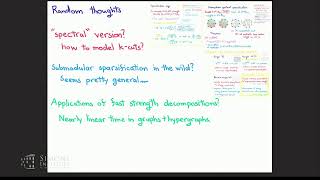
Quotient Sparsification for Submodular Functions
Explores sparsification of matroids and submodular functions, unifying graph and hypergraph cut sparsifiers with applications to set systems and algorithmic efficiency.
Reproducible Builds for Ubuntu
Explore Ubuntu's reproducible builds effort, its progress compared to Debian, and potential community involvement in enhancing software transparency and security.
Machine Learning for LHC Theory - Lecture 2
Explore advanced machine learning techniques for Large Hadron Collider theory, focusing on statistical methods and their applications in high-energy physics research.
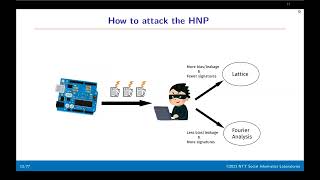
Mathematical Problems Arising from Timing Attacks on Signatures and Their Countermeasures - Invited Talk 2
Exploration of mathematical challenges in timing attacks on digital signatures and strategies for defense, presented by Mehdi Tibouchi at Asiacrypt 2023.

Peter Shor - Quantum Computing - Green Family Lecture at IPAM at UCLA
Explore quantum computing's impact on information theory, computation, and cryptography, including Shor's algorithm for prime factorization and other quantum discoveries.
IPM and Nested Dissection for Planar and Separable LPs
Exploring efficient LP solvers using nested dissection in IPM framework for planar min-cost flow, multicommodity flow, low treewidth LPs, and separable LPs. Focuses on optimization techniques and algorithm design.
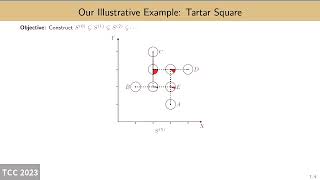
Multiparty Computation Advances - Session 1
Explore cutting-edge developments in multiparty computation at this TCC 2023 session, featuring expert presentations on advanced cryptographic protocols and secure distributed computing.
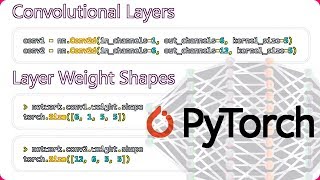
CNN Weights - Learnable Parameters in PyTorch Neural Networks
Explore PyTorch's inner workings, including OOP concepts, convolutional and linear layer weight tensors, and matrix multiplication for deep learning in neural networks.
Drift, Jitter, and Expectations - A Story of Kernel Timers
Explore kernel timers in Zephyr, their importance, and how testing ensures quality. Learn about timer drivers, potential issues, and the significance of setting expectations.
Right-Sizing and Auto-Scaling of MySQL Containers in Kubernetes
Optimizing MySQL container resources in Kubernetes using statistical analysis and algorithms for dynamic sizing and scaling, improving performance and efficiency while reducing costs.

Cyclic Tests Unleashed: Large-Scale Real-Time Analysis with Jitterdebugger
Explore real-time Linux kernel testing with Jitterdebugger. Learn about cyclic task analysis, latency measurement, and statistical evaluation for improved system performance and reliability.
Angel 3.0 - A Full Stack Machine Learning Platform
Explore Angel 3.0, a comprehensive machine learning platform featuring auto feature engineering, hyperparameter tuning, model serving, and PyTorch integration for enhanced graph embedding and GNN algorithms.
Distinguished Seminar in Optimization and Data - Ryan O'Donnell
Explore quantum state tomography, distribution metrics, and independence testing with insights on quantum-inspired improvements to classical problems in optimization and data analysis.
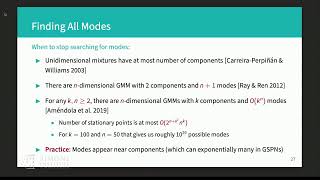
On Finding Modes of Gaussian Sum-Product Networks
Explore challenges and tractability of finding modes in Probabilistic Circuits, focusing on Gaussian Sum-Product Networks for machine learning tasks like structured prediction.
From Phase Separation in Heterogeneous Media to Learning Training Schemes for Image Denoising
Exploring variational approaches in phase separation and image denoising, focusing on heterogeneous media, geometric measure theory, and optimized training schemes for improved performance.
Decision Diagrams for Efficient Inference and Optimization in Expressive Discrete-Continuous Domains
Explore extended algebraic decision diagrams (XADDs) for representing piecewise functions, enabling efficient computations and novel solutions in probabilistic inference, optimization, and decision-making.
3D Transforms in CSS - Creating Complex Shapes and Animations
Explore advanced 3D transforms in CSS, creating complex shapes with shading, animations, and transformations. Learn techniques for building intricate geometric solids and dynamic visual effects.

Ubuntu 14.03 Developer Summit Keynote - Convergence and Future Plans
Mark Shuttleworth discusses Ubuntu's future, covering LTS, convergence, OpenStack, Juju, and mobile developments. He addresses challenges, partnerships, and community questions in this comprehensive keynote.

Mark Shuttleworth: The Road Ahead for Ubuntu - Pre-UOS Keynote and Q&A
Explore Ubuntu's future with Mark Shuttleworth: convergence, free firmware, snaps, cloud, and community. Gain insights on open source, gaming, and innovative technologies.
Tracking Significant Changes in Bandit - IFDS 2022
Explores significant changes in bandit algorithms, focusing on adaptive procedures and random replays for tracking environmental shifts in reward and context distributions.
Bandits II - Advanced Algorithms and Applications
Explore advanced bandit algorithms and their applications in decision-making under uncertainty with Kevin Jamieson from the University of Washington.