Using Servo in a Simple Project with Arduino
Learn to build a visual light brightness indicator using Arduino and servo, applying algebra for precise control and real-world sensor integration.
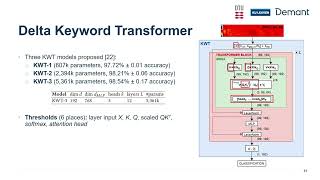
Delta Keyword Transformer: Bringing Transformers to the Edge Through Dynamically Pruned Multi-Head Self-Attention
Explore cutting-edge techniques for optimizing Transformers in edge computing, focusing on the Delta Keyword Transformer and its dynamic pruning approach for efficient multi-head self-attention.
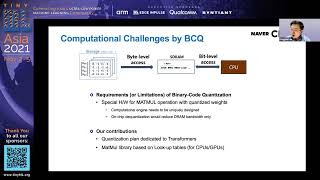
Extremely Low-Bit Quantization for Transformers - tinyML Asia 2021
Explore extremely low-bit quantization techniques for Transformers, focusing on mixed precision strategies to optimize deployment on resource-limited devices without compromising accuracy.

OpenGL and CUDA-Based Tessellation
Explore advanced tessellation techniques using CUDA to overcome OpenGL limitations, enabling higher-order surfaces, custom UV coordinates, and trimming curves for improved visual quality in graphics rendering.
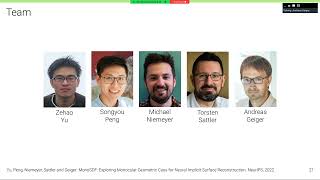
Constraining 3D Fields for Reconstruction and View Synthesis
Explore advanced techniques in 3D field reconstruction and view synthesis, covering RegNeRF, MonoSDF, and TensoRF for improved neural rendering and geometric representation in computer vision.
Benefits of Saying I Don't Know When Analyzing and Modeling the Climate System With ML - Elizabeth Barnes
Explore the benefits of acknowledging uncertainty in climate system analysis using machine learning. Learn about state-dependent predictability and controlled abstention networks for improved modeling accuracy.
Interpretable and Generalizable Machine Learning for Fluid Dynamics - Steven Brunton
Explore interpretable and generalizable machine learning techniques for fluid dynamics, focusing on sparse identification of nonlinear dynamics and incorporating physical constraints for improved accuracy.
Measurement Induced Entanglement Transitions in Quantum Circuits with Decoherence - Ehud Altman
Explores measurement-induced entanglement transitions in quantum circuits, focusing on characterization methods, dynamical symmetry, and connections to classical models. Discusses implications for non-equilibrium many-body physics.
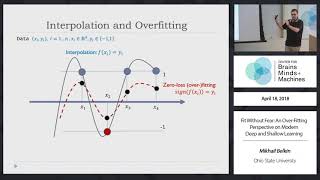
Fit Without Fear - An Over-Fitting Perspective on Modern Deep and Shallow Learning
Explore over-fitting in modern machine learning, challenging conventional wisdom and presenting kernel methods as a competitive alternative to deep learning. Insights on interpolation, generalization, and stochastic gradient descent.
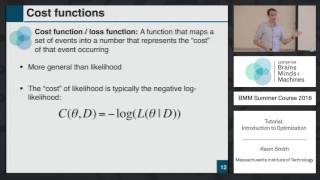
Introduction to Optimization
Learn optimization techniques for machine learning, including likelihood estimation, gradient descent, and regularization, with practical examples and applications.
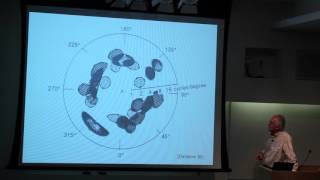
Filters and Other Potions for Early Vision and Recognition
Explore early vision and recognition techniques, including filters, deep networks, and multiscale processing. Learn about spacetime oriented filters and tensor factorization for improved visual analysis.
Undergrad Complexity at CMU - SAT
Explore the intricacies of SAT in computational complexity theory, covering Boolean circuits, algorithms, and CNF formulas in this comprehensive undergraduate lecture.
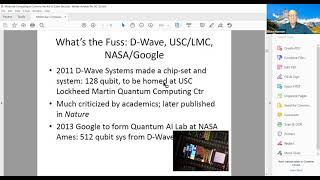
Under the Hood of the Quantum Computer
Explore quantum computing fundamentals, including superposition, quantum circuits, and algorithms, with insights on recent developments and future implications.
Dinur's PCP- Degree-Reduction, Expanderizing, Mini-PCP - Lecture 27c of CS Theory Toolkit
Explore Dinur's PCP Theorem proof, covering degree-reduction, expanderizing, and alphabet-reduction in theoretical computer science. Gain insights into advanced concepts for research in computational complexity.
The Ellipsoid Algorithm - Lecture 19a of CS Theory Toolkit
Explore the Ellipsoid Algorithm for solving Linear Programming and convex optimization, focusing on its polynomial-time efficiency and use of separation oracles in theoretical computer science.
Linear Error Correcting Codes - Lecture 11b of CS Theory Toolkit
Explore linear error correcting codes, their properties, and applications in computer science theory. Learn about decoding, notation, and minimum distance in this graduate-level lecture.
Quantum "Supremacy" - Lecture 25 of Quantum Computation at CMU
Explore quantum supremacy, its challenges, and implications in computational theory. Delve into error correction, threshold theorems, and the potential of quantum systems.
Basics of Quantum Computing - Lecture 10 of Quantum Computation at CMU
Explore quantum computing fundamentals, including efficiency, probabilities, circuits, gates, and reversible computation. Gain insights into key concepts and important questions in this field.
Multi-Qubit Systems - Lecture 5 of Quantum Computation at CMU
Explore multi-qubit systems, tensor products, and joint states in quantum computation. Learn about Bell states and fundamental properties of quantum systems with multiple qubits.
Unitary Transformations and the Elitzur-Vaidman Bomb - Quantum Computation at CMU
Explore unitary transformations and the Elitzur-Vaidman bomb paradox in quantum computation, covering linear transformations, reflections, and allowable quantum operations.

More on Constant-Round Interactive Proof Systems - Graduate Complexity Lecture at CMU
Explore constant-round interactive proof systems in computational complexity theory, covering MA, AM, BPP, and efficient error reduction techniques.