The Subcritical Brain and Motion Control
Explore cortical linguistics, neural circuits, and brain dynamics. Discover how mathematical properties and firing rates drive memory, information processing, and motion control, with applications for neurological impairments.
Mean Field Limits of Heterogeneous Networks - Informal Systems Seminar
Explore mean field limits of heterogeneous networks, focusing on interacting particle systems coupled on digraphs and their macroscopic behavior. Gain insights into Vlasov equations and digraph measures.
Exploring Lagrangian Data Assimilation: Methods and Uncertainty - SIAM MPE Community Meeting
Explore Lagrangian data assimilation methods and uncertainty in fluid dynamics. Learn about ensemble techniques, analytical solutions, and optimal tracer deployment for improved state estimation.
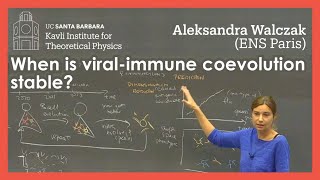
When is Viral-Immune Coevolution Stable?
Explore viral-immune coevolution stability through a theoretical physics lens, examining cross-disciplinary insights and implications for understanding complex biological systems.
C^0 Convex Integration for Incompressible Euler - Lecture 4
Explore C^0 convex integration for incompressible Euler equations, focusing on a novel iteration method producing continuous solutions, drawing parallels with Nash's theorem from Lecture 3.
Developing Kinematic Equations from Data - AP Physics 1
Develop kinematic equations from experimental data using linearization. Learn to create mathematical models for constant acceleration motion in physics.
Energy Dissipation of Navier-Stokes Equation with Non-Characteristic Boundary
Explore energy dissipation in Navier-Stokes equations with non-characteristic boundaries, presented by Jincheng Yang from the Institute for Advanced Study.
Horizontal Gene Transfer Phylogenetics: A Random Walk Approach
Explore horizontal gene transfer phylogenetics using a random walk approach. Discover innovative methods for analyzing evolutionary relationships in the presence of lateral genetic transfer.
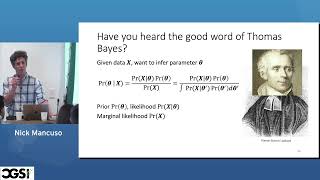
Variational Inference for Large-Scale Genomic Data - CGSI 2022
Explore variational inference techniques for large-scale genomic data analysis, integrating molecular and phenome information to uncover disease mechanisms and enhance genetic association studies.
Timewarp: Transferable Acceleration of Molecular Dynamics by Time-Coarsened Dynamics
Explore Timewarp: a transferable method for accelerating molecular dynamics simulations using normalizing flows, enhancing sampling efficiency for equilibrium properties of molecular systems.
Timewarp: Transferable Acceleration of Molecular Dynamics by Learning Time-Coarsened Dynamics
Explore accelerated molecular dynamics simulation using Timewarp, a transferable AI method for efficient sampling of molecular systems and discovery of metastable states.
Modeling Population Dynamics - Day 4
Explore population dynamics modeling techniques for drug discovery, focusing on innovative approaches and their applications in pharmaceutical research.
Gene Regulatory Network Structure and Perturbation Effects Distribution - Simulation and Analysis
Explore gene regulatory network structure and its impact on perturbation effects. Gain insights into simulating and modeling GRNs for improved understanding of gene expression regulation.
Training Neural Network Potentials: Bayesian and Simulation-based Approaches
Explore advanced techniques for training neural network potentials in molecular dynamics simulations, including data-efficient methods, experimental data integration, and uncertainty quantification for reliable results.
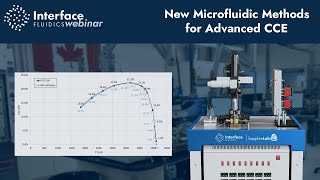
New Microfluidic Methods for Advanced CCE
Explore cutting-edge microfluidic techniques for PVT and CCE testing, extracting extensive data from minimal oil samples to enhance accuracy and efficiency in fluid analysis.
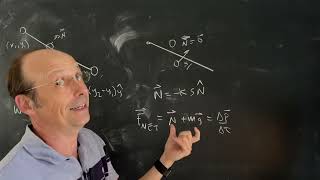
Physics: Three Ways to Calculate the Work Done by the Normal Force
Explore three methods to calculate work done by normal force: constant forces, line integral, and spring-based modeling. Enhance understanding of classical mechanics.

Protein Folding Algorithms - Lecture 9
Explore protein folding algorithms, their applications, and computational approaches in structural biology and drug discovery.
Yudovich Theory for Rough Path Perturbations of Euler's Equation - Lecture 5
Explore Yudovich Theory for rough path perturbations of Euler's equation, delving into advanced fluid dynamics concepts and mathematical techniques.
Differentiable Simulations for Enhanced Sampling of Rare Events
Explore deep learning applications in molecular simulations, including surrogate functions, sampling complex distributions, and time-propagation of differential equations. Learn about active learning, generative models, and reaction path finding.
Yudovich Theory for Rough Path Perturbations of Euler's Equation - Lecture 4
Explore Yudovich Theory for rough path perturbations of Euler's equation, delving into advanced fluid dynamics concepts and mathematical techniques for analyzing fluid flow.

A Short but Up-to-Date Introduction to Partially Parabolic Systems - Lecture 4
Explore advanced concepts in fluid mechanics, focusing on Euler and Navier-Stokes equations. Gain insights into recent breakthroughs and cutting-edge techniques in this field of mathematical physics.