SI Units and Dimensional Analysis in General Physics - Lesson 1.1
Master SI units and dimensional analysis for effective problem-solving in physics. Learn base and derived units, their importance in calculations, and practical application techniques.
Collisions in 2 Dimensions - General Physics
Explore 2D collisions: conservation of momentum, inelastic and elastic collisions. Learn to solve problems involving velocity, direction, and kinetic energy in various collision scenarios.
Relative Motion in Physics - Lesson 3.3
Explore relative motion concepts in 1D and 2D, including train and river crossing problems. Learn to calculate relative velocities and solve physics problems effectively.
Vectors in General Physics - Lesson 1.4
Explore vectors in physics: from trigonometry review to vector components, addition, and resultant vector calculations. Master essential concepts for understanding vector operations in physics.

Gauss's Law and Electric Flux - General Physics
Explore Gauss's Law and electric flux, learning definitions, applications, and problem-solving techniques for calculating electric flux and field magnitude.
Kirchhoff's Rules and Complex DC Circuits - General Physics
Master Kirchhoff's Rules for complex DC circuits. Learn to apply junction and loop rules, solve equations, and use matrix algebra for efficient problem-solving in electrical systems.
Electric Fields in General Physics - Lesson 15.3
Explore electric fields, their mathematical relationships, and practical applications through calculations and visual representations of field lines.
Coulomb's Law - Electrostatic Force Between Point Charges
Explore Coulomb's Law for electrostatic forces, from basic concepts to complex 2D problems. Master calculations and applications in mechanics.
Immersed Methods for Fluid-Structure Interaction
Explore advanced immersed boundary methods for fluid-structure interaction, focusing on large-deformation elasticity, peridynamics for material failure, and sharp-interface coupling techniques.
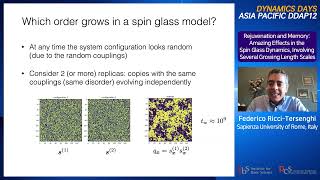
Rejuvenation and Memory: Amazing Effects in Spin Glass Dynamics
Explore spin glass dynamics, rejuvenation, and memory effects through large-scale numerical simulations, uncovering multiple growing length scales in disordered magnets.
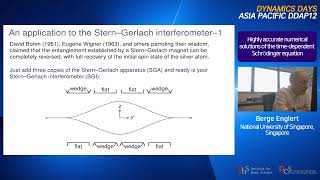
Efficient Approximations for Quantum Dynamics and Stern-Gerlach Interferometry
Explore advanced quantum dynamics approximations and their application in Stern-Gerlach interferometry, featuring innovative five-factor expressions and realistic magnetic field simulations.
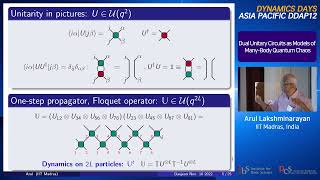
Dual Unitary Circuits as Models of Many-Body Quantum Chaos
Explore many-body quantum chaos through dual-unitary circuits, from quantum ergodic hierarchies to perfect tensors, with insights on construction algorithms and correlation functions.
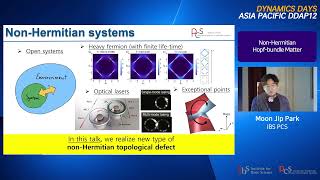
Non-Hermitian Hopf-bundle Matter
Explore non-Hermitian Hopf-bundle matter, examining line excitations, complex eigenenergy strings, and topological structures in higher dimensions. Uncover bulk-boundary correspondence and higher-order skin effects.
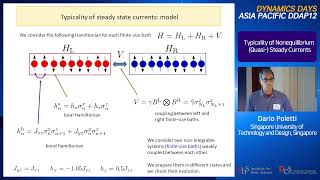
Typicality of Nonequilibrium Quasi-Steady Currents
Explore nonequilibrium steady currents in coupled nonintegrable systems through perturbative analysis and numerical simulations, uncovering prethermalization mechanisms.
A Closed-Form Mathematical Framework for Modeling Turbulent Fluids
Explore a groundbreaking mathematical framework for turbulent fluid motion, covering energy spectra, instability mechanisms, and analytical solutions for turbulence in confined spaces.
Multi-scale Modeling of Topology Change in Multiphase Flow Simulations
Explore advanced geometric volume of fluid methods for tracking sub-grid interfacial features in multiphase flow simulations, including physics-based models for topology changes.
Computational Frontiers in Weather and Climate Modeling
Explore cutting-edge computational approaches in weather and climate modeling, including high-resolution trends, digital twins, and emerging paradigms for advanced simulations.
Numerical Investigation of Vortex Formation in Bose-Einstein Condensates
Explore numerical modeling of vortex patterns in Bose-Einstein condensates using finite elements, focusing on mesh size requirements for accurate approximations of superfluid behavior.
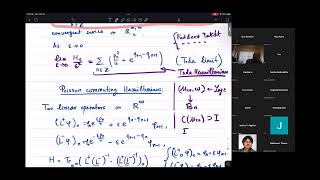
Solitons in Infinite Relativistic Toda System
Explore infinite relativistic Toda systems, soliton solutions, and action-angle variables in this advanced mathematical seminar on integrable systems and cluster varieties.
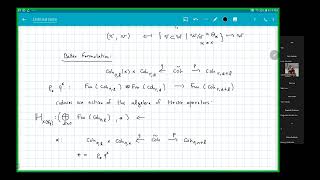
Cohomological Hall Algebras of Zero-Dimensional Sheaves on Surfaces and the P=W Conjecture
Explore cohomological Hall algebras of 2CY categories, focusing on zero-dimensional sheaves on surfaces and their role in proving the P=W conjecture for character varieties.
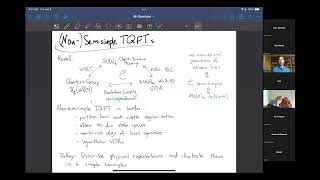
Non-semisimple TQFTs from 3D N=4 Quantum Field Theories - Part 1
Explore non-semisimple TQFTs from 3D supersymmetric field theories, examining their connections to quantum groups and vertex operator algebras in topological quantum field theory.