Modern Numerical Methods in Computational Relativity - Lecture 4
Explore advanced numerical techniques in computational relativity, focusing on solving Einstein's field equations for gravitational-wave astronomy and astrophysical phenomena modeling.
Introduction to Numerical Relativistic Hydrodynamics - Lecture 4
Explore advanced concepts in numerical relativistic hydrodynamics, focusing on computational techniques for modeling high-energy astrophysical phenomena and gravitational wave sources.
Introduction to Numerical Relativistic Hydrodynamics - Lecture 3
Explore advanced concepts in numerical relativistic hydrodynamics, focusing on computational techniques for modeling high-energy astrophysical phenomena and gravitational wave sources.
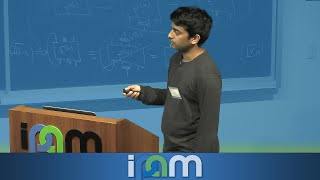
Ultraslow Dynamics, Fragile Fragmentation, Exotic Entanglement
Explore ultraslow dynamics, fragile fragmentation, and exotic entanglement in quantum systems. Discover unusual approaches to equilibrium and unique entanglement properties in ground states of two-dimensional models.
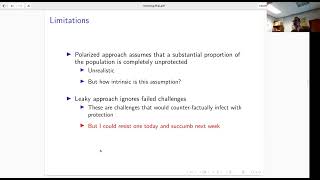
Conceptual Models of Immunity
Explore conceptual models of immunity and their applications in public health, focusing on mathematical approaches to understanding immune system dynamics.
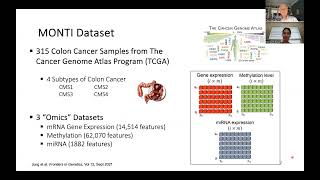
TUSCA: A Method for Tucker3 Modeling with ASCA+ - Webinar
Explore TUSCA, a novel method combining Tucker3 and ASCA+ for analyzing multi-way datasets from designed experiments, enhancing interpretation and visualization of complex data structures.
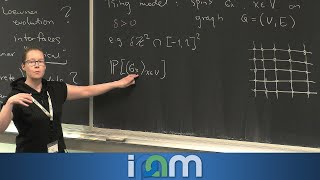
Gaussian Free Field and Schramm-Loewner Evolution - Part 2
Explore Gaussian free field and Schramm-Loewner Evolution in random geometry. Discover connections between these canonical objects and their applications in statistical physics and conformal field theory.
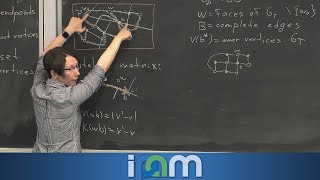
Embeddings and Statistical Mechanics in Dimer Graphs - Part 2
Explore geometric embeddings of dimer graphs and their algebra-combinatorial properties in this advanced tutorial on statistical mechanics and integrability.
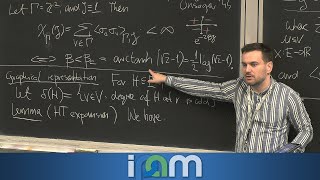
Embeddings and Statistical Mechanics in Planar Ising Models - Part 1
Explore connections between criticality, exact solvability, and geometric embeddings in planar Ising models through this advanced statistical mechanics lecture at UCLA's IPAM.
On the Connection Between Dynamics of Local Observables and Hilbert-Space - Sthitadhi Roy
Explores connections between local observable dynamics and Hilbert-space phenomena in quantum systems, focusing on stability mechanisms and their implications for non-equilibrium physics and quantum technologies.
Non-Abelian Band Singularities and Anomalous Floquet Braiding
Explore non-Abelian band singularities and anomalous Floquet braiding in quantum systems, focusing on stability and coherent time evolution in many-body quantum matter under external drives.
Chaos and Ergodicity in Quantum and Classical Systems by Anatoli Polkovnikov
Explore chaos and ergodicity in quantum and classical systems, examining stability mechanisms and their implications for quantum matter and technologies.
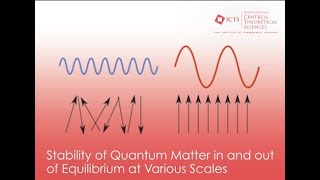
Floquet Fermi and Non-Fermi Liquids by Inti Sodeman
Explore Floquet Fermi and Non-Fermi Liquids in quantum systems, focusing on stability under external drives and mechanisms constraining many-body dynamics in Hilbert space.
Gaussian Free Field and Schramm-Loewner Evolution - Part 1
Explore the Gaussian free field and Schramm-Loewner Evolution, two key concepts in random geometry. Learn their applications in statistical physics and connections to critical phenomena.
Design and Dynamics of Biological Networks - The Case of Cancer Progression - Lecture 2
Explore biological network dynamics and design, focusing on specific case studies. Gain insights into complex systems and their applications in theoretical approaches to cancer research.
A Systems Analysis of Temozolomide Response in a Model Glioblastoma Cell-line
Explore systems analysis of temozolomide response in glioblastoma, uncovering insights into cancer treatment through advanced modeling and data interpretation techniques.
Morphogenesis in Cancer
Explore morphogenesis in cancer with Ramray Bhat, examining fundamental principles and theoretical approaches to understanding cancer progression and potential treatment strategies.
A Systems Biology Approach to Unravel Cell Cycle Dynamics - Lecture 2
Explore systems biology approaches to unravel cell cycle dynamics, focusing on mathematical modeling and computational techniques to understand complex cellular processes.
The Art of Modelling Mammalian Cell Cycle Regulation - Lecture 1
Explore mammalian cell cycle regulation modeling techniques, focusing on theoretical approaches to understand cancer progression and treatment. Gain insights into advanced mathematical and computational methods.
Maps, Networks and Mechanisms: System Modeling and Analysis of Disease Maps
Explore disease map modeling and analysis techniques for understanding complex biological systems and their applications in cancer research and treatment strategies.
Systems-level Analysis of Phenotypic Switching in Melanoma - From Design Principles to Therapeutic Strategies
Explore systems-level analysis of phenotypic switching in melanoma, focusing on design principles and their implications for understanding cancer progression and developing targeted treatments.