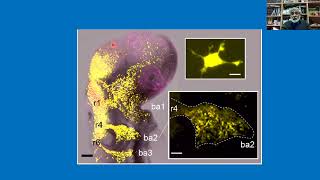
Modelling Collective Cell Migration
Explore mathematical models of collective cell migration in development and cancer, combining theory and experiments to gain insights into biological processes and cell phenotype cooperation.
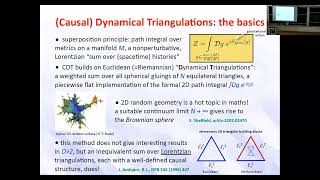
Quantum Ricci Curvature and Quantum Gravity
Explore quantum Ricci curvature's role in quantum gravity theories, examining its implications for spacetime structure and gravitational interactions at the quantum level.
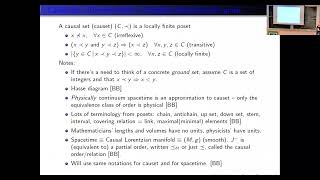
The Ground on Which We Stand
Explore the foundations of mathematical relativity, scalar curvature, and synthetic Lorentzian geometry in this thought-provoking lecture by Fay Dowker from Imperial College London.
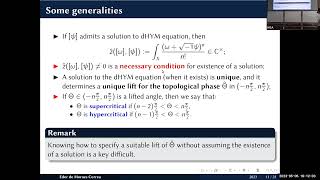
Deformed Hermitian Yang-Mills Equation on Rational Homogeneous Varieties
Explore the deformed Hermitian Yang-Mills equation on rational homogeneous varieties, its solutions, and algebraic obstructions to supercritical solutions using central charges defined by analytic subvarieties.
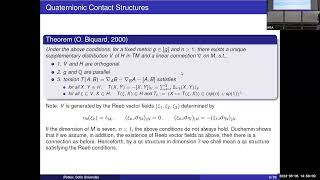
Almost Schur Lemma and Positivity Conditions in Quaternionic Contact Geometry
Explore quaternionic contact geometry, focusing on the Almost Schur Lemma and its implications for estimating qc scalar curvature under specific conditions.
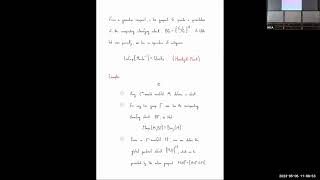
Quantum Toric Geometry, Generalized Geometries and O-Minimality - Enrique Becerra
Explore quantum toric geometry, generalized geometries, and o-minimality with expert Enrique Becerra in this advanced mathematics lecture from the University of Miami.
Symmetric Approach to General Relativity - Applications to Exotic Spheres
Exploring Cheeger deformation to derive Lorentzian metrics on spheres and exotic spheres, with implications for physics and geometry in compact models of spacetime.
On the Sedimentation of Particle Suspensions in Stokes Flows
Explores mathematical models for particle sedimentation in fluids, from microscopic Navier-Stokes equations to macroscopic Vlasov-Stokes systems, focusing on spherical and non-spherical particles with and without inertia.
Homoenergetic Solutions for the Boltzmann Equation
Explore homoenergetic solutions of the Boltzmann equation, their well-posedness theory, and unique long-time asymptotics in nonequilibrium gas dynamics under shear, expansion, or compression.
On a Multi-Species Kinetic Model of Plasma, Theory and Numerics
Explore a new multi-species kinetic model for plasma, examining its theoretical properties and numerical solutions in the context of inertial confinement fusion.
Vlasov-Maxwell-Boltzmann System
Explore the Vlasov-Maxwell-Boltzmann system and its convergence to the Navier-Stokes-Fourier-Maxwell system with Ohm's law, including uniform estimates and classical solution analysis.
Vlasov Poisson Boltzmann Equation in Bounded Domains
Explore the Vlasov-Poisson-Boltzmann system for charged particles in bounded domains, focusing on boundary effects, solution construction, and convergence to global Maxwellian distribution.
Kinetic Theory of Social Phenomena I
Explore statistical mechanics of multi-agent systems to explain distributions in human activities, focusing on skewed distributions in economics and social sciences.
Mean Field Limit by Gamma Convergence
Explores mean-field limit for λ-convex potentials using variational methods, focusing on gradient flows and Γ-convergence in interacting particle systems.
Indirect Diffusion Effect and Convergence to Equilibrium
Explores indirect diffusion in reaction-diffusion systems, showing how non-diffusing species can still reach equilibrium through interactions with diffusing species and reversible reactions.
On the Muskat Problem with Different Mobilities and the Vortex Sheet Problem with Non-Fixed Sign
Explores recent findings on unstable Muskat problem in porous media and vortex sheet problem in Euler equations, discussing h-principle, convex integration, and globally dissipative weak solutions.
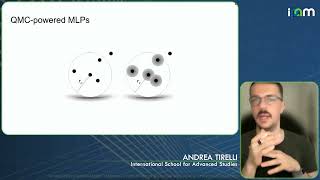
Monte Carlo and Machine Learning Approaches in Quantum Mechanics - IPAM at UCLA
Explore Monte Carlo and machine learning techniques in quantum mechanics with Andrea Tirelli, covering advanced computational methods for solving complex quantum systems.
Estimate Transport Coefficients From Short Equilibrium Molecular-Dynamic Simulation
Discover optimal methods for estimating transport coefficients in molecular dynamics simulations, enhancing efficiency and accuracy in quantum mechanics research.

Acceleration of Quantum Mechanical Systems by Exploiting Similarity - IPAM at UCLA
Explore innovative approaches to accelerate quantum mechanical simulations by leveraging solution similarities, focusing on extended Lagrangian Born-Oppenheimer dynamics and reduced basis methods for quantum-spin systems.
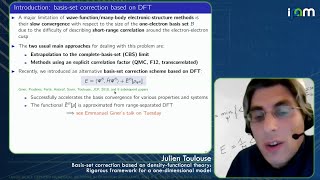
Basis-Set Correction Based on Density-Functional Theory - IPAM at UCLA
Rigorous framework for basis-set correction in quantum mechanics using density-functional theory, explored through a one-dimensional model with delta-potential interactions for systematic analysis.
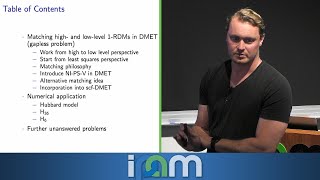
Pure State V-Representability of Density Matrix Embedding - Augmented Lagrangian
Explores density matrix embedding theory for quantum systems, proposing an augmented Lagrangian method to improve accuracy by relaxing assumptions and allowing flexible occupation profiles.