On the Applications of Topology
Explore topological methods for analyzing complex data sets, focusing on persistent homology and mapper, with applications in computer vision, biology, and medicine.
Symplectic Capacities, Viterbo Isoperimetric Conjecture, and Contact Manifolds with Closed Reeb Orbits
Explore symplectic capacities, Viterbo's conjecture, and their impact on symplectic geometry. Gain insights into convex geometry applications and closed Reeb orbits in contact manifolds.

ME3255 - Linear Algebra, Condition Numbers, and Error
Explore linear algebra concepts, condition numbers, and error analysis in numerical methods. Enhance problem-solving skills for engineering applications.

ME3255 - Rocket Equations and Verifying Numerical Integration
Explore rocket equations and verify numerical integration techniques for aerospace applications. Enhance understanding of propulsion systems and computational methods.

ME3255 - Quantitative Descriptions on Monte Carlo Models
Explore Monte Carlo models through quantitative descriptions, enhancing understanding of statistical simulation techniques and their applications in engineering and science.

ME3255 - Moore's Law and Monte Carlo Methods
Explore Moore's law and Monte Carlo methods in computational mechanics, gaining insights into technological advancements and simulation techniques for engineering applications.

Computational Mechanics Course Introduction - Winter 2024
Explore computational mechanics resources and websites for the Winter 2024 course, gaining an overview of available materials and tools.

Measuring Convergence of Integration Methods: Heun and Runge-Kutta Comparison - Homework 3
Comparez les taux de convergence des méthodes de Heun et Runge-Kutta pour l'intégration numérique, avec des résultats surprenants.

ME3255 - Linear Algebra Work for Finite Element Solutions
Explore linear algebra techniques for solving finite element problems in engineering applications. Enhance computational skills for advanced numerical analysis.

Linear Algebra in NumPy and SciPy - ME3255
Learn essential linear algebra operations using NumPy and SciPy libraries in Python for efficient numerical computations and data analysis.

Convergence of Integration Methods and Root Finding with SymPy - ME3255
Explore integration methods and root finding using Sympy, focusing on convergence analysis for enhanced numerical problem-solving skills.

ME3255 - Building Moore's Prediction and Using Monte Carlo Buckling Analysis
Explore Moore's prediction and Monte Carlo buckling analysis techniques for advanced engineering applications. Enhance structural design skills.
Why and How Can a Line be Moved? - Examining Euclid's Elements
Explore ancient mathematicians' efforts to improve proofs of the side-angle-side congruence theorem in Euclid's Elements, examining linguistic peculiarities and textual variations in related propositions.
The Structure of Residuated Lattices
Explore the structure of residuated lattices, from motivating examples to recent research, in this accessible graduate-level seminar on algebraic structures and their applications.
Comparing Oresme's Curvitas with Riemann's Curvature
Explore the historical evolution of curvature concepts from Oresme's 14th-century insights to Riemann's geometric definitions, examining their mathematical and philosophical implications.
Counting Arithmetic - A New Foundational Approach
Explore a new foundational approach to arithmetic centered on counting, challenging traditional views and introducing a novel interpretation of arithmetical equations.
The Congruent Number Problem
Explore the ancient congruent number problem and its connection to the Birch and Swinnerton-Dyer conjecture, one of mathematics' most challenging millennium problems.
The Conundrum of the Fourth Postulate - Euclid's Geometry Revisited
Explore the historical and philosophical aspects of Euclid's fourth postulate, examining its provability within a constructive setting and offering a novel perspective on this classical mathematical problem.
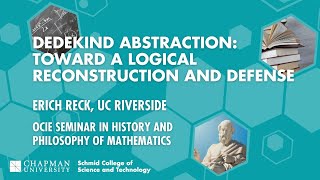
Dedekind Abstraction: Towards a Logical Reconstruction and Defense
Explore Dedekind abstraction in mathematics, its logical reconstruction, and defense. Delve into structuralist positions and their implications for mathematical practice and philosophy.
GCI Speaker Series: Probability, Statistics, and Philosophical Questions - Aubrey Clayton
Explore probability, statistics, and fallacies with Dr. Aubrey Clayton in this thought-provoking speaker series on economic data analysis and philosophical implications.
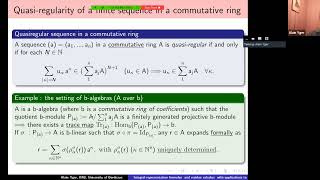
Integral Representation Formulae and Residue Calculus with Applications - Semi-Plenary
Explore integral representation formulae and residue calculus in complex analysis, focusing on applications and potential extensions to non-commutative settings.