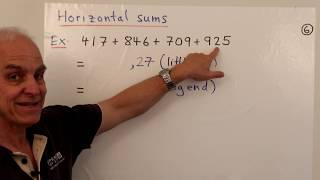
Arithmetic with Monopoly Money - Elementary Mathematics Explained - Lecture 33
Explore how Monopoly enhances arithmetic skills through open numbers and money calculations. Learn practical classroom applications and innovative teaching methods for elementary mathematics.
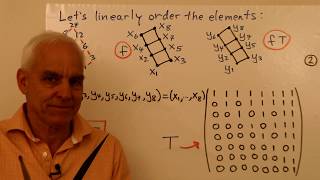
Partial Orders, Maxels, and Möbius Functions in Posets
Explores partial orders, maxels, and Möbius functions in advanced mathematics, connecting Boolean algebra to circuit analysis and introducing novel notation for negative numbers.
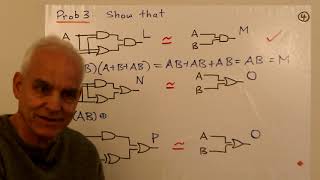
How the Algebra of Boole Simplifies Circuit Analysis - Part 3
Explore Boolean algebra's role in simplifying circuit analysis, covering logic gates, algebraic expressions, and symmetry considerations for efficient circuit equivalence determination.
Puzzles with Measurement - Elementary Mathematics Explained - Lecture 25
Explore engaging measurement puzzles using weights and balances, enhancing problem-solving skills and introducing key mathematical concepts in a fun, interactive way.
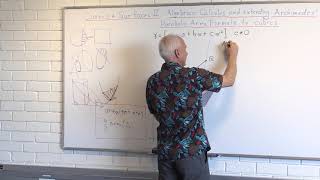
Extending Archimedes' Parabolic Area Formula to Cubics - Algebraic Calculus
Extending Archimedes' parabolic area formula to cubics using Algebraic Calculus and projective geometry. Explores unique aspects of cubic functions and their areas without relying on infinite processes.
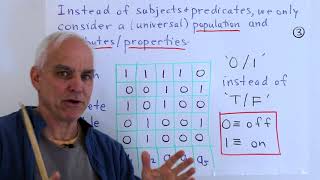
The Algebra of Boole and Boolean Algebra - Key Differences - Part 1
Introduction to the Algebra of Boole, focusing on the bifield of two elements and n-tuples. Explores its role in circuit analysis and contrasts it with Boolean algebra, highlighting implications for 20th-century mathematics.
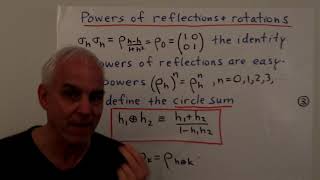
Half-Slope and the Full Group of Euclidean Isometries - WildTrig: Intro to Rational Trigonometry
Explore half-slopes in planar reflections and rotations, circle sums, and translations to understand Euclidean isometries. Gain insights into rational trigonometry and algebraic approaches to geometry.
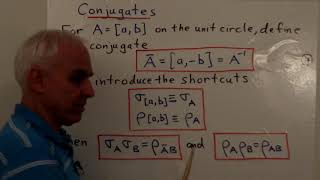
The Geometry of Euclidean Reflections and Rotations - Grounded Case
Explore Euclidean reflections and rotations using rational geometry. Learn about complex number multiplication, group structures, and a visual notation for describing transformations.
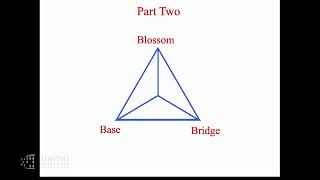
A Theory of Alternating Paths and Blossoms, from the Perspective of Minimum Length
Explores the Micali-Vazirani algorithm for maximum cardinality matching in graphs, presenting new ideas and insights into its structure and efficiency through a novel theory of alternating paths and blossoms.
Causal Inference in Single-cell Genomics - Machine Learning in Computational Biology
Explore causal inference in single-cell genomics, focusing on differential expression analysis and integrating bulk data for high-resolution insights into complex disease mechanisms.
A Generalized Central Limit Conjecture for Convex Bodies
Explore a generalized central limit theorem for convex bodies, its connection to the KLS conjecture, and implications for asymptotic convex geometry in this advanced mathematics lecture.
An Algebraic Perspective on Perfect Graphs - Theory Seminar
Explore the algebraic perspective on perfect graphs, connecting graph theory with polynomial algebra and sum of squares decomposition. Gain insights into sos-perfectness and its equivalence to graph perfectness.
Coding for Sunflowers - Theory Seminar
Explore recent advancements in the sunflower conjecture, simplifying proofs and discussing set theory implications in this mathematical theory seminar by Anup Rao.
Introducing Box Arithmetic - Math Foundations 237
Explore a revolutionary approach to arithmetic using multisets and box/anti-box duality, offering new insights into mathematical foundations and their connection to particle physics concepts.

Standard Staff Notation Issues in Music Theory
Explores issues in music notation, focusing on pitch and duration representation. Critiques current systems, hints at alternatives, and connects mathematics with musical theory.
Central Polynumber Algebra and Baby Weyl Character Formula - Math Foundations 236
Explores central polynumber algebra and Weyl character formula, focusing on SU(2) and SU(3) representations. Connects to particle physics and quaternions, emphasizing polynumbers over complex exponentials.
Scale Adjacency, Sharps and Flats - Mathematics of Music
Explore the mathematical foundations of musical scales, key signatures, and notation systems, connecting music theory to geometry and the circle of fifths for a deeper understanding of harmonics.
Central Polynumbers and SL(2)/SU(2) Characters - Math Foundations 235
Explore a novel algebraic approach to SL(2) and SU(2) representation theory, emphasizing central polynumbers and mset arithmetic, with implications for Lie theory and modern physics.
Alternating and Symmetric Polynumbers - A Missing Chapter of Algebra - Math Foundations 234
Explore symmetric, alternating, and central polynumbers in algebra. Discover their relationships, product formulas, and significance in mathematics and physics.
The Curious World of Integral Polynumbers - Math Foundations 233
Explore integral polynumbers through particle physics concepts, expanding arithmetic to include integers as coefficients and exponents, and viewing polynomials as algebraic objects rather than functions.
Chords and the Mathematical Fretboard - Exploring Guitar Music Theory
Explore the mathematical structure of guitar chords and fretboards, focusing on triads and tetrads. Learn to navigate the instrument using the 12-tone chromatic scale for a deeper understanding of music theory.