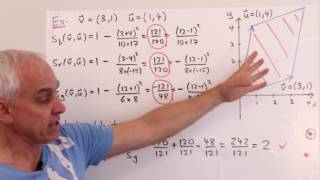
Coloured Spreads and Generalizations in Rational Trigonometry - Lecture 1
Explore colored spreads theorem, planar dot products, and geometric interpretations of quadrances in blue, red, and green geometries. Gain insights into rational trigonometry and linear algebra concepts.
Infinities and Skepticism in Mathematics - Interview with N J Wildberger
Exploration of foundational issues in mathematics, including infinities, skepticism, and modern mathematical challenges. Discusses algorithms, paradoxes, and the future direction of mathematics.
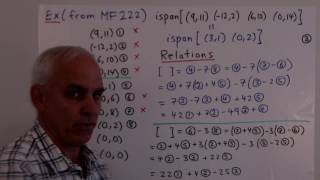
Relations Between Multisets - Abstract Algebra Math Foundations - Lecture 225
Explore integral linear spans and relations between msets, drawing parallels to linear algebra's rank-nullity theorem. Learn to obtain relations using the Hermite normal form algorithm.
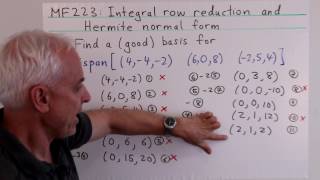
Integral Row Reduction and Hermite Normal Form - Math Foundations 223
Explores integral row reduction algorithm for finding a basis of integral linear space, paralleling Euclid's algorithm. Introduces Hermite normal form for msets of vexels in abstract algebra context.
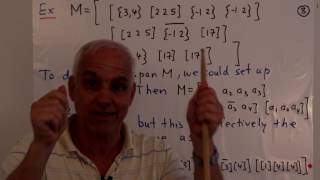
Bases and Dimension for Integral Linear Spaces - Math Foundations 222
Explores algorithm for finding simplified bases of integral linear spaces, adapting Gaussian elimination to work with integral combinations. Introduces key concepts in abstract algebra through practical computation.
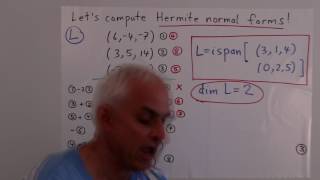
Lattice Relations and Hermite Normal Form - Abstract Algebra Math Foundations 224
Explore lattices and integral linear spans of vexels, including the Hermite normal form algorithm for understanding lattice structure and relations between elements in a spanning set.
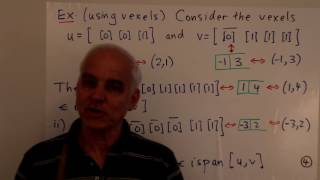
Linear Spaces and Spans II - MathFoundations 220
Introduction to integral linear spaces as abstract algebraic objects, exploring their applications in mathematics, chemistry, and physics. Foundational concepts for linear algebra using vexel language for concrete examples.
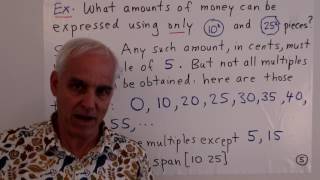
Linear Spaces and Spans I - Abstract Algebra Math Foundations 219
Introduction to linear spaces and spans, generalizing natural numbers with addition to form spans of multisets. Explores fundamental concepts in abstract algebra and linear algebra.
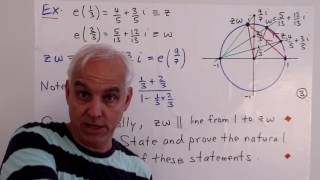
Rethinking Roots of Unity in Complex Algebra - Math Foundations 218
Explores complex roots of unity, challenging traditional views and highlighting logical difficulties in their definition and existence, emphasizing rational parametrization and algebraic approaches over infinite processes.
Fundamental Theorem of Algebra Reexamined - Math Foundations 217
Reexamines the Fundamental Theorem of Algebra, proposing new formulations based on rational complex arithmetic and quadrance, avoiding assumptions about continuity and real/complex numbers.
The Fundamental Dream of Algebra - Math Foundations 216
Challenging the Fundamental Theorem of Algebra, this video explores its flaws and proposes new thinking in mathematics, connecting to broader issues in the field.
Logical Challenges in Abstract Algebra - Math Foundations 214
Explores logical difficulties in abstract algebra, focusing on defining groups and the impact of different definitions on group theory development. Emphasizes critical thinking in mathematical foundations.
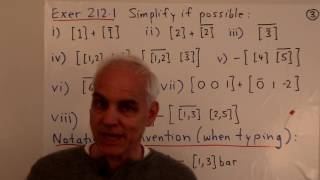
The Anti Operation in Mathematics - Data Structures in Math Foundations 212
Exploring the anti operation in multisets, its symmetry, and applications to vexels and maxels. Expands understanding of mathematical structures and operations.
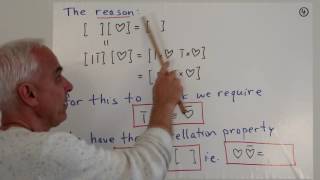
Numbers as Multipliers and Particle-Antiparticle Duality - Data Structures Math Foundations Lecture 211
Exploring the concept of anti-mathematical objects and their role in multisets, drawing parallels to particle/antiparticle symmetry in physics. Provides insights for modern algebra foundations.
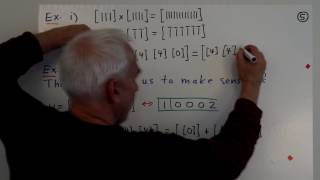
Numbers as Multipliers and Particle-Antiparticle Duality - Data Structures Math Foundations 210
Explores numbers as multipliers for sets and introduces particle/antiparticle duality, extending multiplication from natural numbers to integers in mathematical set theory.
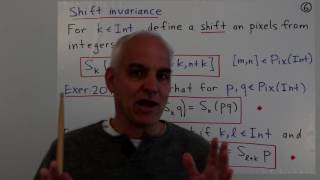
Algebra with Maxels from Integers - Data Structures Math Foundations 209
Exploring maxel theory as an extension of matrix theory, introducing shift invariance and partial identity maxels to restructure linear algebra with integer indices.
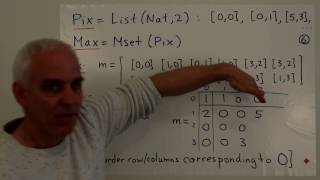
Integral Vectors and Matrices via Vexels and Maxels - Data Structures Math Foundations
Explore integral vectors and matrices through vexels and maxels, expanding on previous concepts with a multiset framework for more flexible indexing and generalized representations.
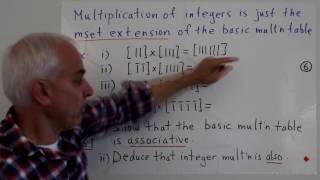
A New Trichotomy for Integer Arithmetic - Math Foundations 206
Novel approach to integer arithmetic using marks, anti-marks, and nothing. Explores symmetry between natural and negative numbers, foundational arithmetic of integers, and the role of multisets in organizing mathematical objects.
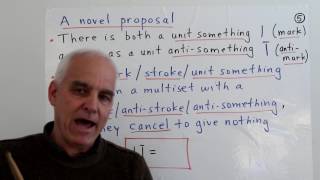
Negative Numbers, Multisets, and Modern Physics in Mathematics - Math Foundations 205
Exploring a new approach to arithmetic with integers using multisets and insights from modern physics, revolutionizing our understanding of negative numbers and mathematical foundations.
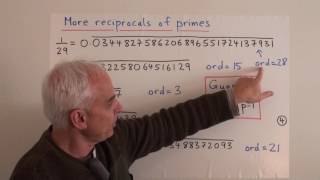
Reciprocals, Powers of 10, and Euler's Totient Function - Math Foundations 202
Explore decimal expansions of fractions, their connection to modular arithmetic, and Euler's totient function. Gain insights into repeated decimal cycles and their relationship with powers of 10 mod n.
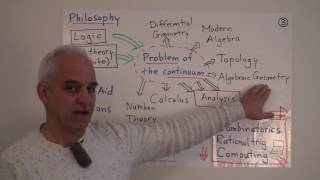
MathFoundations Series - 200 Videos Milestone and Future Directions
Celebrating 200 videos of MathFoundations, reflecting on the series' journey, addressing challenges in modern pure mathematics, and outlining future directions for critical thinking in mathematical foundations.