The Galois Group of the Category of Mixed Hodge Tate Structures
Explore the Galois group of mixed Hodge-Tate structures, focusing on Tannakian formalism and the canonical description of the Hopf algebra in relation to graded comodules.
Michael Hoffman - Multiple Zeta Values and Alternating MZVs Arising From a Combinatorial Problem
Exploration of multiple zeta values and alternating MZVs stemming from a combinatorial problem, discussing formulas involving Euler polynomials and relations among alternating multiple zeta values.
Raf Bocklandt: Deforming Dimers
Explore deformation theory of dimer models, their relation to mirror symmetry for Riemann surfaces, and various aspects illustrated with examples.
Automorphisms of Manifolds and the Farrell Jones Conjectures
Explores recent extensions of the Farrell-Jones Conjecture to Waldhausen's algebraic K-theory of spaces, examining implications for high-dimensional, closed, aspherical manifolds and their automorphism groups.
On Excision in Algebraic K-Theory
Explore advanced algebraic K-theory concepts, focusing on Suslin's excision theorem for Tor-unital rings and its extension to connective ring spectra and localizing invariants.
Motivic Eisenstein Cohomology, P-Adic Interpolation and Applications
Explore motivic Eisenstein classes, p-adic interpolation, and their applications in arithmetic, including explicit reciprocity law for Rankin-convolutions.
Algebraic K-Theory and Descent for Blow-Ups - Lecture 1
Explore algebraic K-theory and descent for blow-ups, focusing on pro-descent for infinitesimal thickenings and its implications for Weibel's conjecture on negative K-groups.
Descriptive Geometry of Function Spaces
Explore the intricate world of function spaces and their descriptive geometry in this advanced mathematical lecture by Shmuel Weinberger, part of the Hausdorff Trimester Program.
Topological and Combinatorial Models of Directed Path Spaces
Explore topological and combinatorial models for directed path spaces in concurrency theory, focusing on methods to analyze execution paths and state spaces in computer science.
Hodge Theory for the Conservativity Conjecture
Explore Hodge theory's application to the conservativity conjecture in algebraic geometry and number theory with Joseph Ayoub's insightful lecture.
Natural Homology Computability and Eilenberg Steenrod Axioms
Explore natural homology computability and Eilenberg Steenrod axioms in this advanced mathematics lecture, delving into applied and computational algebraic topology concepts.
Directed Paths on Cubical Complexes
Explore directed paths on cubical complexes in this advanced mathematics lecture, part of the Hausdorff Trimester Program on Applied and Computational Algebraic Topology.
Poisson U Statistics Subgraph and Component Counts in Random Geometric Graphs
Explore Poisson U statistics, subgraph counts, and component analysis in random geometric graphs, advancing knowledge in applied algebraic topology.
Mesoscale Crystal Plasticity Based on Continuum Dislocation Dynamics
Explores mesoscale crystal plasticity using continuum dislocation dynamics, presenting a novel mathematical model and numerical solution for predicting dislocation patterns in metal crystals.
Fluctuations in Stochastic Homogenization
Explore fluctuations in stochastic homogenization, focusing on the homogenization commutator and its role in driving path-wise fluctuations of key quantities in the field.
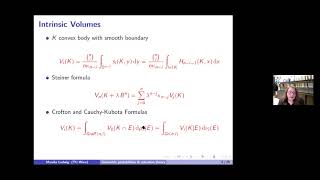
Geometric Probabilities and Valuation Theory
Explore applications of geometric valuation theory to probabilities and integral geometry, including Cauchy-Kubota formulas and recent findings for convex functions.
Gaussian Isoperimetry and Related Topics I
Explore Gaussian isoperimetry's applications in probability and analysis, including concentration inequalities, noise stability, and Sobolev-type inequalities. Learn proof techniques using geometric measure theory.
Categorifying Hecke Algebras at Prime Roots of Unity
Explore advanced algebraic techniques for categorifying Hecke algebras at prime roots of unity, utilizing p-DG categories in this cutting-edge mathematical research presentation.
Mikhail Khovanov: Universal Construction in Ultra Low Dimensions
Explore the universal construction concept as a relaxation of TQFT axioms, with applications in one and two-dimensional spaces.
Martina Lanini- Attractive Forests and Torus Actions
Explore quiver representations, torus actions on quiver Grassmannians, and their applications in algebraic geometry, focusing on attractive forests and nilpotent representations of equioriented cycles.
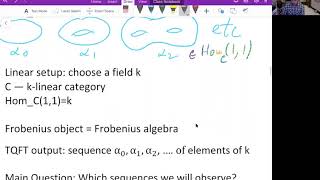
Two Dimensional Topological Field Theories and Partial Fractions
Explore the connection between 2D topological field theories and sequences derived from surface evaluations, examining target category impacts on sequence occurrence.