The Weighted Energy Dissipation WED Principle for Gradient Flows
Explore advanced variational methods for gradient flows, focusing on the Weighted Energy Dissipation principle and its applications in metric spaces and optimal control problems.
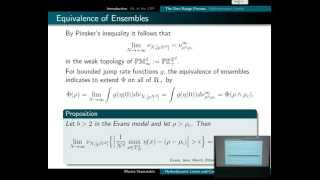
Hydrodynamic Limits and Condensing Zero Range Processes
Explore hydrodynamic limits and condensing zero range processes in interacting particle systems. Learn about phase separation, relative entropy method, and non-closed hydrodynamic descriptions.
Entropy Techniques for Nonlinear Partial Differential Equations - A Few Examples
Explore entropy techniques for nonlinear PDEs, focusing on Fokker-Planck equations. Learn applications in polymeric fluids, molecular dynamics, and high-dimensional algorithms.
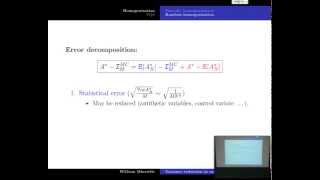
Variance Reduction in Random Homogenization - Special Quasirandom Structures
Explore variance reduction in random homogenization, focusing on special quasirandom structures. Learn about elliptic PDEs, homogenization techniques, and statistical error reduction in numerical approximations.
Borderline Sobolev Inequalities on Symmetric Spaces with Applications
Explores Bourgain-Brezis estimate for symmetric spaces, applying it to wave, Schrodinger, Maxwell equations and 2D Navier-Stokes flow. Presents joint research on advanced mathematical concepts in functional analysis.
Erik Lindgren: Infinity-Harmonic Potentials in Convex Rings
Exploration of Infinity-Laplace equation solutions in planar convex rings, focusing on streamline behavior, bifurcation phenomena, and regularity issues, with detailed analysis of a punctured square case.
Edgard Pimentel - Regularity Theory for Nonlinear PDEs
Explore recent developments in regularity theory for nonlinear PDEs, covering compactness, stability, and scaling arguments. Learn about fully nonlinear PDEs, Isaacs equation, and free boundary problems.
On a Class of Singular Perturbed Elliptic Systems with Asymptotic Phase Segregation
Explores elliptic singular perturbed systems and their convergence to phase segregating systems. Examines existence, uniqueness, and asymptotic behavior, presenting a novel method for solving limiting problems.
Henrik Shahgholian - Free Boundaries on Lattice, and Their Scaling Limits
Explore lattice-based potential theory, examining harmonic functions and free boundary problems. Discover intriguing numerical results and their implications for facet formation in scaling limits.
The Relational Complexity of a Finite Permutation Group
Explores relational complexity in finite permutation groups, discussing its measurement, estimation methods, and recent progress towards proving a key conjecture using theoretical and computational approaches.
Distinguishing Groups and the Group Isomorphism Problem
Explore the scale function in totally disconnected, locally compact groups, its computation methods, and the challenges in obtaining representations for certain groups. Insights into group theory and isomorphism problems.
Growth in Linear Algebraic Groups and Permutation Groups
Exploración de límites de diámetro en grupos simétricos y algebraicos lineales, con énfasis en técnicas simplificadas y conexiones entre diferentes enfoques matemáticos.
Stability and Invariant Random Subgroups I
Explore stability in permutation groups, unimodular random networks, and invariant random subgroups. Learn decision methods for equations in group theory and graph theory.
Derek Holt- Algorithms for Finitely Presented Groups I
Explore fundamental algorithms for computing in finitely presented groups, including Todd-Coxeter coset enumeration and Reidemeister-Schreier algorithm, with practical examples and applications.
Derek Holt- Algorithms for Finitely Presented Groups II
Explore advanced algorithms for finitely presented groups, including Todd-Coxeter coset enumeration, Reidemeister-Schreier algorithm, and automatic structures. Learn applications in group theory computations.
Computing with Gödel's Completeness Theorem
Explore computational approaches to Gödel's completeness theorem, including Krivine's "exploding models," A-translation, and Kripke forcing, with insights on reifying validity proofs into derivability proofs.
Giovanni Sambin - Pointfree Topology Is Real and Pointwise Is Ideal
Explore dynamic perspectives in mathematics, blending computation and spatial intuition. Learn about positive topology, effective pointfree approaches, and the balance between real and ideal mathematical concepts.
Notions of Booleanization in Pointfree Topology
Explores overlap algebras as a potential solution to retain features of Boolean locales while recovering classical properties in intuitionistic pointfree topology.
Two Constructive Approaches to Probability Theory
Explores constructive approaches to probability theory, comparing frequentist and pointfree metric methods with classical Kolmogorov axioms and other paradigms in mathematics.
Every Metric Space Is Separable in Function Realizability
Explore function realizability topos, separable metric spaces, and countable objects with decidable equality. Delve into synthetic topology and its implications for intuitionistic logic.
Derived Rules in Set Theory
Explore intuitionistic set theories and learn about a general machinery for demonstrating derived rules in this advanced mathematical lecture.