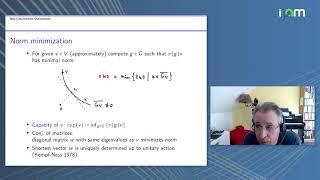
Towards a Theory of Non-commutative Optimization - Geodesic First and Second Order Methods for Moment Maps and Polytopes
Explore non-commutative optimization theory for geodesically convex problems, unifying diverse applications in computer science, mathematics, and physics through innovative first and second-order methods.
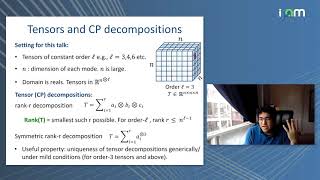
Smoothed Analysis for Tensor Decompositions and Unsupervised Learning
Explore smoothed analysis for tensor decompositions and unsupervised learning, focusing on polynomial time guarantees and robust decompositions of symmetric overcomplete tensors.
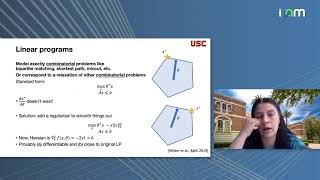
Decision-Focused Learning - Integrating Downstream Combinatorics in ML
Explore the integration of machine learning and discrete optimization to enhance problem-solving in real-world scenarios, focusing on decision-focused learning and tailored solution strategies.
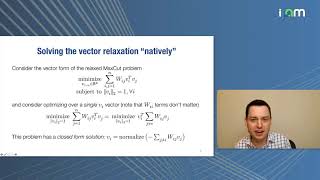
Fast Semidefinite Programming for Differentiable Combinatorial Optimization
Explore advanced techniques in semidefinite programming for combinatorial optimization, focusing on fast and differentiable methods presented by Carnegie Mellon expert Zico Kolter.
Structured ML Training via Conditional Gradients
Explore conditional gradient methods for structured optimization in machine learning, covering applications in traditional and deep learning, with a focus on incorporating polyhedral structures into solutions.
Classifying Small Fusion Categories
Explore the classification of small fusion categories, including recent results on odd-dimensional modular and fusion categories. Learn about different interpretations of "small" in this context.
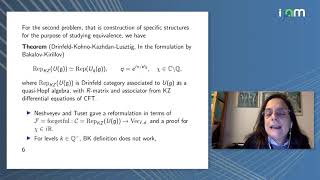
Weak Quasi-Hopf Algebras Associated to Verlinde Fusion Categories
Exploration of weak quasi-Hopf algebras in relation to Verlinde fusion categories, discussing unitarity, quantum groups, and potential applications to Kazhdan-Lusztig-Finkelberg theorem.
Outer Actions of Amenable Groups on von Neumann Algebras
Explore classification of outer actions of amenable groups on von Neumann algebras, focusing on II_1 factors. Covers Ocneanu's uniqueness theorem and Popa's work on 2-cohomology vanishing.
Transportation Engineering for Connected and Automated Vehicles
Explore the impact of connected and automated vehicles on transportation engineering, focusing on mathematical challenges and opportunities in this emerging field.
Basic Traffic Models and Traffic Waves
Explore fundamental traffic models and wave phenomena in vehicular flow, examining mathematical concepts crucial for understanding and optimizing autonomous vehicle systems.
Triangular Ice Combinatorics
Explores Alternating Phase Matrices, a generalization of Alternating Sign Matrices, in the context of triangular lattice ice models. Discusses connections to domino tilings and presents enumeration formulas and limit shape results.
Positivity for Symmetric Functions and Vertex Models
Explore connections between symmetric function homomorphisms and stochastic six-vertex model positivity, linking to RSK correspondence in algebraic combinatorics.
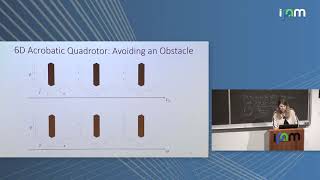
Towards Real-Time Reachability
Explore advanced techniques in real-time reachability analysis for high-dimensional systems, focusing on Hamilton-Jacobi PDEs and their applications in control and safety verification.

Deep Learning of Dynamical Systems for Mechanistic Insight and Prediction in Psychiatry
Explore deep learning techniques for analyzing dynamical systems in psychiatry, uncovering mechanisms, and predicting outcomes using neural and behavioral data from various sources.
Subtly Knotted Surfaces Separated by Many Internal Stabilizations
Exploration of smoothly knotted surfaces in 4-manifolds, focusing on isotopy, internal stabilizations, and diffeomorphisms. Discusses infinite collections of surfaces with unique properties and infinite stabilization diameter.
Homology Cobordism and the Geometry of Hyperbolic Three-Manifolds
Explore the interaction between hyperbolic geometry and homology cobordism using monopole Floer homology, focusing on subgroups generated by hyperbolic homology spheres.
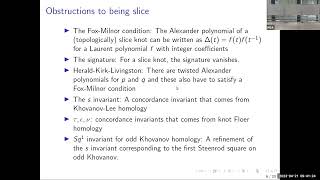
Ribbon Concordances and Slice Obstructions: Experiments and Examples
Explore ribbon concordances between knots, computational methods, and results in low-dimensional topology. Joint work with Nathan Dunfield on slice obstructions and experimental approaches.
Instantons, Suspension, and Surgery
Explore advanced concepts in gauge theory, including instantons, suspension, and surgery techniques for manifolds with boundary components and their applications in cobordism maps.
Instantons, Suspension, and Surgery - Part 1
Explore Dehn surgery number in 3-manifolds, using mod 2 instanton homology and Froyshov's q_3 invariant to prove existence of integer homology 3-spheres with arbitrarily large surgery numbers.
Fan Ye, Harvard University - 2-Torsions in Singular Instanton Homology
Exploration of 2-torsions in singular instanton homology for knots, comparing complex and Z/2 coefficients, with focus on fibered knots and genus 1 knot surgeries.
Instanton Floer Homology and Heegaard Diagrams
Exploring the connection between instanton Floer homology and Heegaard diagrams in 3-manifolds, with insights on extracting information and potential applications in topology.