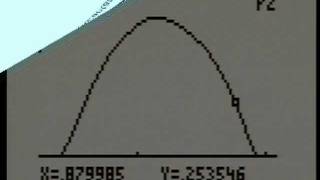
Measuring Speed - Average and Instantaneous Velocity - Part 1
Explore average and instantaneous velocity concepts through practical examples and data analysis techniques in this engaging calculus lesson.
The Pitfalls of Using ML-Based Optimization - IPAM at UCLA
Explore pitfalls of ML-based optimization in graph problems, comparing traditional approaches for Force Path Cut and Hypergraph Discovery. Gain insights on limitations and potential improvements in AI applications.
Discrete Optimization-Aided Structured Learning at Scale - IPAM at UCLA
Explore discrete optimization techniques for structured learning, featuring algorithmic aspects, statistical setups, and approaches to feature selection and learning trees.
Computer-Assisted Proofs in the Arithmetic of Quadratic Forms - IPAM at UCLA
Explore computer-assisted proofs in quadratic forms arithmetic, covering equivalence, representation, local-global principles, and modular forms. Gain insights into complex computations across mathematics.
Formal Mathematics for Mathematicians and Mathematics Students - IPAM at UCLA
Explore formal mathematics' potential to revolutionize mathematical exposition, focusing on benefits beyond proof verification and its impact on mathematicians and students.
Using Machine Learning to Formulate Mathematical Conjectures - IPAM at UCLA
Explore how machine learning aids mathematicians in formulating conjectures, focusing on a discovery linking low-dimensional topology and geometry, with insights on the method's potential and limitations.

Formalizing Invisible Mathematics - IPAM at UCLA
Explore the challenges of formalizing mathematics for computers, examining unspoken conventions, proof assistant techniques, and potential solutions for flexible, user-extensible systems.
The Liquid Tensor Experiment - IPAM at UCLA
Explore the Liquid Tensor Experiment and its implications for machine-assisted proofs in mathematics, featuring innovative concepts and real-time mathematical demonstrations.
Learning How to Break Symmetry With Symmetry-Preserving Neural Networks - IPAM at UCLA
Explore symmetry-preserving neural networks for data efficiency and generalization, learning symmetry-breaking information, and predicting structural distortions in crystalline materials.
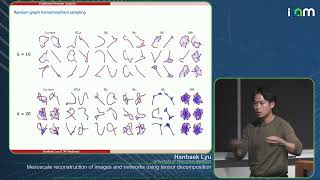
Mesoscale Reconstruction of Images and Networks Using Tensor Decomposition
Explore mesoscale reconstruction of images and networks using tensor decomposition, focusing on a unified framework, error bounds, and online CP-dictionary learning for multi-modal datasets.
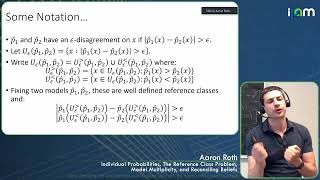
Individual Probability, Reference Class Problem, Model Multiplicity, Reconciling Belief
Explore individual probabilities, reference class problem, and model multiplicity in machine learning. Gain insights on reconciling beliefs and addressing challenges in probability estimation for individuals and groups.
Approximate Matrix Eigenvalues, Subspace Iteration With Repeated Random Sparsification
Explore efficient matrix eigenvalue approximation using subspace iteration and random sparsification, with applications in quantum chemistry and high-dimensional problems.
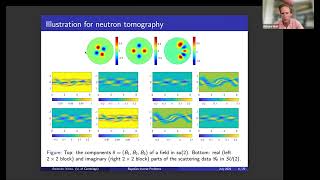
Statistical Inverse Problems and PDEs: Progress and Challenges
Explore statistical inverse problems and PDEs, covering Bayesian approaches, computational challenges, and mathematical guarantees for algorithms in high-dimensional settings.
Enhancing Markov Chain Monte Carlo Sampling Methods with Deep Learning
Explore advanced techniques combining Markov Chain Monte Carlo sampling with deep learning, focusing on importance sampling, normalizing flows, and non-equilibrium methods for enhanced efficiency in high-dimensional problems.
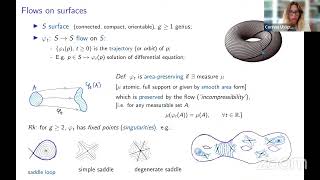
Corinna Ulcigrai - Dynamics and Arithmetics of Higher Genus Surface Flows
Explore dynamics of higher genus surface flows, examining discrete systems, arithmetic conditions, and ergodic integrals. Gain insights into mixing, shearing, and local linearization techniques.
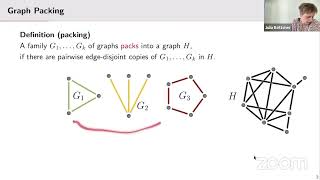
Julia Boettcher- Graph and Hypergraph Packing
Explore graph and hypergraph packing, Latin squares, and randomness in mathematics with Julia Boettcher's insightful lecture on combinatorial structures.
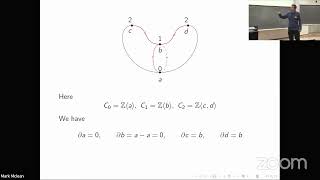
Floer Cohomology and Birational Geometry
Explore Floer cohomology applications in birational geometry, including McKay correspondence and quantum cohomology of Calabi-Yau manifolds.
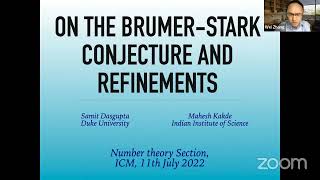
On the Brumer-Stark Conjecture and Refinements
Exploration of the Brumer-Stark conjecture and its refinements, covering group rings, class groups, and related conjectures in algebraic number theory.
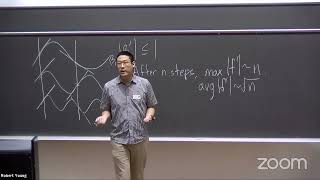
Composing and Decomposing Surfaces in R^n
Explore surface decomposition in R^n, Lipschitz functions, nonorientability, and their applications in mathematics, with insights on the Heisenberg group.

George Willis, Pierre-Emmanuel Caprace - A Totally Disconnected Invitation to Locally Compact Groups
Explore topological groups, focusing on locally compact and totally disconnected types. Discover recent advances in theory, simple groups, local structure, and comparisons with linear groups.
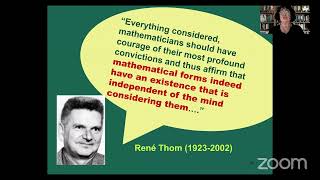
Anna Sfard- The Long Way From Mathematics to Mathematics Education- How Educational Research
Explore the conceptualization of mathematics as narrative creation and its impact on education through a researcher's personal journey and theoretical insights.