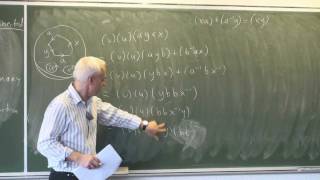
An Algebraic ZIP Proof of the Classification - Algebraic Topology - NJ Wildberger
Algebraic approach to classifying two-dimensional surfaces using spheres with holes, introducing a notation for manipulating edges between holes on spheres. Explores Conway's ZIP proof in a novel way.
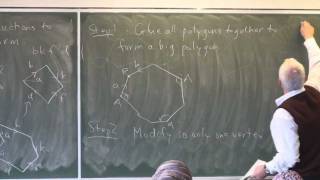
Classification of Combinatorial Surfaces - Algebraic Topology - NJ Wildberger
Introduction to the classification of connected compact combinatorial surfaces in algebraic topology, covering key concepts like polygons, vertices, traversing, Euler number, and orientability.
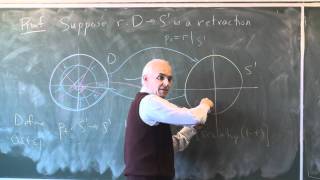
More Applications of Winding Numbers - Algebraic Topology - NJ Wildberger
Explore winding numbers, degree of circle functions, and key theorems in algebraic topology. Learn about retractions, fixed points, and Borsuk's Lemma in this advanced mathematics lecture.
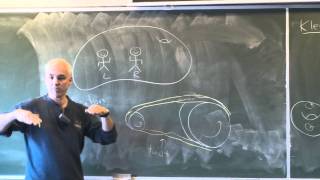
Non-Orientable Surfaces - The Mobius Band - Algebraic Topology
Explore non-orientable surfaces like the Möbius band, understanding their unique properties and applications in algebraic topology. Learn about crosscaps and key deformations.
The Klein Bottle and Projective Plane - Algebraic Topology - NJ Wildberger
Explore the Klein bottle, projective plane, and Platonic solids in this algebraic topology lecture. Learn about Euler's formula and its proof using triangulation and sphere flow.
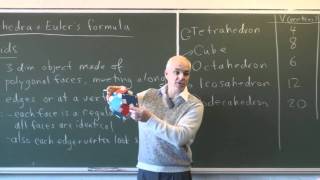
Polyhedra and Euler's Formula - Algebraic Topology
Explore Platonic solids, Euler's formula, and spherical geometry in this engaging lecture on algebraic topology, featuring proofs and insights into fundamental mathematical concepts.
Two-Dimensional Objects - The Torus and Genus - Algebraic Topology
Explore surfaces like cylinders and tori, understanding their properties and connections to complex function theory. Learn about genus and how planes cover different surfaces.
Number Systems Throughout History - Elementary Mathematics Explained
Explore ancient number systems from Babylonian to Roman, understanding their development, unique features, and common elements. Gain insights into the foundations of modern mathematics.
Arithmetic With Rectangles - Elementary Mathematics Explained
Explore arithmetic fundamentals using rectangles. Learn counting, addition, and multiplication with visual representations suitable for young learners. Develop a strong foundation in basic mathematical concepts.
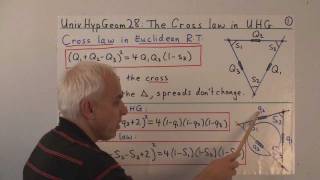
The Cross Law in Universal Hyperbolic Geometry - Universal Hyperbolic Geometry - NJ Wildberger
Explores the Cross law in Universal Hyperbolic Geometry, proving it with a polynomial identity and demonstrating its application to equilateral triangles. Includes exercises and comparisons to Euclidean geometry.
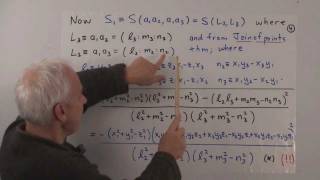
The Spread Law in Universal Hyperbolic Geometry - Universal Hyperbolic Geometry
Explores the Spread law in universal hyperbolic geometry, including its definition, relation to Euclidean geometry, proof, and implications. Covers key concepts like quadrance, spread duality, and quadrea.
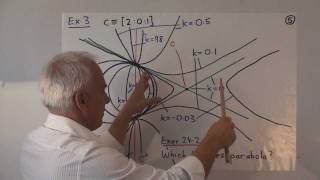
Visualizing Quadrance with Circles - Universal Hyperbolic Geometry - NJ Wildberger
Explore quadrance in universal hyperbolic geometry through circles, examining their appearance as ellipses, parabolas, or hyperbolas with different centers, enhancing understanding of this fundamental concept.
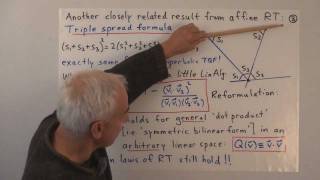
The Triple Quad Formula in Universal Hyperbolic Geometry
Explores the Triple quad formula in hyperbolic geometry, its proof, and related concepts. Compares with Euclidean geometry and discusses algebraic challenges, providing exercises for deeper understanding.
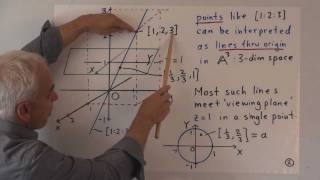
Pythagoras' Theorem in Universal Hyperbolic Geometry
Explore the hyperbolic version of Pythagoras' theorem, its importance in geometry, and the concept of quadrance. Learn about planar coordinates, formulas, and proofs in Universal Hyperbolic Geometry.
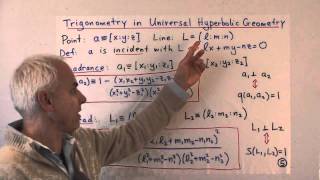
Quadrance and Spread - Universal Hyperbolic Geometry
Introduces algebraic definitions of quadrance and spread in Universal Hyperbolic Geometry, comparing with Rational Trigonometry and exploring main laws and exercises in this advanced mathematical framework.
Apollonius' Circle Construction Problems - Famous Math Problems
Explore Apollonius' circle construction problems, their historical significance, and related geometric concepts. Learn about circle geometry, constructions, and their relevance in modern mathematics.
Change of Basis and Taylor Coefficient Vectors - Wild Linear Algebra A - NJ Wildberger
Explore change of basis, vatrices, and Taylor coefficients in linear algebra. Novel framework connects coordinate vectors to calculus applications, featuring generalized Pascal matrices.
Factoring Large Numbers into Primes - Famous Math Problems
Explore prime factorization of large numbers, modular arithmetic, and theorems by Fermat and Euler. Learn techniques to tackle complex mathematical problems and improve number theory skills.
Cubic Splines Using Calculus - Wild Linear Algebra
Explore cubic spline interpolation using Taylor coefficient vectors, a novel approach to creating smooth curves through given points without requiring prior calculus knowledge.
Cubic Splines - De Casteljau Bezier Curves Using Linear Algebra
Explore de Casteljau Bezier curves and cubic splines using linear algebra, focusing on their elegant formulas and applications in design work from automobiles to modern graphics.
The Time Scale of a Human Life - Elementary Mathematics Explained
Explore the measurement of time through human life stages, astronomical cycles, and life spans. Learn to visualize a century-long timeline and understand key milestones in human development.