
Data Science: Complete Roadmap to Become a Data Scientist
Comprehensive roadmap to becoming a data scientist, covering essential skills, tools, and resources. Includes job prospects, learning strategies, and recommended books for career advancement.

Informational and Topological Signatures of Individuality in Network Neuroscience
Exploring brain function through topological data analysis, demonstrating improved individual and age discrimination using algebraic-topological features extracted from resting fMRI data compared to traditional methods.
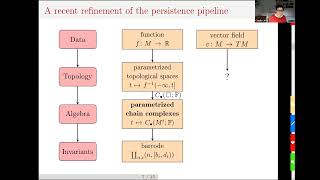
Barcodes for the Topological Analysis of Gradient-Like Vector Fields
Explore topological analysis of gradient-like vector fields using barcodes. Learn about chain complexes, parametrization, and applications in smooth and discrete settings, with insights on stability and approximation.

Discrete Morse Graph Skeletonization and Application to Local Structures of scRNA-seq Data
Explores topological data analysis for extracting graph skeletons from high-dimensional data, with applications in analyzing local structures of scRNA-seq datasets across brain regions.
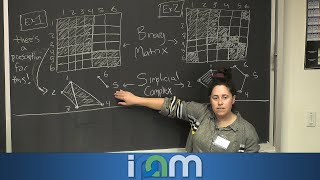
The ABCs of Topological Data Analysis for Matrix Analysis
Explore topological data analysis for matrix structure, focusing on persistent homology and Betti curves. Learn applications in neuroscience, including analysis of neural correlation matrices.
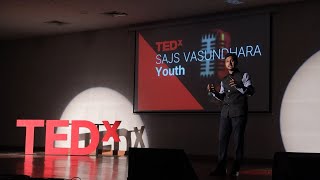
A Journey That Transcends Traditional Boundaries
Explore the intersection of science and art, where technological breakthroughs inspire creativity. Discover how analytical thinking and aesthetic expression converge, guided by Falit Sijariya's innovative perspective on bridging disciplines.
When AI Became ML, and Then AI Again - Tracing the Evolution of Terms and Technologies
Explore the evolution of AI and ML terminology, from early ambitious goals to specialized algorithms, and their recent convergence, reflecting the field's dynamic nature and growing demand for specialized infrastructure.
Toward Equity in Travel Demand Modeling
Explore innovative approaches to incorporate equity considerations in travel demand modeling, addressing transportation disparities and promoting fair access to mobility resources.
Clara Stegehuis- Optimization-Based Analysis of Random Graphs I
Explore random graph models, focusing on power-law degree distributions and optimization-based methods to analyze network properties and underlying geometries.

Turning the Light of Truth - Data Science as a Practice of Resistance
Exploring data science's dual role in oppression and resistance, highlighting its potential for uncovering truth and addressing societal inequalities through real-world examples and critical analysis.

The Power of Sport - Using Football as a Catalyst for Positive Change
Exploring sport's transformative power through personal experiences in football, addressing sectarianism, fostering integration, and empowering marginalized communities to create positive societal change.
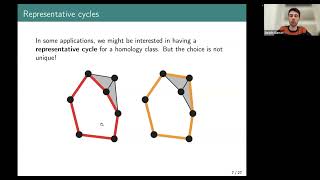
Harmonic Persistent Homology for Disentangling Multiway Interaction in Data
Explore Harmonic Persistent Homology for analyzing multi-omics data, uncovering hidden patterns in complex diseases, and identifying biomarkers associated with latent biological pathways.
Randomized Linear Algebra for Interior Point Methods
Explore randomized linear algebra techniques for efficient interior point methods in linear programming, focusing on applications in data science and scientific computing.
Modeling Noisy Count Data I by Sayan Mukherjee
Explore statistical modeling techniques for analyzing noisy count data, focusing on methods to handle variability and uncertainty in numerical datasets.
Big Data in Biology - How EMBL Delivers Big Data for Biology, and Some Highlights
Explore how EMBL manages and utilizes big data in biology, with insights on key developments and applications in genomics and bioinformatics.

Meaning in the Age of Large Language Models
Exploring how large language models reshape theories of human language, grammar, and semantics, challenging traditional views on language acquisition and conceptual representation.
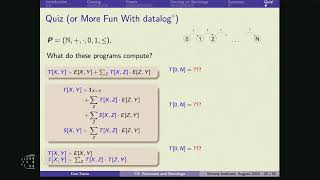
Algebraic Structures in Logic and Query Evaluation - Lecture 3
Explore algebraic structures in logic and query evaluation, focusing on advanced concepts and their applications in database theory and AI.
Algebraic Structures in Logic and Query Evaluation - Part 4
Explore algebraic structures' role in logic and query evaluation, focusing on advanced concepts and their applications in database theory and AI.
Why Great Leaders Must Unlearn to Succeed in Today's Exponential World
Discover how leaders can adapt to rapid change by unlearning outdated practices and embracing new strategies for revitalized business success in an exponential world.
Embrace the Chaos - Turning Unpredictability into Creativity and Growth
Discover how embracing life's unpredictable moments can lead to creativity and personal growth. Learn to view chaos as an opportunity for expanded awareness and insight.
Teaching Neural Networks a Sense of Geometry
Explore Topological Data Analysis (TDA) and its intersection with machine learning to enhance neural networks' geometric reasoning abilities across various applications.