Finite-Time Guarantees of Contractive Stochastic Approximation - Mean-Square
Explore finite-time guarantees of contractive stochastic approximation, focusing on mean-square analysis. Learn about advanced probabilistic methods in data science and optimization.
The Problem Dependant Complexity of Sequential Optimization by Aurélien Garivier
Explores problem-dependent complexity in sequential optimization, focusing on probabilistic and optimization techniques for data science and their applications in various fields.
The Beautiful Mind of a Timeline - Data Exploration and Analysis in Digital Forensics
Explore data science techniques for anomaly detection and noise reduction in digital forensics using Timesketch, with insights from Google security experts.
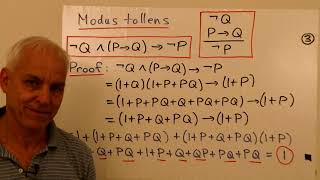
Inference Rules via the Algebra of Boole - MathFoundations 275
Explore propositional logic inference rules using Boolean algebra, simplifying complex logical concepts and eliminating the need for memorization. Includes application to a Lewis Carroll puzzle.
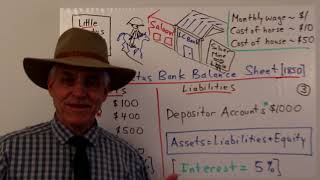
A Mathematician's View of Banking - Wild West Banking
A mathematician's perspective on 19th-century banking, exploring fundamental concepts like assets, liabilities, and balance sheets through the fictional Little Cactus Bank in the Wild West.
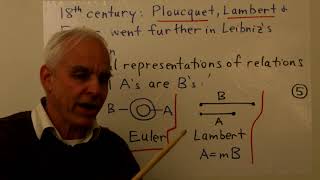
A Brief History of Logic: From Leibniz to Boole - Math Foundations 254
Explore the evolution of logic from Leibniz to Boole, covering key thinkers and innovations in systematic reasoning, diagram representations, and the introduction of mathematics to classical logic.
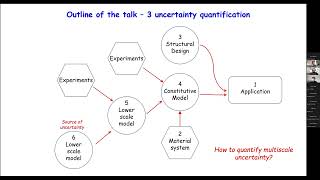
Learning-Based Multiscale Modelling: Computing, Data Science, and Uncertainty Quantification
Explore machine learning frameworks for multiscale modeling in materials science, including Fourier and recurrent neural operators, to accelerate computations and bridge scales across multiple physics levels.
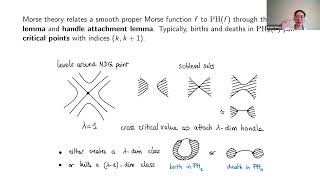
Generalized Morse Theory of Distance Functions to Surfaces for Persistent Homology
Unifying distance fields, persistent homology, and Morse theory to quantify complex shape textures, with applications in characterizing vascular structures in leukemia samples.
Federated and Collaborative Learning - Session 1
Explore cutting-edge topics in federated learning, including data valuation, privacy, uncertainty quantification, and scaling to foundation models, presented by leading experts in the field.
Automating Bone Age Assessment from Pediatric Xrays
Learn to automate bone age assessment from pediatric X-rays using machine learning techniques. Explore practical applications in healthcare for more efficient and accurate diagnoses.
Cancer Diagnostics - Opportunities and Challenges by Sudha Sundar
Explore opportunities and challenges in cancer diagnostics, focusing on innovative approaches and potential advancements in early detection and personalized treatment strategies.
Digital Twins in Engineering: From Air Pollution to Cardiology - Day 3
Advancing digital twins: Experts explore foundational aspects, research challenges, and key applications, bridging data-driven and mechanistic modeling for engineering and scientific domains.
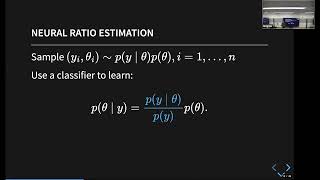
Digital Twins Workshop: Foundations and Challenges - Day 1
Advancing digital twins research: Experts explore Bayesian inference, irregular posteriors, and geophysical applications in this foundational workshop for data-driven engineering.

Google Earth Pro Fundamentals and Advanced Features Course
Learn to navigate Google Earth Pro, plan trips, create custom maps, and explore advanced features like recording tours and analyzing geographical data.
GPU-Acceleration for Pandas, NetworkX, and Apache Spark MLlib - Accelerating Data Science Tools
Discover GPU-accelerated data science tools for pandas, NetworkX, and Apache Spark MLlib. Learn about RAPIDS cuDF, accelerated data processing, and optimizing machine learning pipelines for enhanced performance and accessibility.
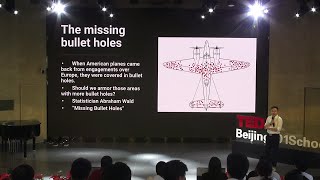
Correlation vs. Causality - Unraveling the Relationship
Explore the crucial distinction between correlation and causation through real-world examples and philosophical insights, enhancing critical thinking skills for data interpretation and decision-making.
Setting the Stage with Networks and Network Dynamics
Explore fundamental concepts in network science and dynamics, including various network types and their applications in connectome analysis, with interactive discussions and project formulation.
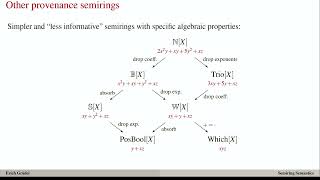
Semiring Semantics
Explore semiring semantics in logic, evaluating statements with values beyond true/false. Learn applications in database queries, provenance analysis, and extensions to various logical systems.
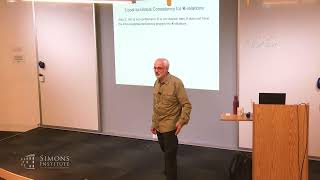
Consistency, Acyclicity, and Positive Semirings
Explore local vs. global consistency in probability distributions and relational databases, generalizing results using K-relations over positive semirings and acyclic hypergraphs.
Tableau Business Intelligence - Advanced Techniques and Dashboard Creation
Master advanced Tableau techniques for creating insightful dashboards. Learn to analyze world population data, explore USA colleges, and develop powerful visualizations for real-world business scenarios.
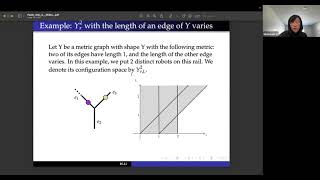
Two-Parameter Persistent Homology of Second Configuration Spaces in Star Graphs
Explore configuration spaces in robot motion planning, focusing on 2-parameter persistent homology of second configuration spaces of star graphs with restraint parameters.