Low Rank Tensor Methods in High Dimensional Data Analysis
Explore low rank tensor methods for analyzing high-dimensional data in various fields. Learn about recent progress, challenges, and applications in extracting information from multilinear arrays.
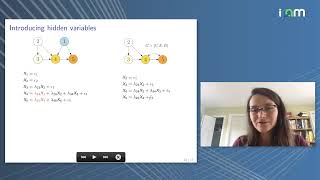
Hidden Variables in Linear Non-Gaussian Causal Models
Explore hidden variables in linear non-Gaussian causal models, using high-order cumulant information to uncover causal structures in data science applications with multiple observed variables.

Calculus Review - The Derivative, the Power Law, and the Chain Rule
Comprehensive review of derivatives, power law, and chain rule in calculus. Essential concepts for understanding differential equations and dynamical systems.

Robust, Interpretable Statistical Models - Sparse Regression with the LASSO
Explore sparse regression and LASSO algorithm for building interpretable, robust models with minimal variables. Learn key concepts and applications in data science and machine learning.

Workshop on Parameter Estimation with Bilby by Greg Ashton
Learn parameter estimation techniques for gravitational wave analysis using bilby software, focusing on Bayesian inference and practical applications in astrophysics.

Minimal Cycle Representatives in Persistent Homology Using Linear Programming
Explores optimization techniques for selecting minimal cycle representatives in persistent homology, comparing effectiveness and computational costs of various algorithms using linear programming methods.
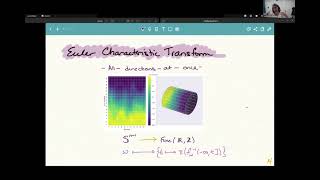
The Directional Transform
Explore the directional transform in topological data analysis, its applications in understanding complex structures, and its potential for enhancing machine learning models and data shape quantification.

A Topological Study of the Space of Planar Pentagons
Exploring topology of planar pentagons as a model for molecular conformation spaces, using topological data analysis for dimensionality reduction and visualization.
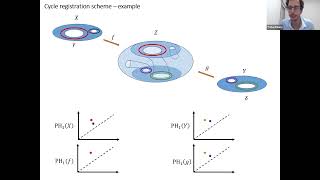
Persistent Cycle Registration and Topological Bootstrap
Novel approach for comparing persistent homology representations, utilizing spatial placement of persistent cycles. Demonstrates application in topological inference to differentiate signal from noise in point cloud data.
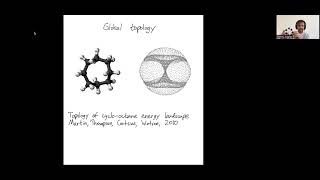
Henry Adams - Topology in Machine Learning
Explore persistent homology in machine learning, covering applications in materials science, computer vision, and agent-based modeling. Learn how topology relates to dataset geometry and explainable AI.
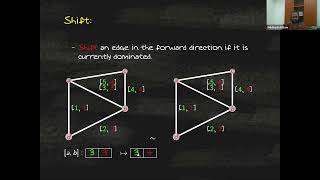
Swap, Shift and Trim to Edge Collapse a Flag Filtration
Exploring efficient algorithms for reducing flag filtrations in persistent homology, with focus on edge collapse techniques and their applications in computational topology.
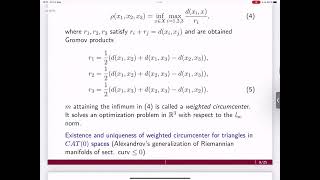
Geometry and Topology of Data
Explore hyperconvexity and generalized curvature in metric spaces, linking topological data analysis with geometric concepts for a deeper understanding of data structures.

The Generalized Persistence Diagram Encodes the Bigraded Betti Numbers
Explore how generalized persistence diagrams encode bigraded Betti numbers in 2-parameter persistence modules, with implications for RIVET software and interval decomposable modules.
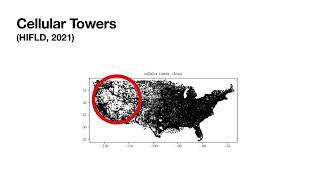
Small Density Vacuum and How to Find Them Robustly
Explore a new TDA method for identifying small density vacuums in high-density regions, with proven robustness and bounded persistence. Includes simulations and theoretical insights.
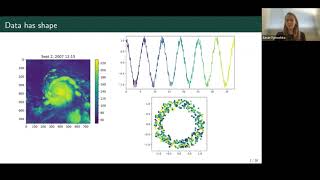
Topological Time Series Analysis for Hurricanes and Dynamical Systems
Explore topological data analysis applications in studying hurricane satellite imagery and dynamical system bifurcations using persistent homology and zigzag persistence techniques.
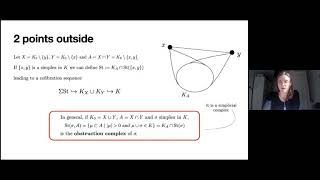
Homotopical Decompositions of Simplicial and Vietoris Rips Complexes
Explore homotopical decompositions of simplicial complexes, focusing on obstruction complexes and their applications in topological data analysis, with insights on Vietoris-Rips complexes.
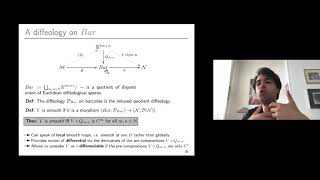
Differential Calculus on Persistence Barcodes
Explore differential calculus on persistence barcodes, covering differentiability concepts, lifts to ordered barcodes, and applications in topological data analysis.
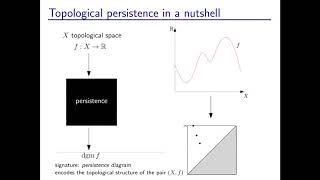
On the Metric Distortion of Embedding Persistence Diagrams into RKHS
Explores embedding Persistence Diagrams into Reproducing Kernel Hilbert Spaces, analyzing metric properties and stability guarantees for machine learning applications in Topological Data Analysis.
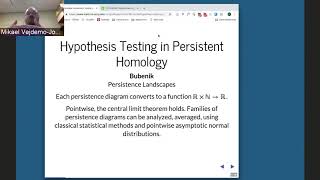
Multiple Hypothesis Testing with Persistent Homology
Exploring methods for multiple hypothesis testing in persistent homology, including family-wise error rates and false discovery rates, with applications to Mapper complex validation.
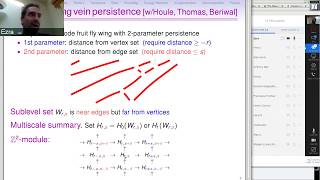
Real Multiparameter Persistent Homology
Explores real multiparameter persistent homology, addressing challenges and practical applications in data science. Introduces topological tameness and its implications for algebraic concepts and computational methods.
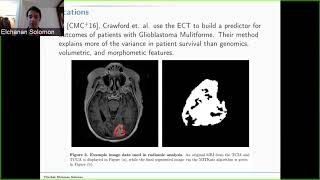
An Intrinsic Persistent Homology Transform
Explores an intrinsic persistent homology transform for metric spaces, focusing on metric graphs. Discusses injectivity results and compares to related constructs in topological data analysis.