
Other Persistence Invariants - Homotopy and the Cohomology Ring
Explore persistent homotopy groups and cohomology rings, focusing on fundamental groups, rational homotopy, and cup-length diagrams. Learn about new tools complementing persistent homology in topological data analysis.

Massimo Ferri - Selection of Points in Persistence Diagrams
Explore point selection in persistence diagrams, including Kurlin's criterion and the Ziqqurat method, for noise reduction and improved data analysis in topological data analysis.
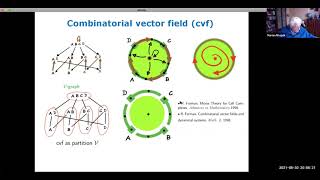
Marian Mrozek - Combinatorial vs. Classical Dynamics: Recurrence
Explore combinatorial dynamics in data science, its ties to classical dynamics, and applications in computer-assisted proofs. Learn about topological invariants and recent developments in recurrent behavior analysis.

On Characterizing Rare Events in Persistent Homology
Explore rare events in persistent homology, focusing on indecomposables in multi-parameter settings. Learn about large deviation principles and laws of large numbers in topological data analysis.
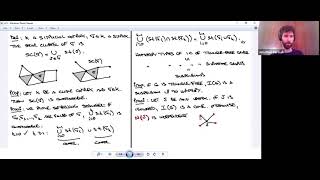
Star Clusters in Clique Complexes and the Vietoris-Rips Complex of Planar Sets
Explore star clusters in simplicial complexes and their applications to independence complexes and Vietoris-Rips complexes of planar sets, with insights on homotopy information and related conjectures.
Sequence Alignment - Hidden Markov Models, Category Theory and All That Jazz by Soumyashant Nayak
Explore sequence alignment methods, from traditional algorithms to modern pseudo-alignment techniques, with insights on hidden Markov models and applications in RNA-Seq data analysis and evolutionary genetics.

The Usefulness of Useless Knowledge by Robbert Dijkgraaf - Followed by a Panel Discussion
Explore the value of curiosity-driven research and its impact on technological progress, featuring insights from renowned scientists and a panel discussion on global science trends.
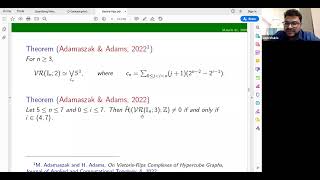
Vietoris-Rips Complexes of Hypercube Graphs
Explore Vietoris-Rips complexes of hypercube graphs, their collapsibility, and applications in genetic trees and persistent homology. Gain insights into simplicial complexes and topological data analysis.
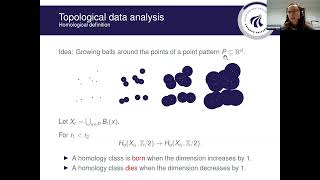
Analyzing Point Processes Using Topological Data Analysis
Explore point processes using topological data analysis, covering models, statistical techniques, and applications in spatial statistics. Learn to distinguish between process types and understand central limit theorems.

GPU Accelerated Computation of VR Barcodes in Evaluating Deep Learning Models
GPU-accelerated computation of VR barcodes for evaluating deep learning models, focusing on Ripser++ software and its applications in measuring data distribution shifts and analyzing attention graphs in BERT models.
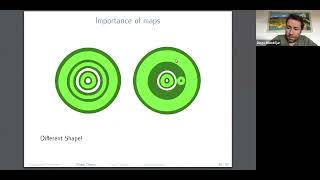
Approximation of Compact Metric Spaces by Finite Samples
Explore topological data analysis through finite approximations of compact metric spaces, connecting Shape Theory and Persistence for robust feature extraction from noisy datasets.

Discrete Homotopy Theory and Applications
Explore discrete homotopy theory's evolution, applications in topology, geometry, and group theory. Learn simplified approaches to fundamental groups and covering spaces, with insights into various mathematical domains.
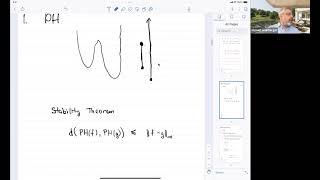
Shmuel Weinberger - PH(X^Y) and the Geometry of Function Spaces
Exploring persistent homology in function spaces through geometric considerations, focusing on examples that illuminate this central topic in algebraic topology.

Barbara Giunti - Average Complexity of Barcode Computation for Vietoris-Rips Filtrations
Explore algorithmic complexity of persistent homology in random Vietoris-Rips filtrations, focusing on boundary matrix fill-up and its implications for computational efficiency.
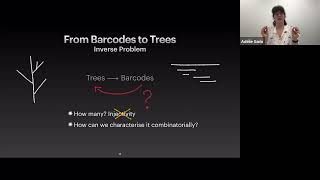
From Trees to Barcodes and Back Again - Combinatorial and Geometric Perspectives
Explore topological data analysis, focusing on the inverse problem from barcodes to merge trees. Discover connections between barcodes, symmetric groups, and geometric group theory for statistical insights.
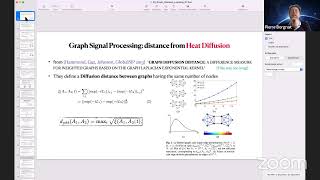
Learning Distances for Attributed Graphs with Optimal Transport
Explore optimal transport techniques for learning distances between attributed graphs, enhancing graph analysis and comparison methods in data science.

Tractable Network Interventions for Large Socio-Technical Systems
Explore strategies for effective interventions in complex socio-technical networks, focusing on scalable approaches for large-scale systems and their practical applications.
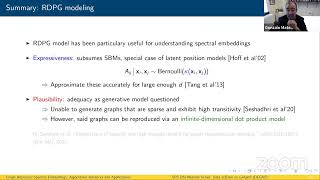
Graph Adjacency Spectral Embeddings - Algorithmic Advances and Applications
Explore algorithmic advances and applications of graph adjacency spectral embeddings, focusing on data science and signal processing innovations in network analysis and representation learning.
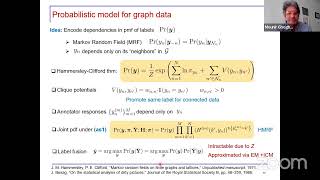
Learning from Unreliable Labels via Crowdsourcing
Explore techniques for learning from unreliable labels in crowdsourcing, presented by experts in signal processing and data science for the DEGAS Webinar Series.
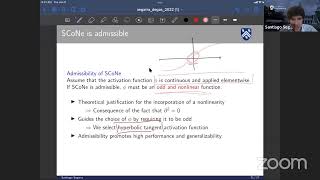
Principled Simplicial Neural Networks for Trajectory Prediction
Learn advanced techniques for trajectory prediction using simplicial neural networks, exploring their principles and applications in data science and signal processing.
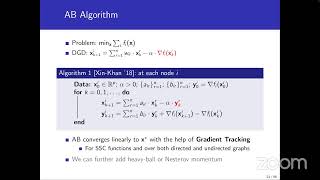
Distributed Stochastic Non-Convex Optimization - Optimal Regimes and Tradeoffs
Explore optimal regimes and tradeoffs in distributed stochastic non-convex optimization with Usman A. Khan. Gain insights into advanced data science concepts and their applications in signal processing.